
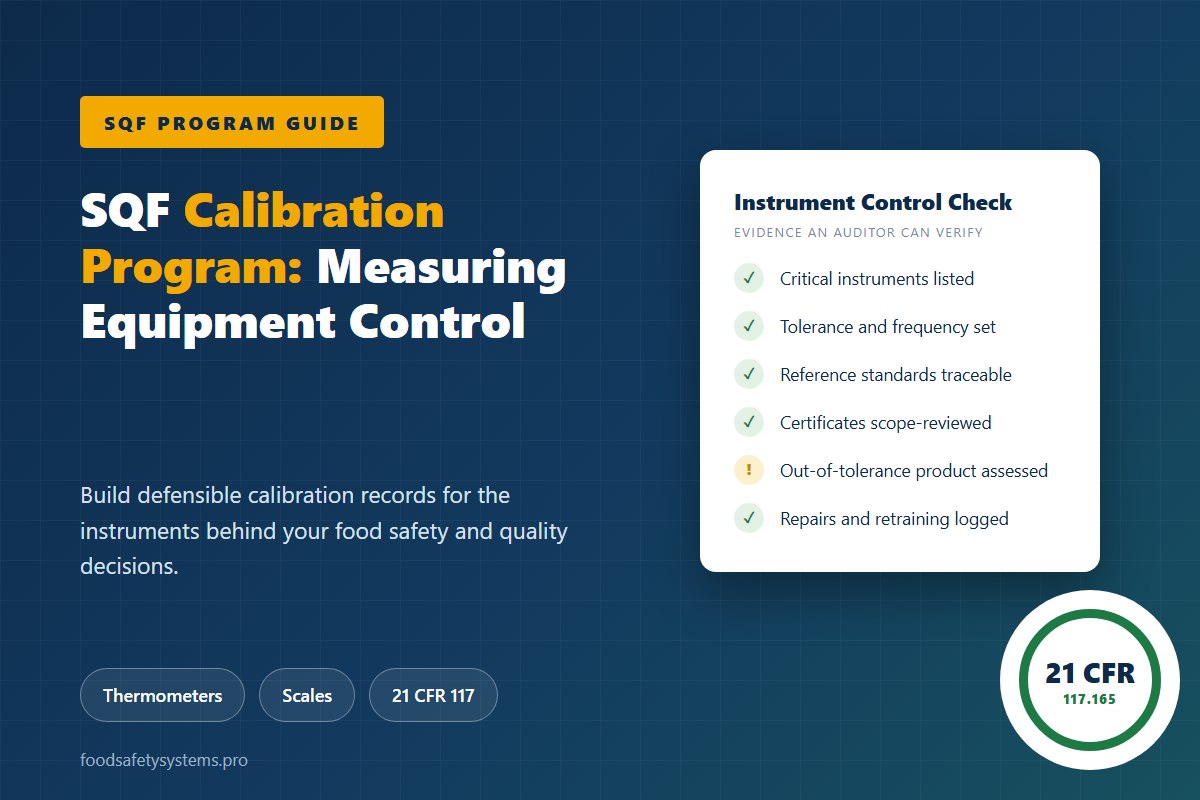
An SQF calibration program proves that the thermometers, scales and detectors behind your food safety decisions read correctly. Food manufacturers who want to supply major retailers such as Costco need reliable, documented controls. They also need to explain those controls clearly. Regulatory duties depend on the product, facility and transaction, so confirm retailer-specific supplier conditions directly with the buyer.
Quick answer: list every instrument that affects a safety or quality decision, set measurable acceptance criteria, control your reference standards and service providers, and assess product whenever an instrument fails. Facilities covered by the FDA preventive controls rule must also calibrate process monitoring and verification instruments, or check them for accuracy, under 21 CFR 117.165.
Who this guidance is for
SQF practitioners, maintenance leads, quality technicians and production supervisors at food manufacturing sites.
Identify instruments that affect decisions
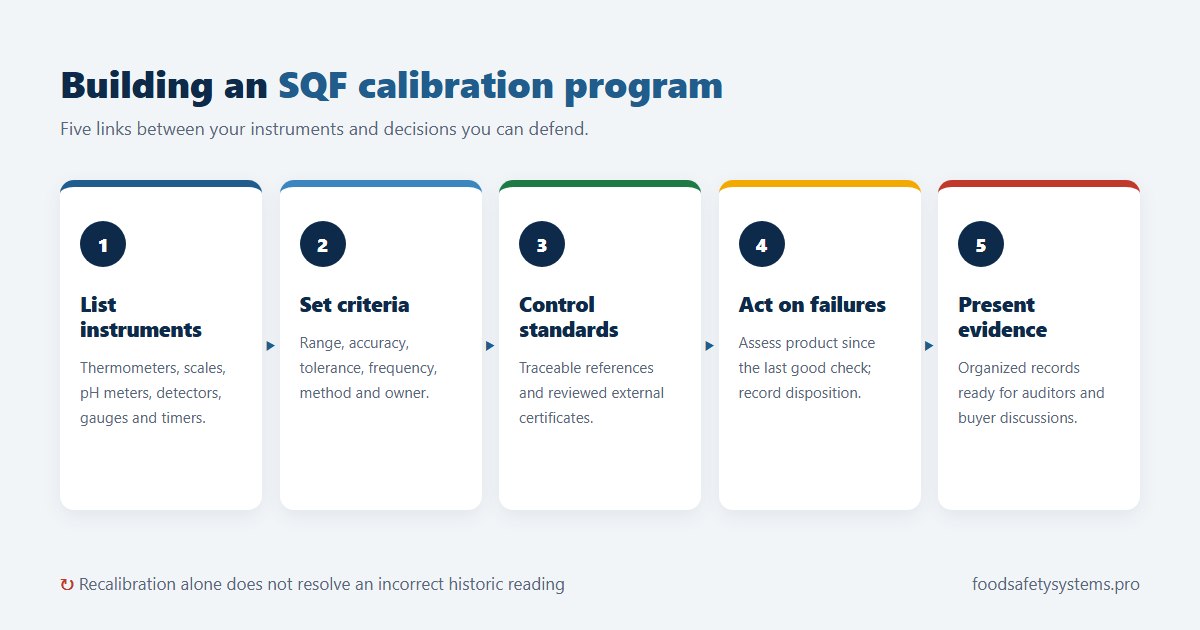
Inventory thermometers, scales, pH meters, metal detectors, pressure gauges, timers and other equipment used for safety or quality determinations. Then classify critical instruments by the risk of an incorrect reading and by the applicable SQF Code requirements. Our SQF validation and verification guide explains where these readings fit.
Define measurable acceptance criteria in your SQF calibration program
For each instrument, specify the range, accuracy, tolerance, frequency, method, reference standard and responsible person. Base the limits on process needs. An arbitrary annual interval may be too long for a probe used every hour on a critical step.
Control standards and service providers
Document that each reference instrument is suitable and, where appropriate, traceable to recognized standards. Keep external certificates with equipment identifiers, dates and pass or fail results. Before you accept a certificate, check that the service scope covers the range you actually use.
Respond to out-of-tolerance results
Go back to the last known acceptable check and assess the product that may have been affected. Record containment, remeasurement, disposition, and any retraining or repair. A simple recalibration does not resolve the impact of an incorrect historic reading. Our CAPA process guide shows how to document the investigation, and our record retention requirements page covers how long to keep the evidence.
Present evidence to prospective customers
For a manufacturer discussing Costco distribution, organized calibration evidence can support food safety and quality discussions. However, any buyer-specific equipment requirements must be confirmed through the current contract or specification.
Supplier readiness checklist
- Confirm applicable regulations, certification scope and buyer-specific requirements in writing.
- Identify the accountable process owner and the current approved procedures.
- Collect recent objective records tied to the correct facility, product and lots.
- Resolve exceptions with documented corrective actions and effectiveness checks.
- Test record retrieval and make the review package available to authorized reviewers.
Frequently asked questions
How often should food plant instruments be calibrated?
Set the frequency by risk, use and past performance. Instruments that drift or support critical decisions usually need more frequent checks than an annual default.
Is recalibration enough after an out-of-tolerance result?
No. You also need to assess product measured since the last acceptable check and record the disposition decision.
Can a service provider’s certificate replace in-house checks?
Not always. Review the certificate’s scope, range and result, and keep routine accuracy checks between external calibrations.
How Consultare Inc. Group can help
Consultare Inc. Group supports food businesses with program development, supplier documentation, regulatory readiness and quality system improvement.
- SQF gap assessments and internal audits: review calibration records and gaps.
- FDA compliance integration: align calibration with preventive controls verification.
- Corrective action support: investigate out-of-tolerance findings.
- Document control services: keep the instrument register and procedures current.
Need help managing your SQF responsibilities?
Discuss your products, documentation and compliance priorities with the Consultare team in a free consultation, or contact our team.
Start building your compliance system
Prefer to organize your compliance activities yourself? Create a free SystemsBuilder account to manage specifications, controlled documents, assigned actions and records in one structured workflow. Software supports record management; it does not by itself ensure compliance.
Technical sources: SQFI, FDA FSMA Preventive Controls for Human Food rule and 21 CFR 117.165. Independent educational content: Consultare Inc. Group is independent of Costco Wholesale and does not claim Costco affiliation, endorsement or authority to approve suppliers. We are not affiliated with or endorsed by SQFI or FDA. This article is not legal advice or a statement of Costco supplier approval policy. Requirements may change; confirm current rules and written buyer terms before relying on this guide.