
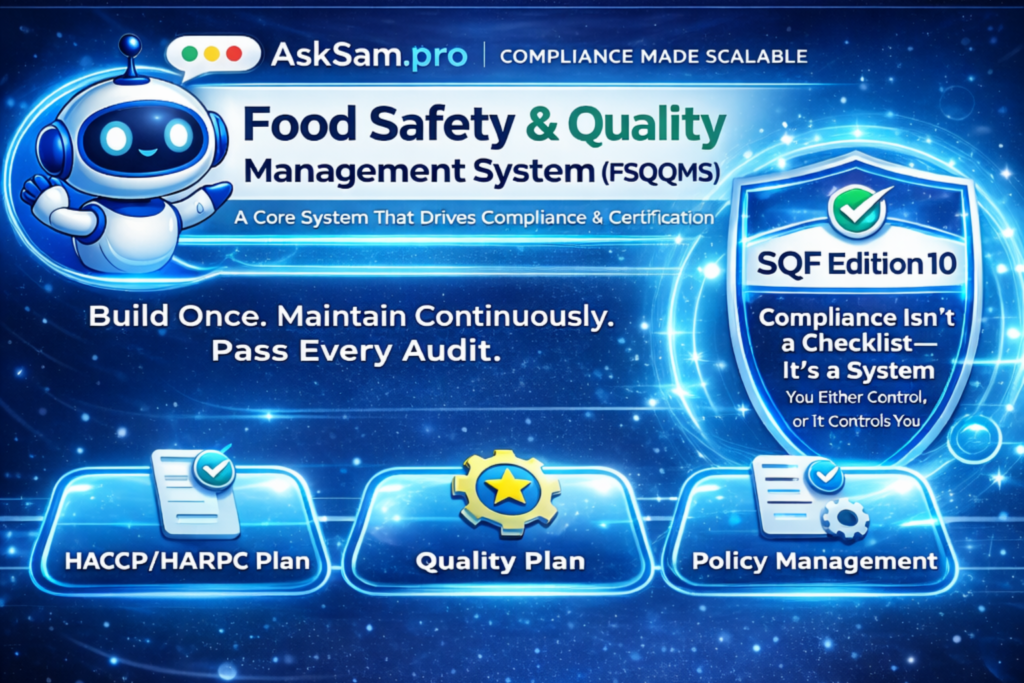
An SQF compliance management system is what turns SQF Edition 10 requirements into daily practice. In this guide, we explain what auditors actually evaluate, which clauses define your system and how to build an audit-ready food safety system that scales. As a result, you can move from last-minute audit preparation to a system that stays compliant every day.
In today’s food manufacturing environment, achieving SQF Edition 10 certification is no longer just a regulatory milestone—it’s a business necessity. Retailers, distributors, and government buyers increasingly require suppliers to demonstrate not just compliance, but systemized, repeatable, and scalable food safety and quality management systems. Yet many companies still approach SQF as a documentation exercise rather than what it truly is: A fully integrated management system. At AskSam.pro (Systems Assistant Manager), in collaboration with FoodSafetySystems.pro, we help businesses transform SQF compliance into a living, operational system—one that works every day, not just during audits.
What Is SQF Edition 10 Really About?
SQF Edition 10 is designed to evaluate whether your organization has:
- A functioning Food Safety & Quality Management System (FSQMS)
- A controlled and traceable documentation system
- A validated and implemented food safety plan (HACCP / HARPC)
- A culture of continuous improvement and accountability
It is not enough to “have” documents. You must demonstrate that your system is:
- Implemented
- Maintained
- Verified
- Continuously improved
The Core of Your SQF Compliance Management System: The FSQMS
The Core System: FSQMS (Food Safety & Quality Management System)
At the center of SQF compliance is the FSQMS, often referred to as the “Mother System.”
Purpose
To establish, implement, maintain, and continually improve a comprehensive food safety and quality management framework.
This system connects all operational elements, including:
- Food safety programs
- Quality management processes
- Document control systems
- Supplier approval programs
- Training and competency systems
- Corrective action and CAPA systems
Without a properly structured FSQMS, compliance becomes fragmented—and audit risk increases significantly.
Key SQF Edition 10 Clauses That Define Your System
Key SQF Edition 10 Clauses That Define Your System
A strong SQF system must align with critical clauses that form the backbone of compliance.
2.1 Management Commitment
- Defined roles and responsibilities
- Resource allocation
- Food safety culture
- Management review processes
This is where compliance begins—with leadership ownership.
2.2 Document Control
- Controlled documents and records
- Version management and approvals
- Accessibility and traceability
- Protection of data integrity
Poor document control is one of the most common causes of audit findings.
2.4 Food Safety System
- HACCP or HARPC plan
- Hazard analysis
- Preventive controls
- Monitoring and verification systems
This is your technical core—and must be both scientifically valid and operationally executed.
Breaking Down the FSQMS: Core Sub-Systems
Breaking Down the FSQMS: Core Sub-Systems
To function effectively, the FSQMS must be built as a collection of interconnected sub-systems.
1. Food Safety Plan System (HACCP / HARPC)
- Hazard identification and analysis
- Critical Control Points (CCPs) or preventive controls
- Monitoring procedures
- Verification activities
- Corrective action processes
With FoodSafetySystems.pro, this system is:
- Expert-built
- Regulatory-aligned
- Audit-ready
With AskSam.pro, it becomes:
- Digitally managed
- Continuously monitored
- Fully traceable
2. Quality Management System
Beyond food safety, SQF requires a strong focus on product quality. This system includes:
- Product specifications
- Quality objectives and KPIs
- Inspection and testing procedures
- Deviation and non-conformance management
This ensures that your products are not only safe—but consistent and market-ready.
3. Policy & Governance System
This defines how your system is led and enforced. It includes:
- Food safety policy
- Quality policy
- Organizational structure
- Defined responsibilities
- Management review procedures
Without governance, even the best systems fail.
The AskSam + FoodSafetySystems Approach
Despite having documentation, many companies struggle to pass SQF audits consistently. Understanding why most systems fail is critical to building a robust FSQMS.
Common Reasons Systems Fail:
- Disconnected documents
- Lack of system integration
- Manual tracking and poor visibility
- Inconsistent implementation across teams
- Reactive (instead of proactive) compliance
In short: They have documents—but not a system.
The Solution: AskSam
AskSam.pro is a technology-driven compliance engine that:
- Structures your FSQMS into micro-systems
- Tracks artifacts and records
- Maintains document control
- Keeps your system audit-ready
This system transforms reactive compliance into a proactive, fully integrated process.
AskSam is not just software—it’s the engine that powers a resilient, audit-ready FSQMS.
From Compliance to Competitive Advantage
FoodSafetySystems.pro
- Builds your SQF system from the ground up
- Develops HACCP / HARPC plans
- Implements policies and SOPs
- Supports ongoing compliance and maintenance
Together, They Deliver
- System + Implementation + Maintenance
- Technology + Expertise
- Setup + Sustainability
SystemsBuilder Framework
- Document Control Management System
- Supplier Management System
- Training & Competency System
- CAPA & Corrective Action System
- Environmental Monitoring System
- Risk Management System
- Clearly defined
- Fully integrated
- Audit-ready
- Scalable across facilities
Designed for Real-World Food Businesses
- Startups preparing for their first SQF certification
- Established manufacturers upgrading to Edition 10
- Multi-site operations needing system standardization
- Companies supplying major retailers or government buyers
From Compliance to Competitive Advantage
- Faster audit readiness
- Reduced compliance risk
- Improved operational efficiency
- Stronger customer trust
- Scalable growth infrastructure
Build Once. Operate Daily. Pass Every Audit
- Not rebuilt every year
- Not dependent on individuals
- Not reactive to audits
It should be: A system that runs your operation
Start Building Your SQF Compliance Management System
If you’re ready to move from:
❌ Scattered Documents
➡️
✅ Structured System
❌ Audit Stress
➡️
✅ Audit Confidence
❌ Compliance Gaps
➡️
✅ Continuous Control
Get Started Today — Schedule a Consultation
SQF Implementation & Support — FoodSafetySystems.pro
Final Thought
Food safety is not a checklist.
It’s not a binder.
It’s not an annual event.
✅ It’s a system
And the strength of your system defines the strength of your business.
Key Takeaways
- First, SQF Edition 10 evaluates a working food safety and quality management system, not just a set of documents.
- In addition, an SQF compliance management system must be implemented, maintained, verified and continuously improved.
- Breaking the FSQMS into core sub-systems makes it easier to assign ownership and prove control.
- As a result, a well-built system keeps you audit-ready all year instead of only before the audit.
Related SQF Resources
To go further, explore our SQF Code requirement guides, SQF compliance management software and what changed in SQF Edition 10. In addition, the official SQF Code documents are available from the Safe Quality Food Institute (SQFI).