
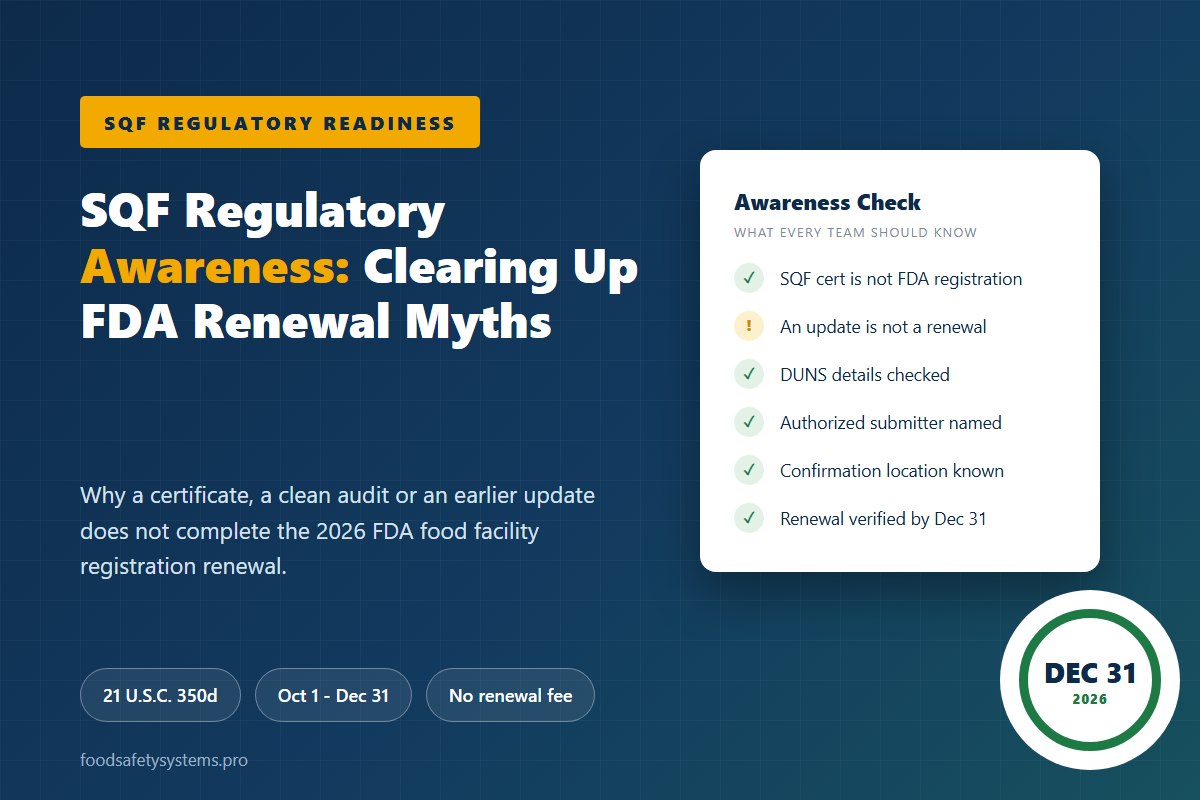
Strong SQF regulatory awareness helps food safety teams avoid a common trap: assuming that a recent certificate renewal, a successful audit or an updated FDA record means every administrative obligation is done. Each of these events serves a different purpose. When staff blur them together, the 2026 FDA food facility registration renewal can slip through the cracks, even at a well-run site.
Quick answer: SQF certification shows conformity with a certification program, while FDA Food Facility Registration is a separate legal obligation for covered facilities. An update made earlier in 2026 is not the biennial renewal. Teach staff the difference, check DUNS-related facility details for consistency, name who can submit the renewal and verify completion before December 31, 2026.
Who this guidance is for
SQF practitioners, quality managers, regulatory coordinators, site leaders and internal auditors at food facilities that may be required to register with FDA.
Why SQF regulatory awareness matters for FDA registration
Food safety teams manage many recurring events. Certification audits, certificate renewals, customer audits and regulatory filings all come with dates, documents and confirmations. Because these events look similar on a calendar, people tend to treat them as one stream of work.
That is where problems start. An SQF certificate confirms that a certification body audited the site against the SQF Code. In contrast, FDA registration under section 415 of the Federal Food, Drug, and Cosmetic Act is a statutory duty that applies to covered facilities regardless of certification. Neither event proves the other one happened. Good SQF regulatory awareness simply means that the people involved understand which event they are looking at and what evidence it produces.
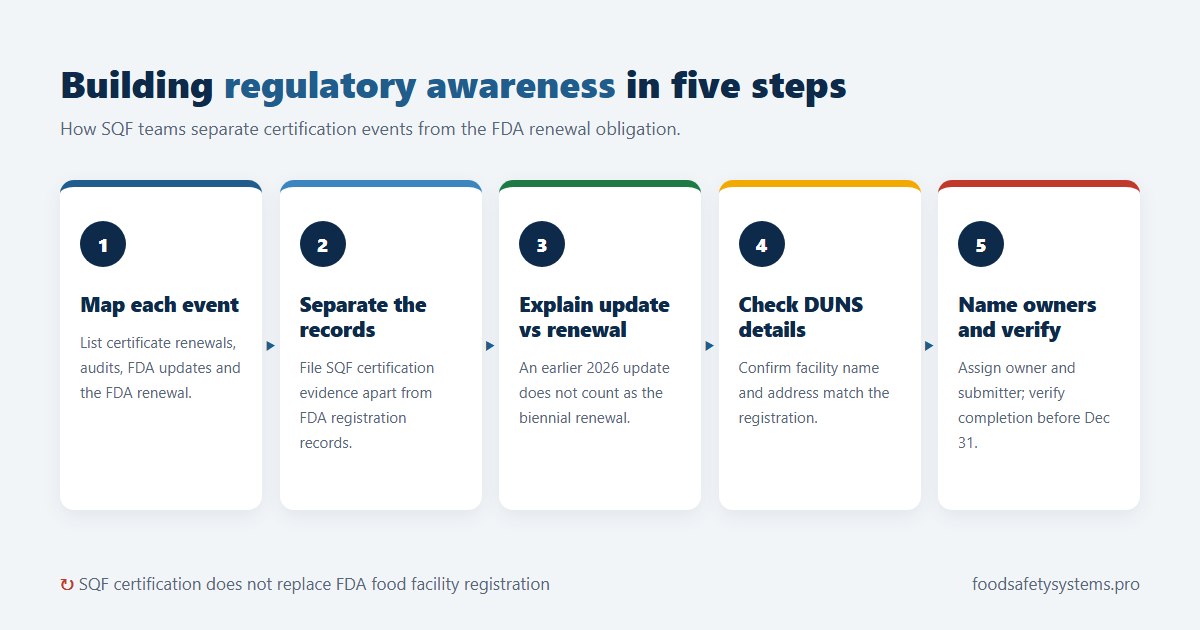
Five common FDA renewal misunderstandings
The misunderstandings below come up repeatedly in SQF facilities. Each one sounds reasonable, which is exactly why it deserves a clear answer in staff guidance.
1. “Our SQF certificate covers FDA registration”
It does not. SQF certification demonstrates conformity with a voluntary certification program. FDA registration is a separate obligation, and a current certificate is not evidence that the 2026 renewal was submitted.
2. “We updated our registration this year, so we are renewed”
An update and a renewal are different actions. Facilities must update registration information when required details change, generally within 60 calendar days under 21 CFR 1.234. However, an update made earlier in 2026 does not count as the biennial renewal.
3. “We passed our audit, so the paperwork is complete”
A successful certification audit reflects the scope of that audit. It does not confirm that every regulatory filing outside that scope was completed. Therefore, regulatory obligations need their own tracking and their own evidence.
4. “DUNS details are someone else’s problem”
FDA currently recognizes the DUNS number as an acceptable Unique Facility Identifier. As a result, the facility name and address linked to the DUNS record should be checked for consistency with the registration. Someone needs to own that check.
5. “Anyone in quality can submit the renewal”
Awareness is not authority. Staff should know who is authorized to submit the renewal and where the confirmation is kept. Under 21 CFR 1.230, a renewal submitted by someone other than the owner, operator or agent in charge must identify the individual who authorized it.
2026 FDA renewal context
Under section 415 of the Federal Food, Drug, and Cosmetic Act (21 U.S.C. 350d) and 21 CFR Part 1, Subpart H, food facilities that are required to register must renew between October 1 and December 31 of each even-numbered year. The 2026 deadline is December 31.
An earlier update does not count as renewal. FDA does not charge a fee for registration renewal. Keep in mind, too, that registration is not FDA approval of a facility or its products. Applicability and exemptions depend on each facility’s circumstances, so confirm them for your own site.
Who does what
Clear roles turn awareness into action. Most sites can cover the essentials with four responsibilities:
- Renewal owner: accountable for confirming applicability and the final outcome.
- Authorized submitter: holds account access and the authority to submit.
- Reviewer: checks facility details, DUNS consistency and the confirmation record.
- SQF practitioner: keeps staff guidance accurate and makes sure records stay correctly filed.
Our post on assigning FDA renewal responsibilities explains how to document these roles in more detail.
Records worth keeping
Good records let anyone confirm the status quickly. Keep the following, filed separately from SQF certification evidence:
- A short staff guidance note explaining update versus renewal.
- The applicability assessment for each facility.
- The named owner, submitter and reviewer.
- The 2026 renewal confirmation, identified by facility and cycle.
- Notes on any DUNS or address discrepancy and how it was resolved.
Example workflow: correcting a misunderstanding
Consider a mid-sized SQF-certified plant. In October, the quality supervisor notes that the facility updated its FDA registration in May after a change in contact details. She assumes the renewal is therefore complete.
During a monthly compliance check, the SQF practitioner asks a simple question: “Where is the 2026 renewal confirmation?” The file only contains the May update. The practitioner escalates to the renewal owner, who confirms that the biennial renewal has not been submitted. Next, the reviewer checks the DUNS-linked address against the registration. The authorized submitter then completes the renewal in November, and the confirmation is filed in the regulatory folder. Finally, the team adds a one-paragraph explanation of the update-versus-renewal distinction to its staff guidance.
No single person did anything wrong. The gap came from a reasonable assumption that nobody had challenged. Targeted FDA renewal awareness training is one practical way to challenge it earlier.
Practical SQF regulatory awareness checklist
- Explain the update-versus-renewal distinction in staff guidance.
- Separate SQF certification evidence from FDA registration records.
- Assign a named renewal owner and reviewer.
- Check DUNS-related facility information for consistency.
- Confirm who is authorized to submit and where the confirmation is retained.
- Verify completion before December 31, 2026.
An internal audit program can then sample these points to confirm they work in practice.
Frequently asked questions
Does SQF certification mean our facility is registered with FDA?
No. SQF certification and FDA registration are separate. A certificate does not show that a covered facility registered or renewed.
We updated our FDA registration in 2026. Do we still need to renew?
Yes, if the facility is required to register. FDA treats an update and the biennial renewal as different actions, and the 2026 renewal must be completed by December 31.
Is there a fee for the 2026 renewal?
No. FDA does not charge a fee for food facility registration or renewal.
How Consultare Inc. Group can help
Consultare Inc. Group supports food businesses with regulatory awareness and SQF system support, tailored to the agreed engagement scope.
- Food safety training and education: SQF awareness training for your teams.
- SQF gap assessments and internal audits: internal audit support for regulatory records.
- FDA compliance integration: regulatory obligation registers.
- SQF post-certification compliance management: management review assistance.
Need help managing your SQF responsibilities?
Discuss your products, documentation and compliance priorities with the Consultare team in a free consultation, or contact our team.
Start building your compliance system
Prefer to organize your compliance activities yourself? Create a free SystemsBuilder account to manage specifications, controlled documents, assigned actions and records in one structured workflow. Software supports record management; it does not by itself ensure compliance.
Official references: FDA biennial registration renewal user guide, FDA renewal reminder, FDA online registration of food facilities, 21 U.S.C. 350d and 21 CFR Part 1, Subpart H. Independent educational content: Consultare Inc. Group is not affiliated with or endorsed by FDA or SQFI and does not act on behalf of FDA. This article does not constitute legal advice or an official statement of FDA policy, and we do not promise certification, regulatory approval or an audit outcome. Requirements may change and their applicability depends on each facility’s operations; verify current requirements through official FDA sources.