
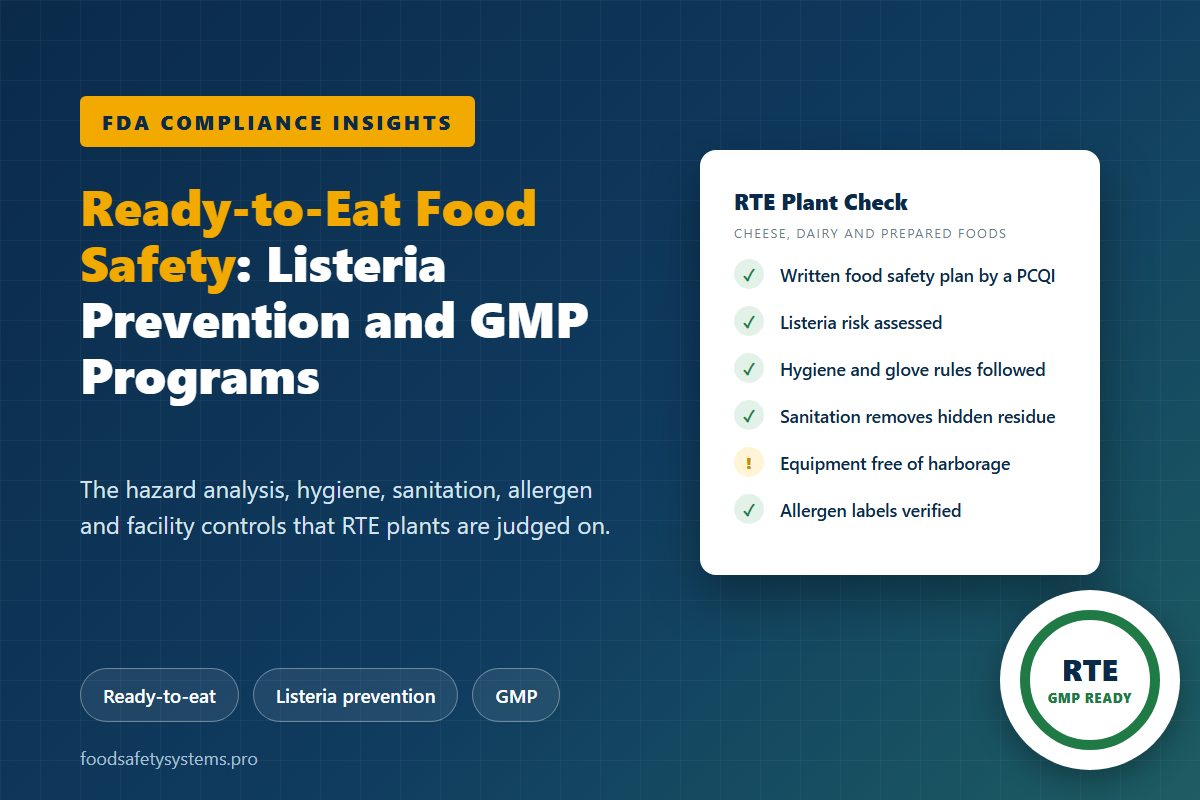
Ready-to-eat food safety depends on controls that work without a safety net, because many RTE foods receive no further kill step before they are eaten. RTE manufacturers need a food safety system that addresses hazards throughout processing, handling, packaging and storage. Environmental contamination, employee handling, sanitation and allergen controls all need careful evaluation. An effective SQF system connects hazard analysis, preventive controls, prerequisite programs, verification and continual improvement.
FDA warning letters to cheese, dairy and prepared food plants tend to cite the same cluster of issues: an incomplete food safety plan, Listeria risks not assessed, poor hygiene practices, and equipment in a condition that harbors bacteria. The eight areas below cover each one.
Establish a complete food safety plan and hazard analysis
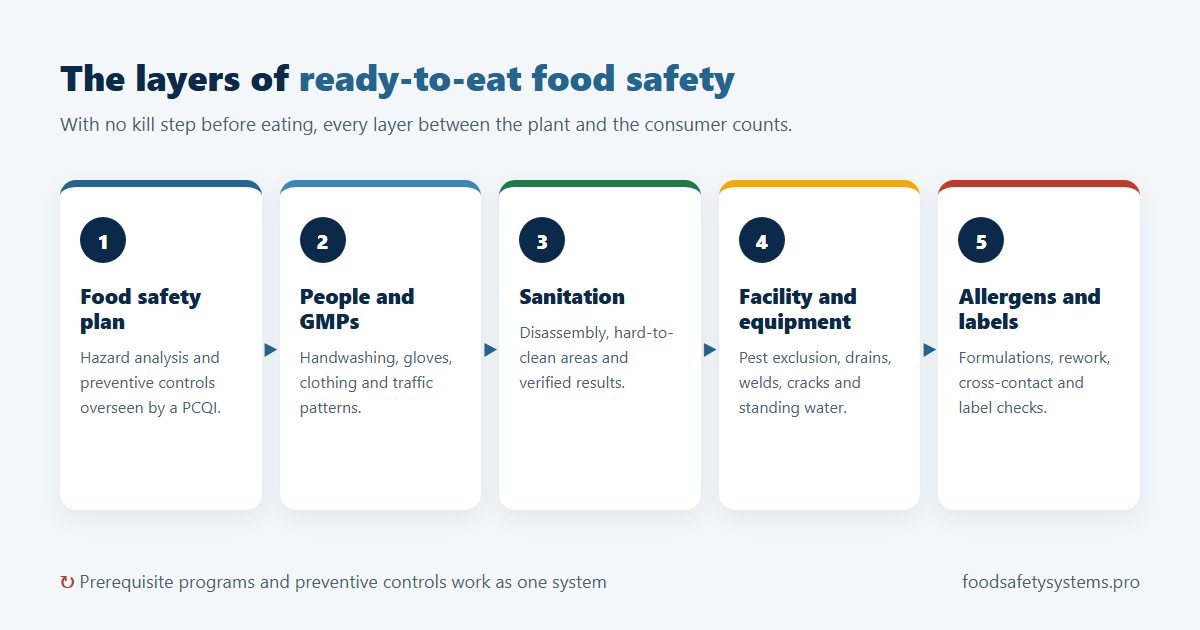
Identify known or reasonably foreseeable biological, chemical, physical and allergen hazards for each food and process. Document why each hazard does or does not need a preventive control. Under the Preventive Controls rule, the plan must be prepared or overseen by a preventive controls qualified individual (PCQI), as applicable. See the 21 CFR Part 117 requirements.
Evaluate Listeria and environmental pathogen risks
Assess product exposure, food-contact surfaces, equipment, employee handling and post-process operations. Where an environmental pathogen is a hazard requiring a sanitation preventive control, put sanitation controls and environmental monitoring in place as the rule requires. Our guide to Listeria environmental monitoring and sanitation covers program design in detail.
Strengthen GMP and employee hygiene for ready-to-eat food safety
Set practical rules for handwashing, glove use and change, protective clothing, personnel traffic and hygiene. Train employees not to touch contaminated surfaces and then handle exposed RTE food, and verify on the floor that they follow the rules. See our GMP implementation guide.
Verify sanitation effectiveness
Write sanitation procedures that cover equipment disassembly, hard-to-clean areas, food-contact surfaces, utensils and processing environments. Verify that cleaning removes visible and hidden residues and that sanitizing steps are applied at the right concentration and contact time.
Control food allergens and cross-contact
Verify incoming ingredients, maintain accurate formulations, prevent allergen cross-contact, control rework and confirm that labels declare the nine major food allergens, including sesame. Our allergen control measures guide explains the SQF expectations.
Improve pest exclusion and facility conditions
Maintain doors, screens, structural openings, floors, drains and other building features to keep pests out and prevent contamination. Set monitoring and corrective action procedures, as described in our guide to facility design, maintenance and pest control.
Maintain hygienic equipment and facilities
Inspect equipment design, welds, seams, cracks, crevices, damaged surfaces, standing water and other conditions that can harbor residues or microorganisms. Set preventive maintenance and repair priorities so harborage sites are removed, not just cleaned more often.
Implement corrective action, verification and records
Document deviations, assess affected product, find root causes, correct the problem and verify that the fix works. Keep food safety plan, sanitation, monitoring and verification records, along with a current product recall and withdrawal procedure.
How Consultare Inc. Group can help
Consultare Inc. Group supports SQF gap assessments, food safety plan and hazard analysis review, Listeria risk assessment, sanitation and SSOP development, GMP and employee hygiene programs, allergen control, pest control program review, hygienic equipment assessment, internal audits and corrective action planning. We help translate audit and regulatory findings into practical implementation plans and documented deliverables.
- SQF gap assessments and internal audits
- Food safety system development
- FSQA implementation support
- Corrective action support
Need help managing your SQF responsibilities?
Whether you make cheese, dairy products, prepared foods or other ready-to-eat products, book a free consultation to discuss your SQF system, hazard analysis, sanitation program, environmental monitoring and certification readiness. You can also contact our team.
Start building your compliance system
Prefer to organize your compliance activities yourself? Create a free SystemsBuilder account and begin building a structured system for your compliance documentation and processes.
Technical sources: 21 CFR Part 117 and FDA’s draft guidance Control of Listeria monocytogenes in Ready-To-Eat Foods. This article is educational; specific requirements depend on your products, facility, certification scope and applicable regulations.