
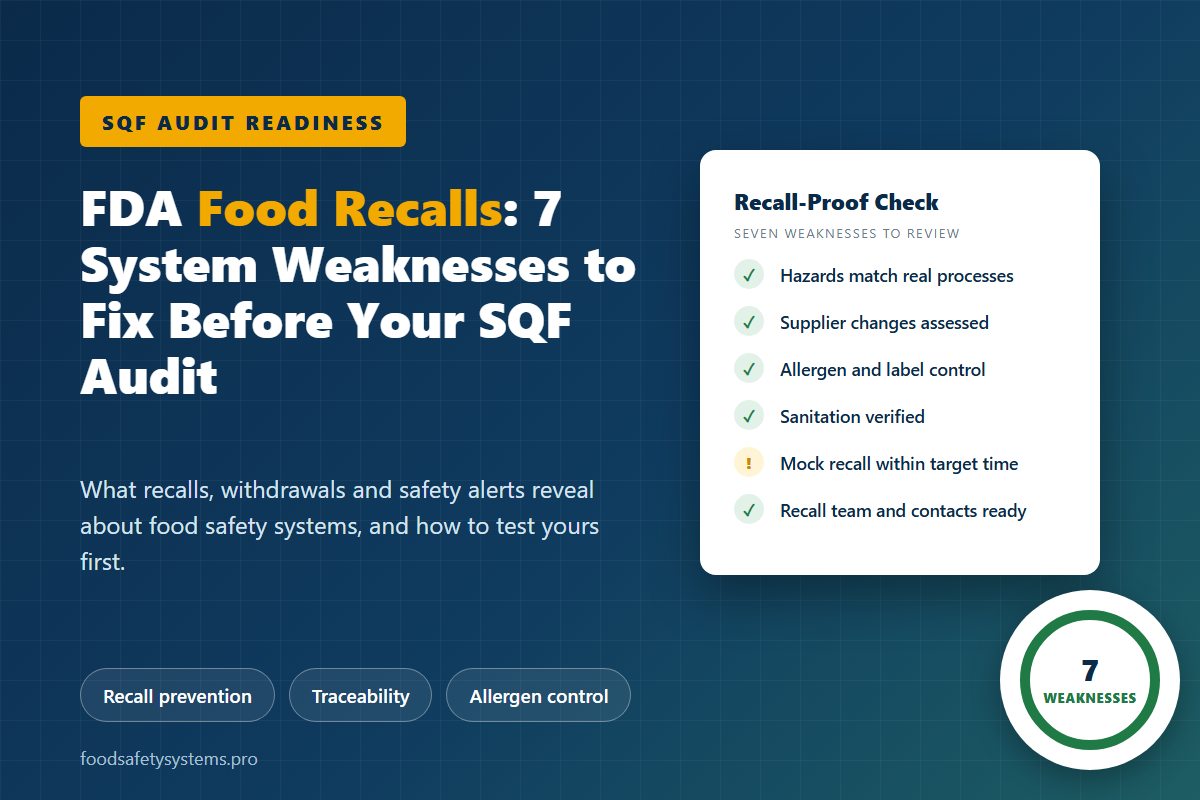
FDA food recalls, market withdrawals and safety alerts are a free audit of the food industry: each one shows where a food safety system failed in practice. A recall can expose weaknesses in supplier approval, allergen control, sanitation, traceability, labeling or corrective action. For SQF-certified and certification-seeking facilities, these events are a chance to check whether your own system is implemented and effective before a regulator, customer or auditor tests it for you.
FDA publishes recalls, withdrawals and safety alerts on its recalls page. Undeclared allergens, Listeria monocytogenes, Salmonella and foreign material appear again and again. The seven weaknesses below sit behind most of them.
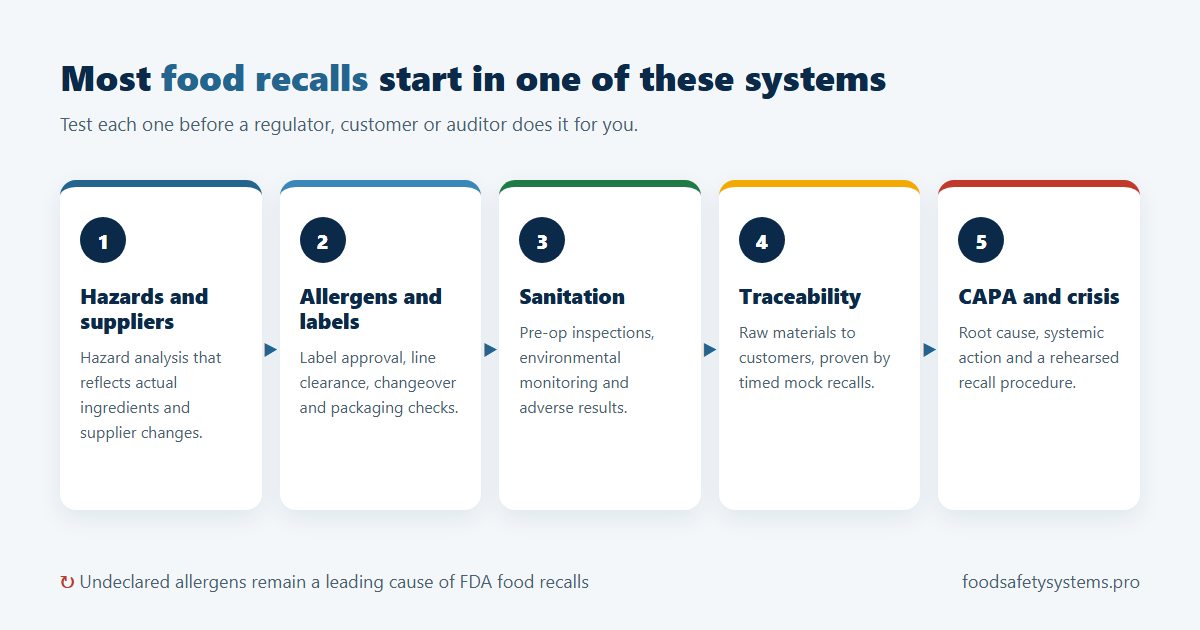
1. Hazard identification and control
Check that the food safety plan identifies the relevant biological, chemical, physical and allergen hazards and that suitable controls are in place. The hazard analysis should reflect actual ingredients, processes, intended use and reasonably foreseeable conditions, not a template.
2. Supplier approval and incoming materials
Confirm that supplier approval, specifications, receiving checks and risk-based verification fit each ingredient and packaging material. Make sure supplier changes and material substitutions are assessed before use. Our approved supplier program guide explains what SQF expects.
3. Allergen and label control
Review formulation controls, label approval, line clearance, changeovers, rework and packaging verification. Undeclared allergens and wrong labels create serious risks for consumers and are among the most common reasons for FDA food recalls. See our allergen control verification guide.
4. Sanitation and environmental controls
Evaluate sanitation procedures, pre-operational inspections, hygienic practices, environmental monitoring where appropriate and corrective actions for adverse results. Our guide to hygiene and sanitation programs covers the basics.
5. Traceability and mock recall
Test whether the site can identify affected raw materials, work in process, finished products, customers and distribution records within its own target time and any applicable requirements. Run mock recalls in both directions, from a raw material forward and from a finished lot back. Note that FDA’s Food Traceability Rule adds specific record-keeping for foods on its Food Traceability List; check whether it applies to your products and its compliance date.
6. Nonconformity and corrective action
Go beyond correcting the immediate problem. Find the root cause, assess product impact, take systemic action, assign responsibility and verify effectiveness, following a structured CAPA process.
7. Recall and crisis management
Confirm that the recall and withdrawal procedure names the decision-makers, communication responsibilities, product control steps, regulator and customer contact routes, effectiveness checks and post-event review. Facilities subject to the Preventive Controls rule need a written recall plan for any food with a hazard requiring a preventive control. See our product recall and withdrawal procedure and crisis management plan guides.
FDA food recalls readiness checklist
- Does the hazard analysis match the ingredients and processes you run today?
- Are supplier changes and substitutions assessed before use?
- Is every label checked against the approved formula at line start-up and changeover?
- Did your last mock recall reconcile quantities and finish within your target time?
- Does everyone on the recall team know their role and have current contacts?
How Consultare Inc. Group can help
Consultare Inc. Group supports facilities with SQF gap assessments, food safety system development and review, internal audit support, hazard analysis review, supplier and traceability program assessment, mock recall exercises, corrective action planning and audit-readiness support. The exact scope is set after reviewing the facility, products, applicable SQF requirements and requested assistance.
- SQF gap assessments and internal audits
- SQF crisis and regulatory support
- SQF audit readiness coaching
- Corrective action support
Need help managing your SQF responsibilities?
Whether you are preparing for SQF certification, reviewing an existing system, testing traceability or closing food safety gaps, you do not have to manage it alone. Book a free consultation to discuss your food safety system, audit readiness, traceability, recall preparedness and corrective action priorities, or contact our team.
Start building your compliance system
Prefer to organize your compliance activities yourself? Create a free SystemsBuilder account and begin building a structured system for your compliance documentation and processes. The right time to review your controls, documentation and response process is before a product safety concern becomes a business problem.
Technical sources: FDA Recalls, Market Withdrawals and Safety Alerts and 21 CFR Part 117. This article is educational; specific requirements depend on your products, facility, certification scope and applicable regulations.