
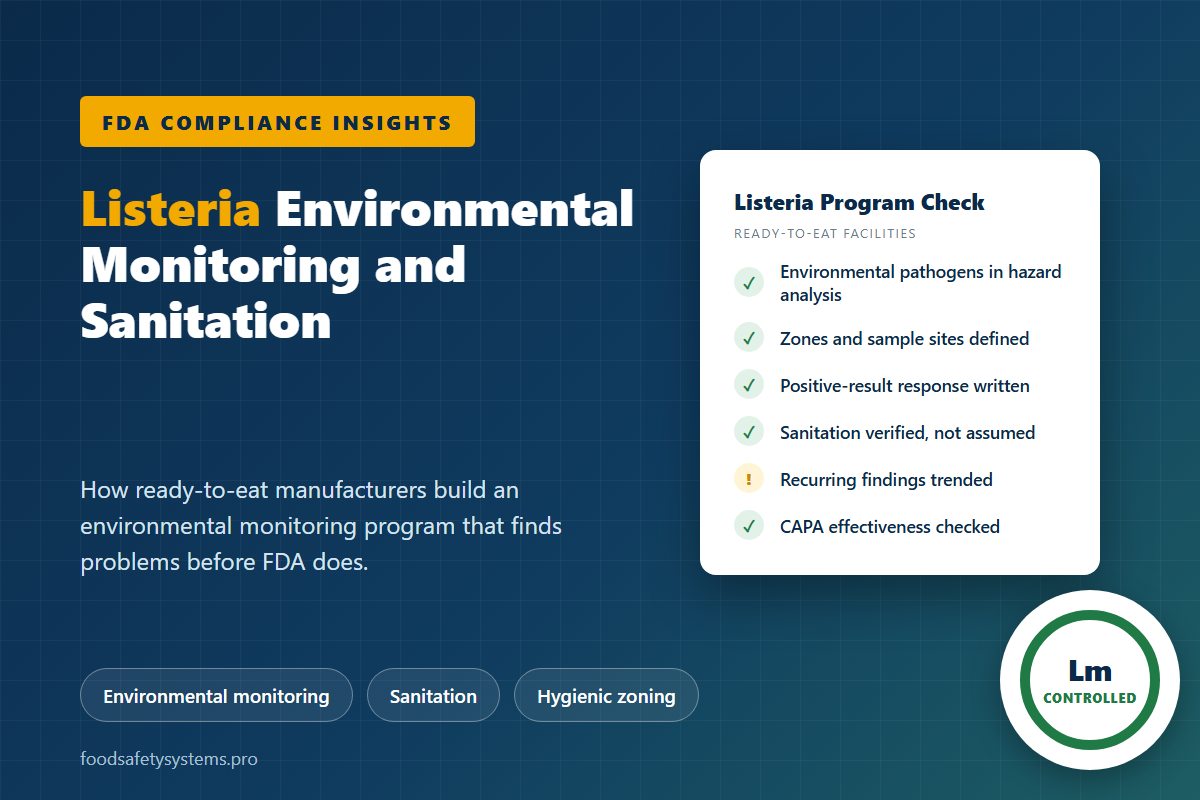
Listeria environmental monitoring is how a ready-to-eat facility proves its sanitation program keeps Listeria monocytogenes out of exposed product, by actively looking for it in the environment. Ready-to-eat food manufacturers must evaluate and control environmental pathogens, especially where exposed product receives no further lethal treatment. Freezing does not make contaminated ready-to-eat food safe. An effective SQF system connects hazard analysis, sanitation preventive controls, environmental monitoring, personnel hygiene, hygienic zoning and documented corrective action.
FDA warning letters to ready-to-eat and frozen food plants frequently cite repeated Listeria findings in the environment that were cleaned but never investigated, and hazard analyses that left environmental pathogens out. The seven areas below address both problems.
Evaluate environmental pathogens in the hazard analysis
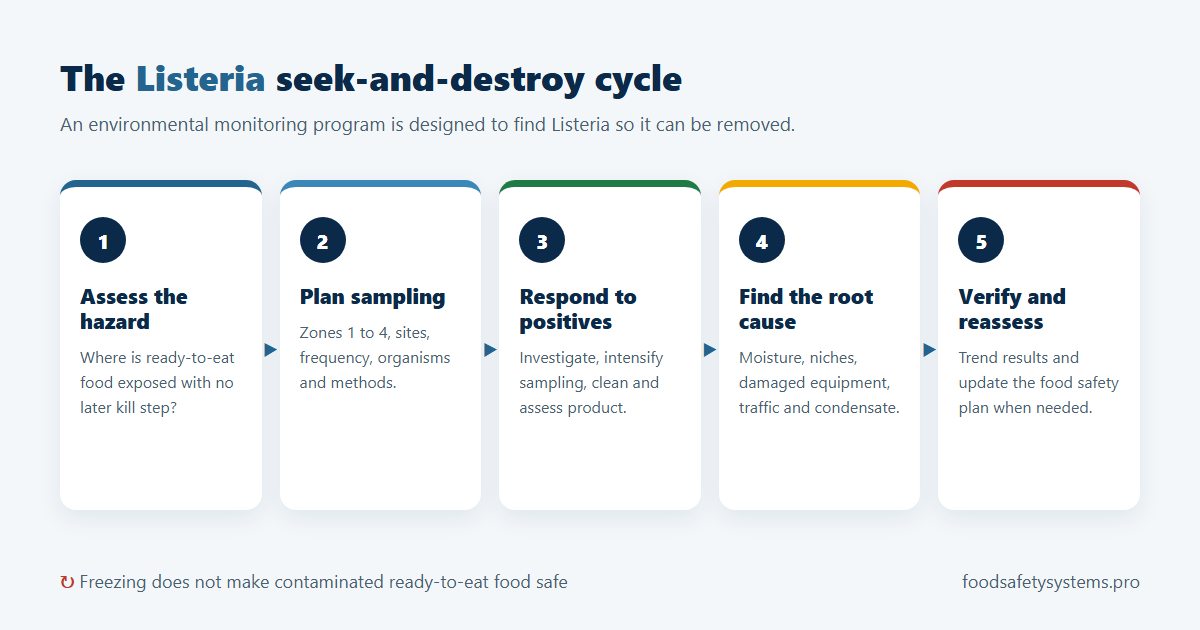
Review each step where exposed ready-to-eat food, food-contact surfaces or packaging meet the processing environment. Decide whether Listeria monocytogenes or other environmental pathogens are known or reasonably foreseeable hazards that require preventive controls. Under 21 CFR 117.165(a)(3), when contamination of ready-to-eat food with an environmental pathogen is a hazard requiring a preventive control, environmental monitoring is required to verify the sanitation controls.
Build a risk-based Listeria environmental monitoring program
Define the program’s purpose, sampling sites, hygienic zones, frequency, target organisms (Listeria species or L. monocytogenes), methods, responsibilities and response criteria. Base the sampling plan on facility layout, product exposure, equipment, traffic patterns and historical findings. Most programs use four zones, from food-contact surfaces (zone 1) out to areas outside the processing room (zone 4). The goal is to find Listeria, so sample where it is most likely to be, including during production and after equipment is opened up.
Respond effectively to positive findings
Write a response procedure for presumptive and confirmed positives before you need it. Include investigation, intensified sampling where appropriate, sanitation and corrective actions, product impact assessment, root cause analysis and effectiveness verification. A zone 1 positive normally triggers an evaluation of the product produced on that line.
Strengthen sanitation preventive controls
Support cleaning and sanitizing procedures with scientific evidence where appropriate. Verify execution, chemical preparation, contact time, equipment disassembly, hard-to-clean areas and the effectiveness of corrective sanitation. Our guide to hygiene and sanitation programs covers the SQF expectations.
Improve hygienic zoning and personnel practices
Assess how people, tools, carts, waste, ingredients and equipment move between hygiene zones. Set practical handwashing, glove-change, footwear, clothing and barrier procedures, and verify that employees follow them. See our guide to GMP implementation.
Investigate recurring findings beyond immediate cleaning
Trend results by organism, location, equipment, shift and time. Ask whether moisture, niches, damaged equipment, traffic, condensate or poor sanitary design keeps the problem coming back. Repeated positives at the same site point to a harborage point that routine cleaning cannot reach.
Reassess the food safety plan and verify CAPA
Decide whether recurring findings or new information require a hazard analysis reassessment. Record the root cause, actions, owners, deadlines, evidence and effectiveness checks, as described in our corrective and preventive action (CAPA) process guide.
Listeria environmental monitoring checklist
- Does the hazard analysis address environmental pathogens at every exposed step?
- Are zones, sampling sites and frequencies justified by product exposure and history?
- Is there a written response for presumptive and confirmed positives?
- Is sanitation effectiveness verified, including hard-to-clean equipment?
- Are results trended by site, shift and equipment?
- Are corrective actions closed only after follow-up sampling shows they worked?
How Consultare Inc. Group can help
Consultare Inc. Group supports SQF gap assessments, hazard analysis review, environmental monitoring program development or assessment, sanitation and SSOP review, hygienic zoning assessments, personnel hygiene procedures, internal audits, root cause analysis and corrective action planning. Support can include a prioritized gap register, revised procedures and forms, and implementation guidance within the agreed project scope.
- SQF gap assessments and internal audits
- Non-conformance and regulatory response
- Corrective action support
Need help managing your SQF responsibilities?
Whether you are preparing for SQF certification, dealing with recurring environmental findings, improving Listeria controls or strengthening sanitation and employee hygiene, book a free consultation to discuss your facility, products, environmental monitoring program and food safety system. You can also contact our team.
Start building your compliance system
Prefer to organize your compliance activities yourself? Create a free SystemsBuilder account and begin building a structured system for your compliance documentation and processes.
Technical sources: 21 CFR Part 117 and FDA’s draft guidance Control of Listeria monocytogenes in Ready-To-Eat Foods. This article is educational; specific requirements depend on your products, facility, certification scope and applicable regulations.