
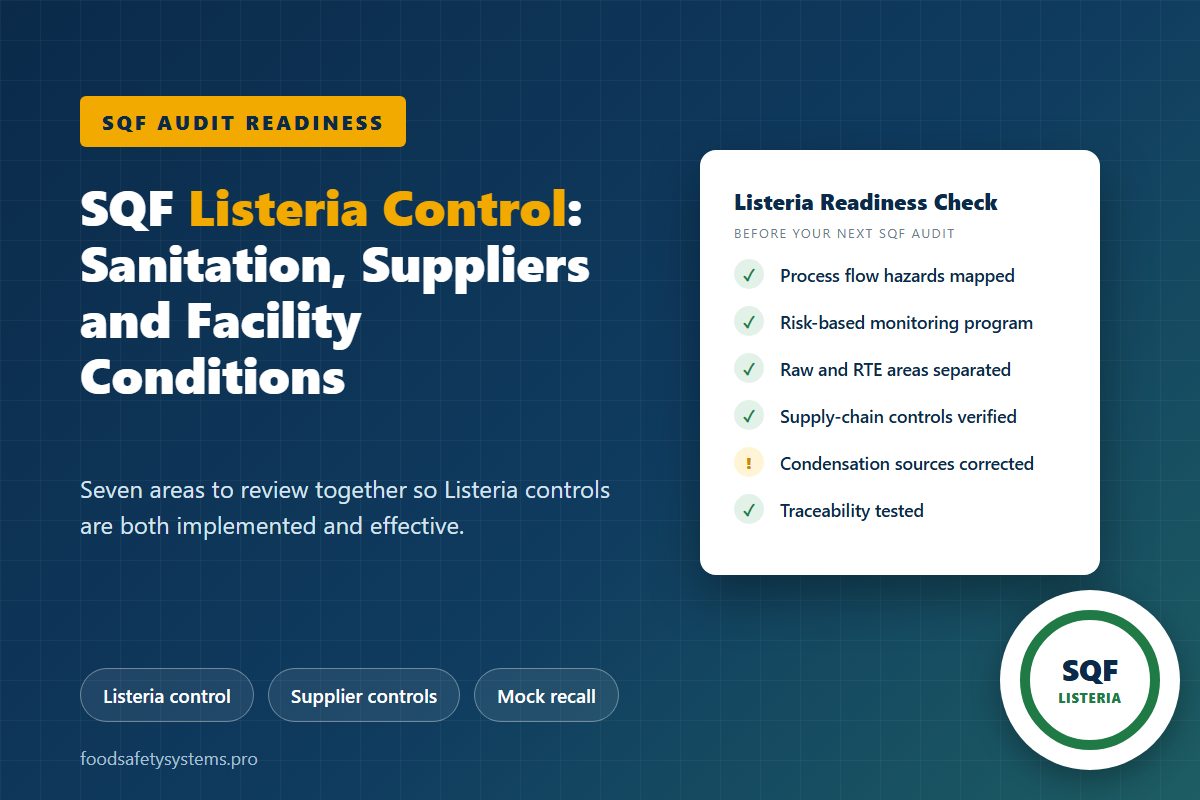
SQF Listeria control works only when sanitation, environmental monitoring, supplier controls, facility conditions and corrective action are evaluated together. Ready-to-eat food operations need effective controls to stop environmental pathogens from contaminating exposed product. A food safety management system has to connect hazard analysis, sanitation, monitoring, supplier controls, facility conditions and corrective actions. For SQF-certified and certification-seeking facilities, the question an auditor asks is not only whether these programs exist, but whether they are implemented and effective.
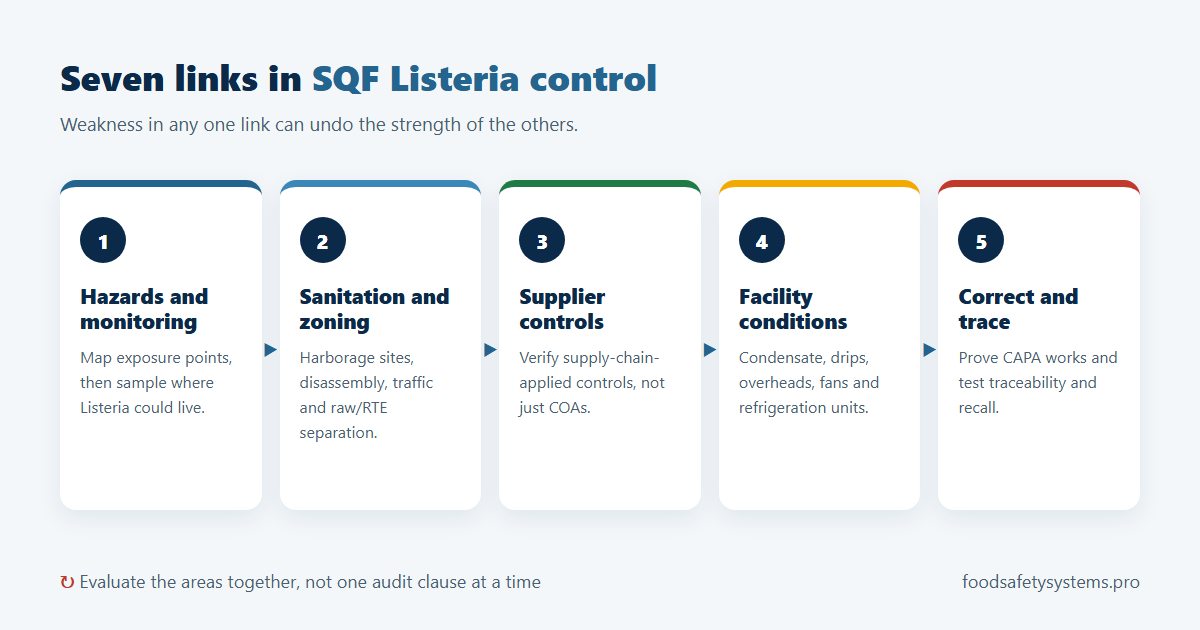
FDA warning letters involving Listeria often describe several weaknesses at once: condensate dripping over exposed product, supplier COAs accepted in place of required verification, and positives that were cleaned without a root cause. This article walks through seven areas to review as one system.
Evaluate environmental pathogen hazards
Walk the process flow and mark every point where exposed ready-to-eat food could be contaminated. Consider employee handling, equipment, utensils, traffic patterns, raw materials and the absence of a later lethal treatment. The hazard analysis should describe the actual product and process, not a generic template.
Build a risk-based environmental monitoring program
Define the program’s purpose and scope, target organisms or indicators, sampling sites, frequency, methods, laboratory arrangements, responsibilities and response criteria, all justified scientifically and operationally. Our detailed guide to Listeria environmental monitoring and sanitation covers zoning, positive-result response and trending.
Strengthen sanitation and hygienic zoning for SQF Listeria control
Evaluate cleaning and sanitizing procedures, equipment disassembly, hard-to-clean areas, utensils, traffic flow, personnel practices and separation of raw and ready-to-eat areas. Confirm that sanitation procedures specifically address potential harborage sites. See our hygiene and sanitation programs guide.
Verify supplier and raw material controls
Assess whether hazards in incoming produce and other ingredients are controlled by the right entity in the supply chain. Supplier approval, COAs and receiving inspections do not automatically replace verification of a supply-chain-applied control that the Preventive Controls rule requires under 21 CFR Part 117, Subpart G. Our supplier verification support service can help set this up.
Correct facility and condensation conditions
Inspect overhead structures, refrigeration units, fans, pipes, ducts and other sources of drip or condensate. FDA’s CGMPs require plants to be built and kept so that drip or condensate does not contaminate food, food-contact surfaces or packaging. Protect exposed food and packaging, correct the source and verify the condition does not return. Our guide to facility design, maintenance and pest control covers the SQF side.
Demonstrate corrective action effectiveness
Record the affected area and product assessment, immediate correction, root cause, intensified cleaning or other measures, follow-up sampling where appropriate, evaluation of results and the criteria for closure. A corrective action is not closed until evidence shows it worked.
Test traceability and incident response
Confirm that you can identify potentially affected ingredients and finished products, evaluate distribution and activate the incident or recall process when warranted. Timed annual mock recalls are the best way to prove this capability before you need it.
How Consultare Inc. Group can help
Consultare Inc. Group supports SQF gap assessments, food safety system review and development, hazard analysis review, sanitation and environmental monitoring program assessment, supplier program evaluation, traceability and mock recall exercises, internal audit support and corrective action planning. Engagements can include a structured action plan, document review, implementation support and verification criteria, as agreed in the project scope.
- SQF gap assessments and internal audits
- Food safety system development
- SQF audit readiness coaching
- Corrective action support
Need help managing your SQF responsibilities?
Whether you are preparing for SQF certification, strengthening Listeria controls, reviewing your environmental monitoring program or closing sanitation and supplier-control gaps, you do not have to manage it alone. Book a free consultation to discuss your facility, food safety system, audit readiness and corrective action priorities, or contact our team.
Start building your compliance system
Prefer to organize your compliance activities yourself? Create a free SystemsBuilder account and begin building a structured system for your compliance documentation and processes. The right time to strengthen your controls, documentation and corrective action process is before a compliance gap becomes a business problem.
Technical sources: 21 CFR Part 117 and SQFI Food Safety Program. This article is educational; specific requirements depend on your products, facility, certification scope and applicable regulations.