
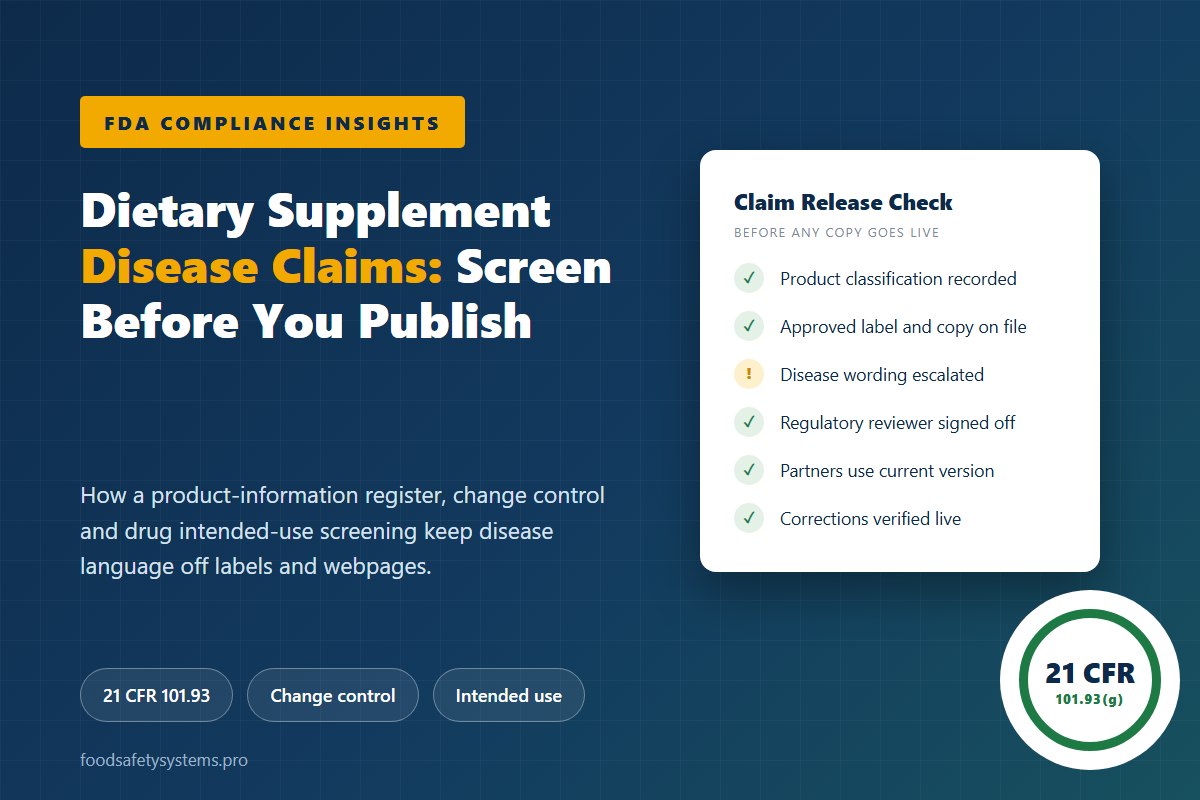
Dietary supplement disease claims can turn a supplement into an unapproved drug in FDA’s eyes, and a food safety certificate offers no protection against that outcome. SQF certification helps a company control documented information. However, it is not an authorization to make disease-treatment claims. Labels, online descriptions and marketing assets therefore need their own approval, revision and escalation process, because FDA may consider the totality of a product’s claims when it determines intended use.
Quick answer: use a documented review and change-control process to keep packaging, websites and other promotional claims aligned with the product’s regulatory classification. Screen every new statement for disease language before it is published. SQF certification does not establish that a promotional claim is FDA-compliant.
Who this guidance is for
SQF food safety teams, document control coordinators and quality managers at sites that make, pack or market dietary supplements.
Separate food safety certification from claims authorization
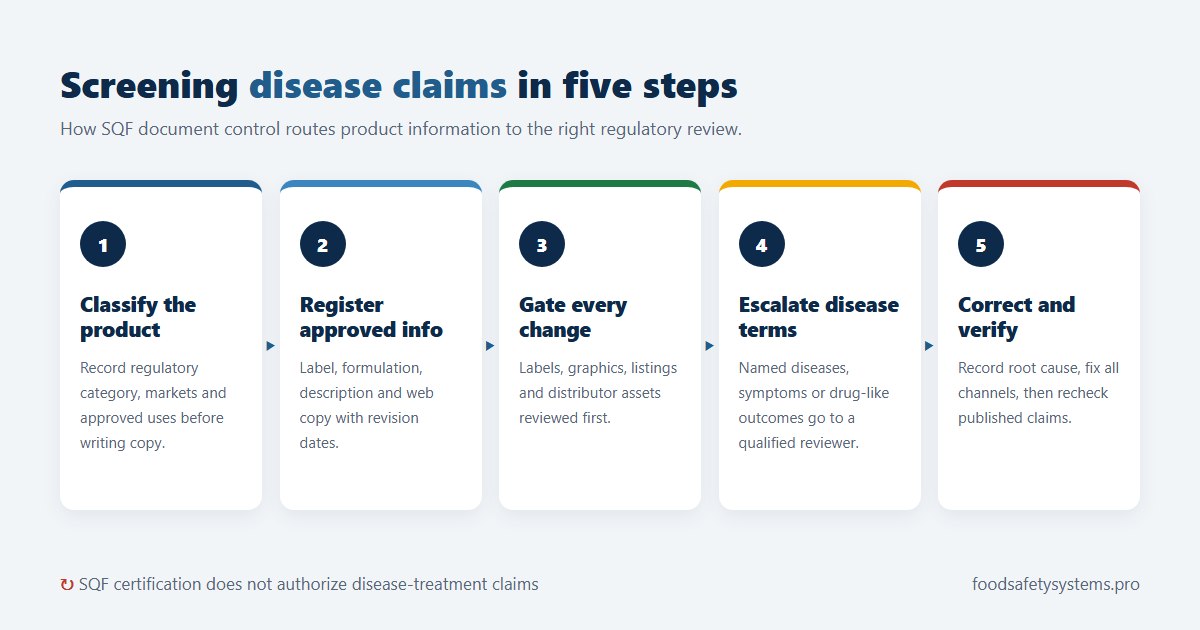
First, decide which documents the site’s SQF system manages and which need separate regulatory review. A specification or a batch record is a food safety document. A product page that describes health outcomes is a regulatory claims document. Never treat an audit certificate as approval of a therapeutic claim.
Know what makes a dietary supplement disease claim
Under the Federal Food, Drug, and Cosmetic Act, an article intended for use in the diagnosis, cure, mitigation, treatment or prevention of disease meets the drug definition in 21 U.S.C. 321(g)(1). FDA’s criteria for dietary supplement disease claims are set out in 21 CFR 101.93(g). In short, a statement is a disease claim if it says or implies that the product affects a specific disease or its characteristic symptoms. The criteria also capture implied claims made through a product name, ingredient references, cited publications, pictures or symbols. FDA considers the context in which the claim appears.
Maintain an approved product-information register
Keep one controlled register for each product. It should show the current product identity, formulation, approved label, approved description and website copy. Add revision dates and the names of the people who may authorize changes. As a result, anyone can check published wording against an approved source rather than memory. Our document control procedure guide shows how to structure controlled records.
Control cross-functional content updates
Require review before anyone publishes changes to labels, health-related descriptions, promotional graphics, distributor assets or e-commerce listings. Marketing often moves faster than quality, so the review step must sit inside the publishing workflow. Our guide to dietary supplement website claims covers change control for product pages and blogs.
Screen language that suggests drug intended use
Set clear escalation triggers. Wording about treating or preventing a disease, reducing recurrent cardiovascular events or achieving a disease-specific therapeutic outcome should go to a qualified regulatory reviewer. The reviewer, not the marketing team, makes the determination and records it.
- Named diseases or classes of disease, such as diabetes, cancer or heart disease.
- Characteristic symptoms of a disease, described in scientific or lay terms.
- Product names, images or symbols that imply a disease effect.
- Claims that the product replaces, or works with, a drug therapy.
- Citations or linked articles that refer to a disease use.
Verify the documents used in operations and marketing
Check that packaging staff, website administrators, customer support and external marketing partners all use the approved version. An outdated distributor sell sheet can carry an old claim long after the label changed.
Document corrections and effectiveness
When a problem claim is found, record the affected materials and the immediate correction. Then record the root cause, the assigned action and the verification. Finally, schedule periodic reviews of published claims to confirm the fix holds. Our CAPA process guide explains effectiveness checks.
Dietary supplement disease claims checklist
- Identify every controlled product-information channel and its document owner.
- Maintain approved labels, descriptions, change history and reviewer records.
- Escalate disease-related representations for qualified regulatory review.
- Verify approved content across packaging, websites and partner materials.
- Audit effectiveness and track repeat issues through corrective actions.
Frequently asked questions
Does SQF certification approve dietary supplement marketing claims?
No. SQF certification and FDA review of product intended use answer different questions. A certificate covers the food safety system, not the claims made about the product.
Should product webpages be included in document control?
Yes. Where a company uses webpages to promote its products, those statements belong in its claims-review scope. Testimonials and social posts deserve the same attention; see our guide to dietary supplement testimonials.
What records support a stronger control process?
Approved wording, version history, reviewer decisions, change requests and periodic checks of live content are all useful evidence.
How Consultare Inc. Group can help
Consultare Inc. Group provides practical food safety and regulatory compliance support. Deliverables and scope depend on the specific product, operation and agreed engagement.
- SQF gap assessments and internal audits: find uncontrolled product information.
- Document control services: product-information registers and change control.
- FDA compliance integration: connect your SQF system with FDA claims requirements.
- Corrective action support: plan and verify claim corrections.
Need help managing your SQF responsibilities?
Discuss your products, documentation and compliance priorities with the Consultare team in a free consultation, or contact our team.
Start building your compliance system
Prefer to organize your compliance activities yourself? Create a free SystemsBuilder account to manage specifications, controlled documents, assigned actions and records in one structured workflow. Software supports record management; it does not by itself ensure compliance.
Technical sources: 21 CFR 101.93, 21 U.S.C. 321, FDA dietary supplements and SQFI. Independent educational content: Consultare Inc. Group is not affiliated with or endorsed by FDA, SQFI or any company referenced in the underlying regulatory materials. This article does not constitute regulatory approval, certification or legal advice; applicability must be assessed for each product, facility and operation.