
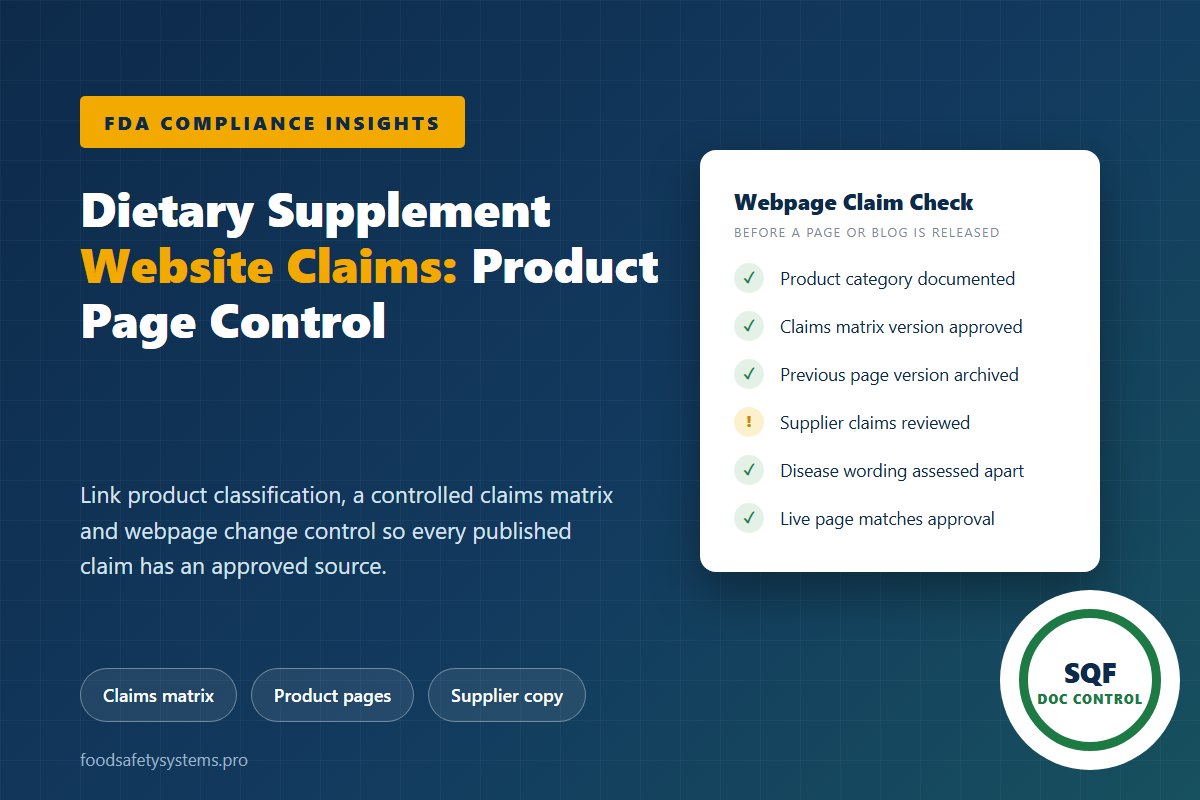
Dietary supplement website claims often change faster than any controlled production document, which is why product pages and blogs need the same change control as a label. Where a business maintains an SQF food safety management system, a defined interface between product information, label approval and marketing release can stop inconsistent claims from going live. Disease claims still require a separate FDA regulatory assessment, even when the product is made under a certified food safety system.
Quick answer: SQF document control can help an organization assign reviewers, control approved product information and keep evidence of changes to webpages and sales materials. SQF certification does not itself authorize disease-treatment claims or replace an FDA marketing-claims review.
Who this guidance is for
Food and dietary supplement manufacturers and importers, quality managers, regulatory affairs teams and the people who own website and marketing content.
Identify the product and its intended regulatory category
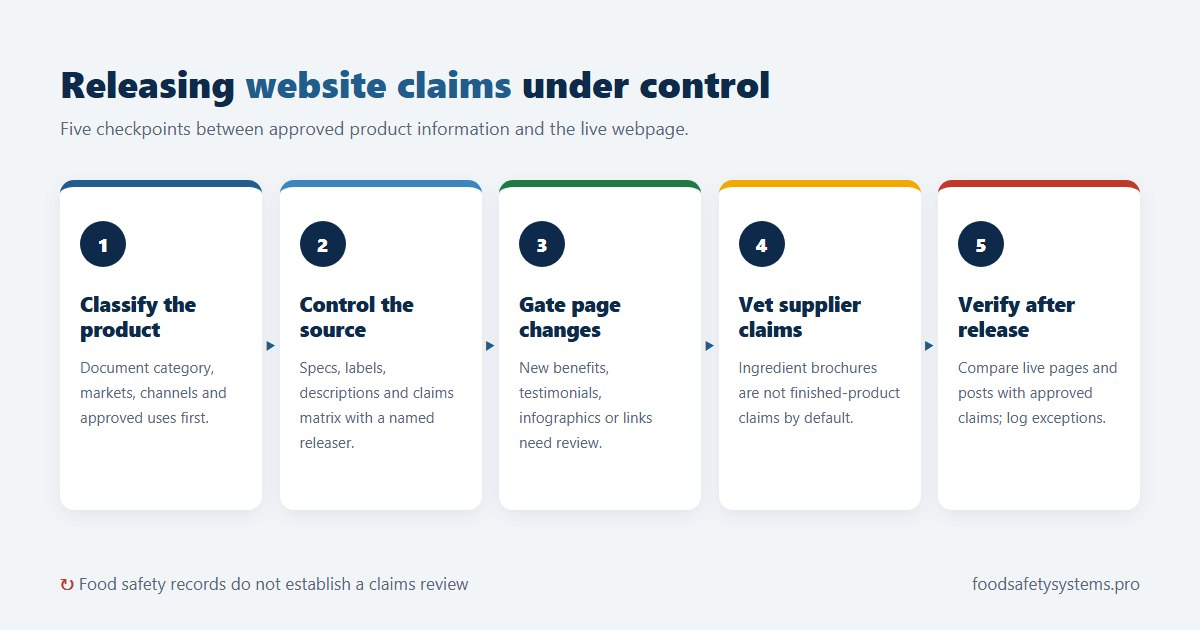
Start with a documented product classification. List the markets, sales channels and approved uses for each product. Dietary supplement status, food safety certification and drug classification are three separate questions. A product promoted to treat or prevent disease can meet the drug definition in 21 U.S.C. 321(g)(1), whatever its certification status.
Control the approved source of dietary supplement website claims
Maintain current specifications, labels, product descriptions and a claims matrix under document control. Identify the approved version and the person authorized to release it. The website should then copy from this source, never from an old brochure. Our guide to product specifications and label review shows how these records link together.
Apply change control to webpages and blogs
Require review whenever someone adds a new benefit statement, disease reference, testimonial, infographic or linked article. Archive previous versions and record the approval date. As a result, you can show what was live on any given day. Disease wording needs particular care; our guide to dietary supplement disease claims sets out the escalation triggers.
- New or edited product descriptions and benefit statements.
- Blog posts and linked articles that mention health conditions.
- Infographics, images and video captions that contain claims.
- Testimonials and reviews displayed on product pages.
Link cross-functional review to risk
Quality, regulatory, marketing and management teams should each have defined responsibilities. Higher-risk wording should get a deeper review. A claims review does not exist merely because food safety records exist, so assign it as a separate, named task.
Review supplier-provided claims critically
Do not automatically republish ingredient supplier brochures or generic health claims. An ingredient benefit is not automatically an acceptable claim for the finished product. Confirm that each claim suits the finished product and the intended U.S. market. Our article on dietary supplement supplier controls covers ingredient approval more broadly.
Verify public content after release
Periodically compare live webpages, social media posts and sales materials with the approved claims. Record exceptions and corrective actions. Testimonials and social channels need their own sampling; see our guide to dietary supplement testimonials. Recurring exceptions are a good input to management reviews.
Dietary supplement website claims checklist
- Confirm product classification and the applicable FDA regulatory pathway.
- Maintain an approved inventory of products, labels, website content and connected social channels.
- Identify the staff responsible for reviewing and approving new or revised claims.
- Document review decisions, version history and evidence supporting product information.
- Evaluate disease-related wording separately from product safety, certification and supplier assurance.
- Verify corrections on live pages and linked channels, and review recurrence through management oversight.
Frequently asked questions
Does SQF certification approve dietary supplement disease claims?
No. SQF certification concerns the applicable food safety management standard. It is not FDA authorization for disease-treatment claims.
Should website copy be included in document control?
It can be. A business can manage regulated product information and marketing approvals through its document control or change control system, which gives website copy an owner, a version and an approval record.
Are ingredient benefits automatically acceptable product claims?
No. The product-specific wording, context and intended use require separate evaluation.
How Consultare Inc. Group can help
Consultare Inc. Group combines practical quality-system improvement with coordination of relevant regulatory expertise. Services are scoped to the specific product, the applicable requirements and the agreed engagement.
- SQF gap assessments and internal audits: readiness reviews that include product information.
- Document control services: claims matrices and webpage change control.
- Supplier verification support: review supplier information before you reuse it.
- Corrective action support: cross-functional plans to fix live content.
Need help managing your SQF responsibilities?
Discuss your products, documentation and compliance priorities with the Consultare team in a free consultation, or contact our team.
Start building your compliance system
Prefer to organize your compliance activities yourself? Create a free SystemsBuilder account to manage specifications, controlled documents, assigned actions and records in one structured workflow. Software supports record management; it does not by itself ensure compliance.
Technical sources: 21 U.S.C. 321, 21 CFR 101.93, FDA dietary supplements and SQFI. Independent educational content: Consultare Inc. Group is not affiliated with or endorsed by FDA, SQFI or any company referenced in the underlying regulatory materials. This article does not constitute regulatory approval, certification or legal advice; applicability must be assessed for each product, facility and operation.