
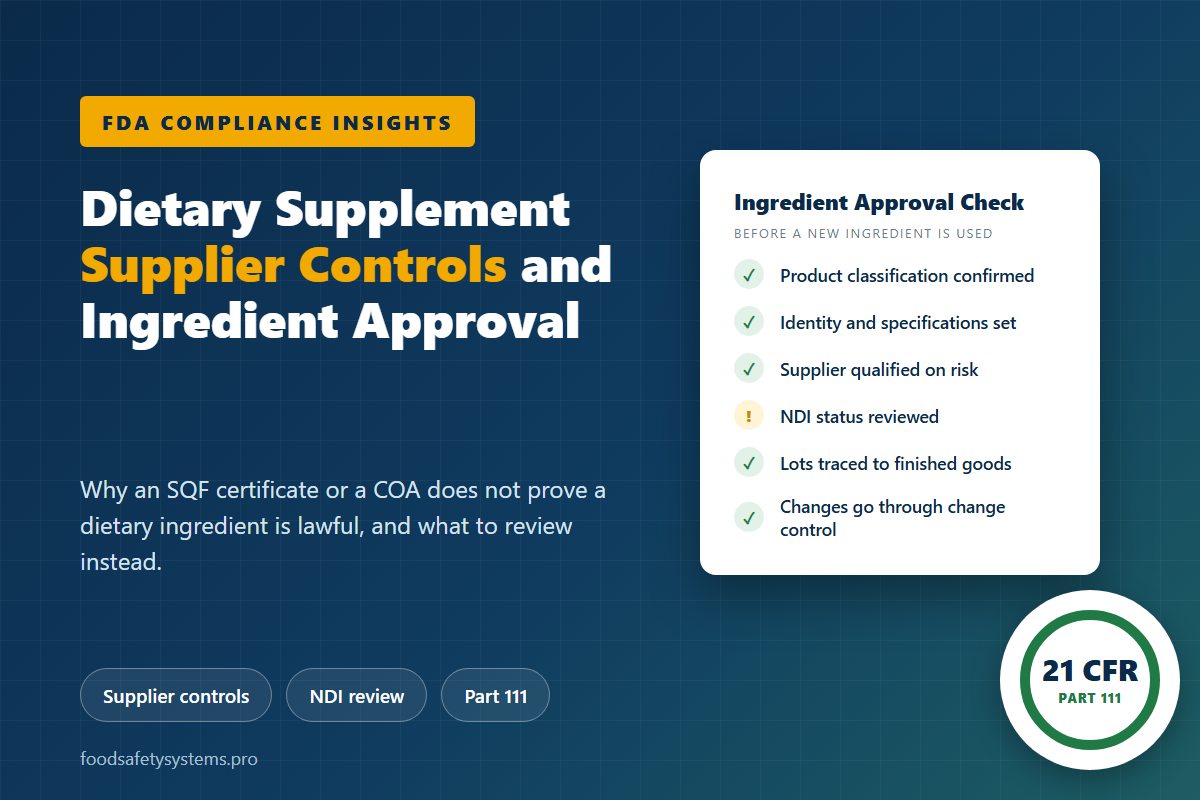
Dietary supplement supplier controls decide whether every ingredient that enters your facility is the right material, from a qualified source, and lawful to use. Food safety certification systems such as SQF can support structured management practices, but they do not replace the FDA requirements that apply to dietary supplements. A food safety certificate or a certificate of analysis (COA) shows that a supplier operates a system or that a lot was tested. It does not show that a dietary ingredient is lawful or adequately substantiated as safe.
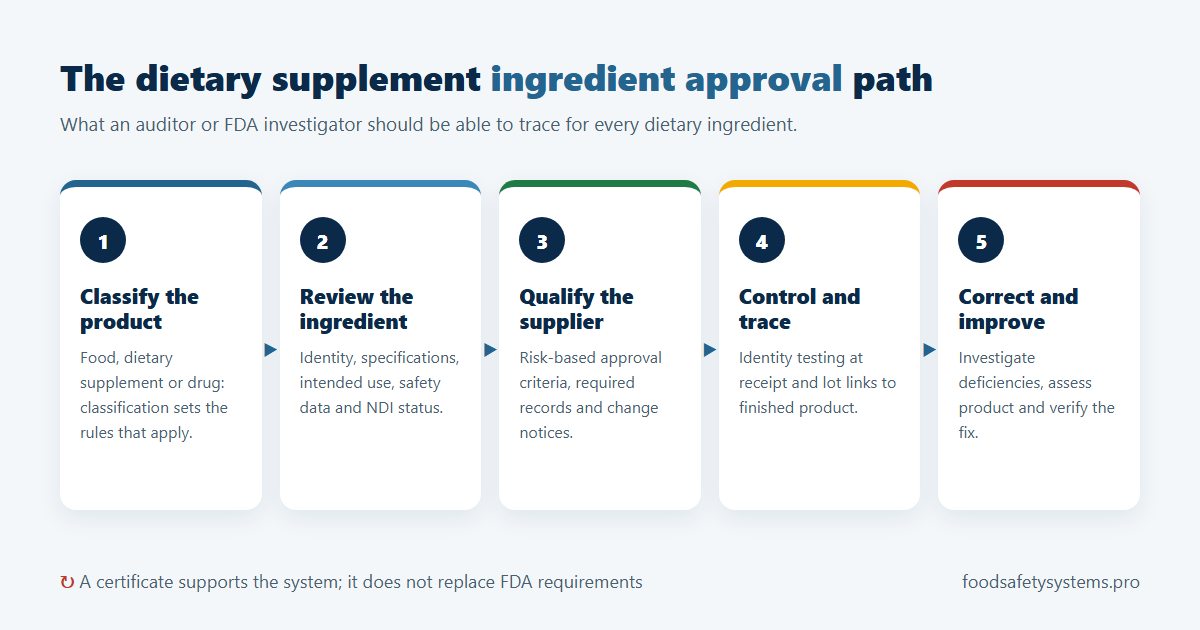
FDA warning letters to supplement firms keep pointing to the same gaps: products classified incorrectly, ingredients approved without a regulatory review, identity never confirmed, and supplier changes that nobody assessed. The six areas below close those gaps.
Confirm product classification before selecting a framework
Decide first whether the product is a conventional food, a dietary supplement, a drug or another regulated product. Classification sets the manufacturing, labeling, ingredient and safety rules that apply. Dietary supplements fall under the dietary supplement CGMP rule in 21 CFR Part 111, while conventional foods follow 21 CFR Part 117. Our overview of dietary supplement manufacturing food safety system requirements explains how SQF fits alongside these rules.
Establish documented ingredient approval
Before a material is approved, review its identity, specifications, supplier information, intended use, regulatory status and available safety information. Record who approved it and on what evidence. Part 111 requires at least one appropriate test or examination to verify the identity of each dietary ingredient before use, so a supplier COA alone cannot confirm identity for a dietary ingredient.
Strengthen dietary supplement supplier controls and monitoring
Set risk-based supplier approval criteria and define the records each supplier must provide. Review supplier performance, complaints and changes such as a new manufacturing site or a new sub-supplier. Keep traceability from each supplier lot to the finished products that used it. Our approved supplier program guide and COA and certification verification guide cover the SQF side of this work.
Evaluate ingredient safety and NDI status
For supplements, assess whether each ingredient is eligible for use as a dietary ingredient and whether new dietary ingredient (NDI) requirements apply. Under section 413 of the FD&C Act, a dietary ingredient not marketed in the United States before October 15, 1994 generally needs an NDI notification to FDA at least 75 days before it is marketed, unless an exception applies. FDA explains the process on its NDI notification page. Supplier documentation can support this review, but the responsibility stays with the firm that markets the product.
Maintain change control and traceability
Evaluate changes to ingredient sources, composition, specifications, manufacturing processes and intended use before they take effect. A new extraction solvent or a different plant part can change both the safety profile and the regulatory status of an ingredient. Keep records that link suppliers, incoming lots, production batches and finished products.
Use corrective action to strengthen the system
When an ingredient or supplier deficiency is found, investigate it, assess any affected product, document the root cause and verify that the action prevents recurrence. Trend supplier issues so repeat problems lead to re-approval or removal of the supplier.
Dietary supplement supplier controls checklist
- Is each product correctly classified as a food, dietary supplement or drug?
- Does every ingredient have an approved specification and a documented regulatory review?
- Is the identity of each dietary ingredient verified before use, not taken from a COA alone?
- Are suppliers approved on risk, with defined records and change notification?
- Has NDI status been assessed and documented for each dietary ingredient?
- Can you trace any ingredient lot to every finished batch that used it?
How Consultare Inc. Group can help
Consultare Inc. Group supports SQF gap assessments for operations within the applicable certification scope, along with supplier qualification, ingredient specification review, traceability, document control, internal audits and corrective action planning. Dietary supplement activities need a separate assessment against Part 111, NDI, ingredient safety and labeling requirements.
- SQF gap assessments and internal audits: find supplier and ingredient control gaps before your auditor does.
- Supplier verification support: build risk-based approval and monitoring.
- FDA compliance integration: align your SQF system with applicable FDA rules.
- Document control and corrective action support: keep specifications, approvals and CAPA records current.
For dedicated dietary supplement CGMP support, see our sister site DietarySupplements.pro.
Need help managing your SQF responsibilities?
Whether you are reviewing ingredient eligibility, supplier documentation, quality systems or regulatory responsibilities, book a free consultation with the Consultare team. Discuss your products, suppliers, documentation and compliance priorities, or contact our team.
Start building your compliance system
Prefer to organize your compliance activities yourself? Create a free SystemsBuilder account and begin building a structured system for your compliance documentation and processes.
Technical sources: 21 CFR Part 111 and FDA NDI notification process. This article is educational; specific requirements depend on your products, facility, certification scope and applicable regulations.