
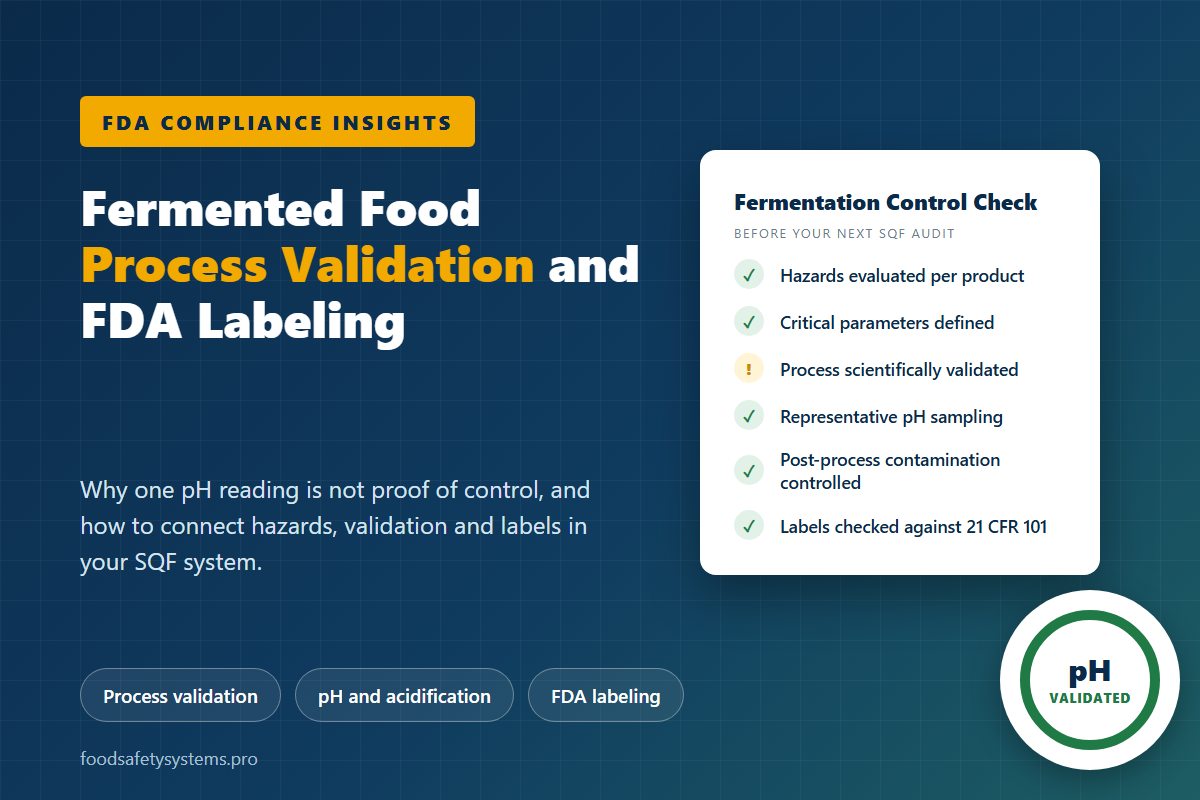
Fermented food process validation is the evidence that your fermentation or acidification step controls pathogens every time, not just on the day a sample was taken. Fermented and acidified foods need carefully designed controls so the process consistently achieves its intended food safety outcome. A low pH reading on its own does not show that all relevant pathogens have been controlled. Manufacturers should connect hazard analysis, process validation, sanitation, supplier approval, monitoring, verification and accurate labeling within one documented food safety system.
Recent FDA warning letters to producers of fermented vegetables, pickled products and cultured foods show a familiar pattern: a single pH check treated as proof of safety, no scientific basis for the process, and labels that miss required information. Here is how to avoid each one.
Evaluate biological hazards in fermented and ready-to-eat foods
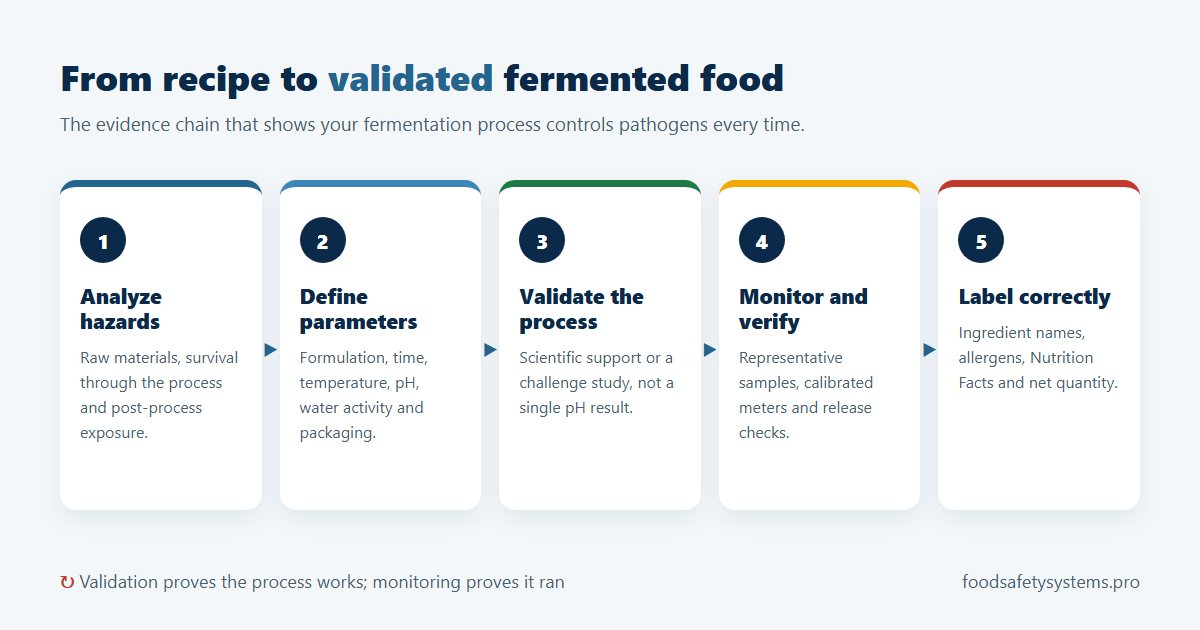
Identify hazards that could enter with raw materials, survive processing or contaminate product during post-process handling. Depending on the ingredients and process, consider vegetative pathogens such as Listeria monocytogenes, Salmonella and pathogenic E. coli, as well as Clostridium botulinum, parasites and viruses.
Establish scientifically supported fermentation and acidification controls
Define the process parameters that matter: formulation, starter culture or brine strength, fermentation time and temperature, target pH, water activity where relevant and packaging conditions. Decide which of these are critical to the safety outcome and set limits for them. Note the regulatory boundary: FDA’s acidified foods rule in 21 CFR Part 114 applies to low-acid foods with acid added to reach an equilibrium pH of 4.6 or below, and it excludes fermented foods. Products that are partly fermented and partly acidified need a careful classification, because the answer changes which rules apply.
Fermented food process validation, not a single pH result
Gather scientific support suited to the product and process. Ask whether the process prevents pathogen growth, reduces pathogens that may be present, or both, and whether a challenge study, published literature or a process authority review is needed. Our guide to validation and verification of control measures explains the difference between proving a process works and checking that it ran as designed.
Strengthen monitoring and verification
Specify when samples are collected, how representative samples are taken, how often testing happens and how pH meters are calibrated. Records should show that monitoring takes place at meaningful stages, including before release where the process depends on it.
Control post-process environmental contamination
Assess exposed ready-to-eat product, packing areas, equipment, personnel practices, sanitation procedures and environmental monitoring where appropriate. A validated fermentation does not protect product that is recontaminated during packing. See our guide to hygiene and sanitation programs.
Implement risk-based supplier approval
Assess raw-material hazards and decide whether supplier controls or other supply-chain controls are needed. Review specifications, supplier verification records and incoming acceptance procedures through your approved supplier program.
Review labels against FDA requirements
Check common or usual ingredient names, the ingredient list, major food allergen declarations, Nutrition Facts, net quantity, statement of identity, and the name and address of the business. Under 21 CFR Part 101, if any label representation appears in a foreign language, the required label information must also appear in that language. Our allergen identification and documentation guide covers the allergen side.
Close gaps through corrective action and management review
Investigate deviations, assess affected product, document the root cause, put corrective actions in place and verify that they work. Update the food safety plan and procedures whenever the recipe, process or equipment changes.
How Consultare Inc. Group can help
Consultare Inc. Group supports SQF gap assessments, food safety plan review, hazard analysis, fermentation and acidification process documentation, validation planning, sanitation and SSOP development, supplier approval, internal audits, corrective action and FDA label compliance reviews. SQF certification support is scoped separately from product-specific scientific validation and regulatory labeling assessments.
- SQF gap assessments and internal audits
- HACCP implementation support
- FDA compliance integration services
- Corrective action support
Need help managing your SQF responsibilities?
Whether you make fermented vegetables, pickled products, cultured foods or other acidified and ready-to-eat products, book a free consultation to discuss your hazard analysis, process controls, validation evidence, supplier program and labeling. You can also contact our team.
Start building your compliance system
Prefer to organize your compliance activities yourself? Create a free SystemsBuilder account and begin building a structured system for your compliance documentation and processes.
Technical sources: 21 CFR Part 114 and 21 CFR Part 101. This article is educational; specific requirements depend on your products, process, certification scope and applicable regulations.