
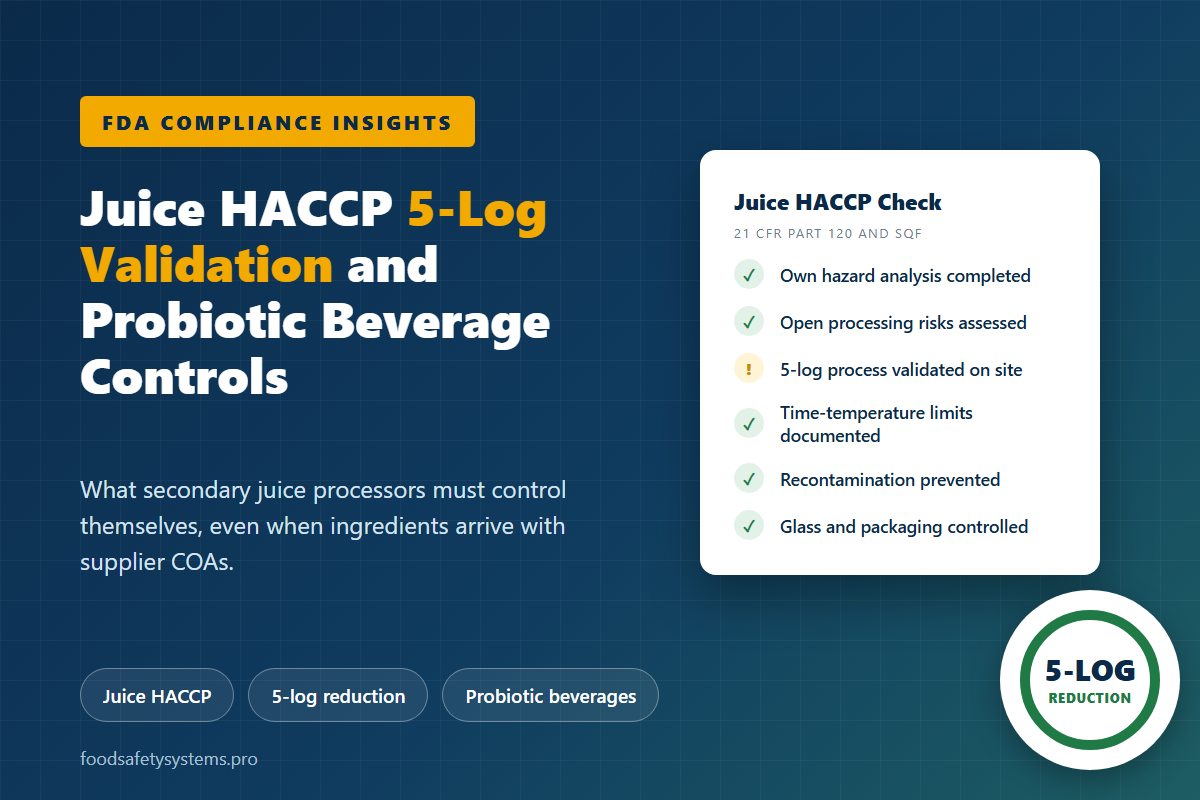
Juice HACCP 5-log validation is the core of food safety for any juice or juice-based probiotic beverage: the process must reliably cut the most resistant pathogen of concern by at least 100,000-fold. Juice and probiotic beverage manufacturers need a system that covers the whole manufacturing process, not just the ingredients they receive. Blending, ambient holding, filling and packaging can all introduce hazards that no upstream supplier controlled. An effective SQF system connects hazard analysis, validated process controls, sanitation, packaging controls, supplier approval and documented verification.
FDA warning letters to juice and beverage processors often describe the same situation: a secondary processor that relied on supplier COAs and shelf-stable ingredients, but never analyzed the hazards of its own blending and filling operation. The areas below show how to avoid that position.
Connect supplier controls with your own hazard analysis
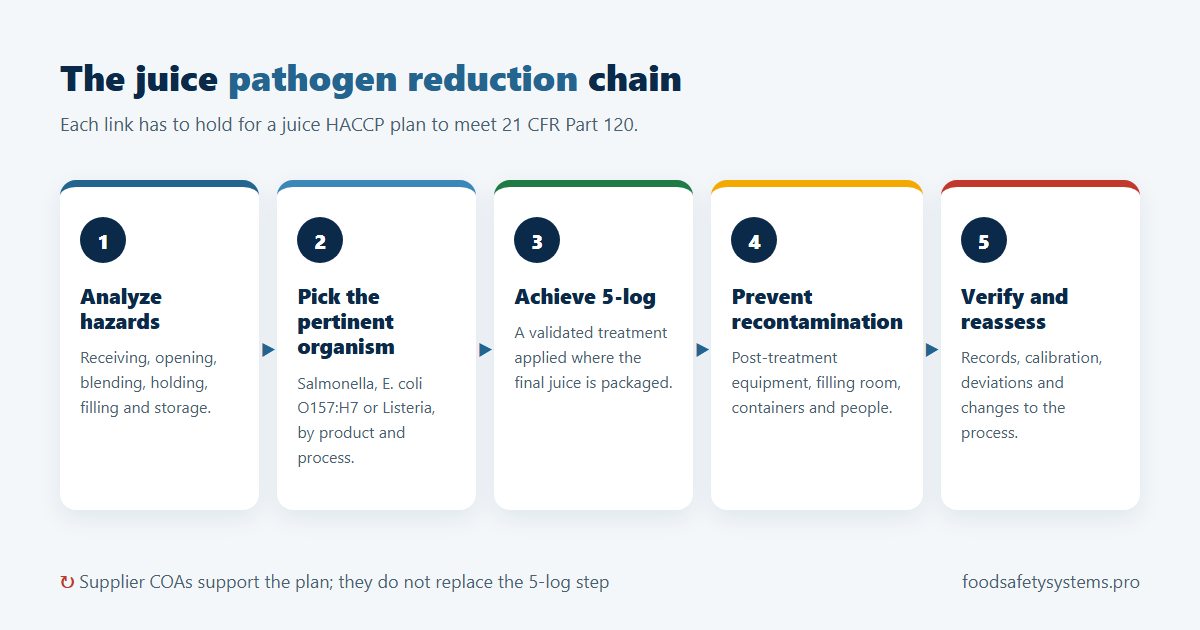
Evaluate each juice product and each operation: receiving, opening, blending, holding, filling, packaging and storage. A secondary processor must assess the hazards introduced or reasonably likely to occur during its own operations, even when ingredients arrive shelf-stable or with supplier COAs. Under 21 CFR Part 120, juice includes juice used as an ingredient in beverages, so a probiotic drink made with juice may fall within scope.
Assess pathogen exposure during open processing
Assess environmental contamination and pathogen introduction during non-aseptic or exposed handling. Consider Salmonella, pathogenic Escherichia coli such as O157:H7, Listeria monocytogenes and other relevant pathogens based on the product, process and intended consumers.
Document time-temperature limits and process monitoring
Set scientifically and regulatorily appropriate limits for processing and holding times and temperatures. Record actual operating conditions, evaluate cumulative exposure across steps, and define monitoring, deviation response and product disposition procedures.
Verify the juice HACCP 5-log validation
For juice subject to Part 120, identify the pertinent microorganism, the most resistant pathogen likely to occur in the juice, and establish a process that achieves at least a 5-log reduction of it, subject to the regulation’s provisions and exemptions. The process must be properly supported, applied at the facility where the final product is packaged, and integrated with controls against recontamination. Document the scientific basis of the treatment, its operating parameters, monitoring and verification. For probiotic beverages, show how live cultures are added without undoing the pathogen reduction step. FDA’s Juice HACCP Hazards and Controls Guidance is the starting reference.
Protect treated product from recontamination
Assess post-treatment equipment, product contact surfaces, the filling environment, packaging and handling. A validated 5-log step is wasted if treated juice is recontaminated on the filler. Our hygiene and sanitation programs guide covers the supporting controls.
Control glass and packaging hazards
Evaluate glass containers and other packaging for breakage and foreign-material risks. Set inspection, container integrity, glass breakage, product hold, cleanup and disposition procedures, with critical control points where the hazard analysis calls for them.
Use prerequisite programs as supporting controls
Supplier documentation, sanitation programs, environmental controls, finished-product testing and other prerequisite programs support the food safety system. They do not replace the product- and process-specific hazard analysis or the controls Part 120 requires. Finished-product testing in particular cannot substitute for a validated 5-log process.
Manage corrective action and system reassessment
Record monitoring, validation, verification, calibration, deviations, affected product assessment, corrective actions and effectiveness checks. Reassess the plan whenever ingredients, formulation, equipment, packaging, processing conditions or intended use change. See our validation and verification of control measures guide.
How Consultare Inc. Group can help
Consultare Inc. Group supports SQF gap assessments, juice hazard analysis review, Juice HACCP plan development, process validation planning, sanitation and SSOP development, glass and foreign-material procedures, supplier approval, internal audits, corrective action and certification readiness. Where juice-specific rules apply, the project addresses 21 CFR Part 120 directly rather than relying on a general certification checklist.
- HACCP implementation support
- SQF gap assessments and internal audits
- FDA compliance integration services
- Corrective action support
Need help managing your SQF responsibilities?
Whether you make juice blends, probiotic beverages, shelf-stable drinks or other juice products, book a free consultation to discuss your hazard analysis, 5-log process, blending and filling operations, sanitation and certification readiness. You can also contact our team.
Start building your compliance system
Prefer to organize your compliance activities yourself? Create a free SystemsBuilder account and begin building a structured system for your compliance documentation and processes.
Technical sources: 21 CFR Part 120 and the FDA Juice HACCP Hazards and Controls Guidance. This article is educational; specific requirements depend on your products, process, certification scope and applicable regulations.