
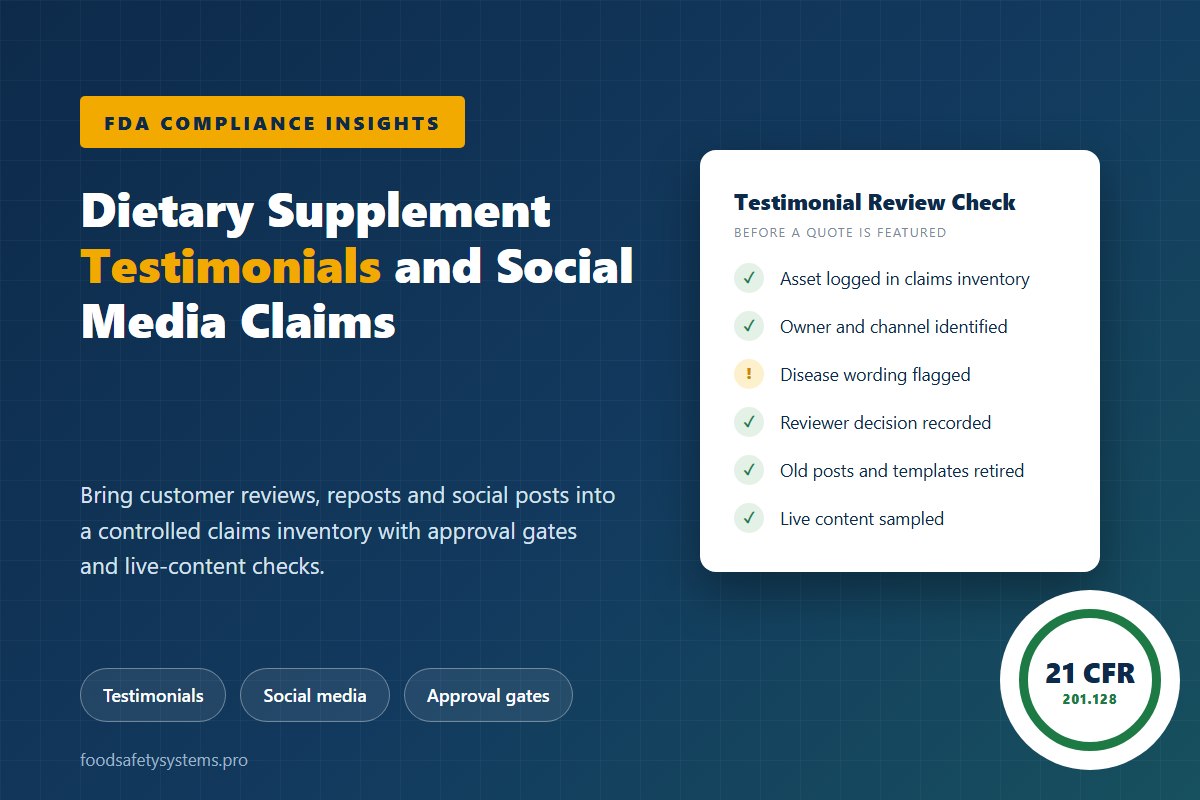
Dietary supplement testimonials, reposted reviews and social media posts are some of the hardest marketing content to control, and they can shape how FDA views a product’s intended use. Claims change quickly across product pages, advertisements, blog posts and social channels. When a statement suggests that a supplement prevents or treats disease, it may affect how FDA classifies the product. Fortunately, sites with SQF-based controls already have document disciplines they can apply to this content.
Quick answer: SQF document control can support the approval, revision, distribution and withdrawal of product-information records, including testimonials and social posts. It does not, by itself, determine whether a dietary supplement claim complies with FDA law. That determination requires a separate claims review.
Who this guidance is for
Food and dietary supplement businesses operating an SQF-certified or SQF-aligned management system, together with the marketing and social media teams that publish on their behalf.
Map the claims inventory, including testimonials
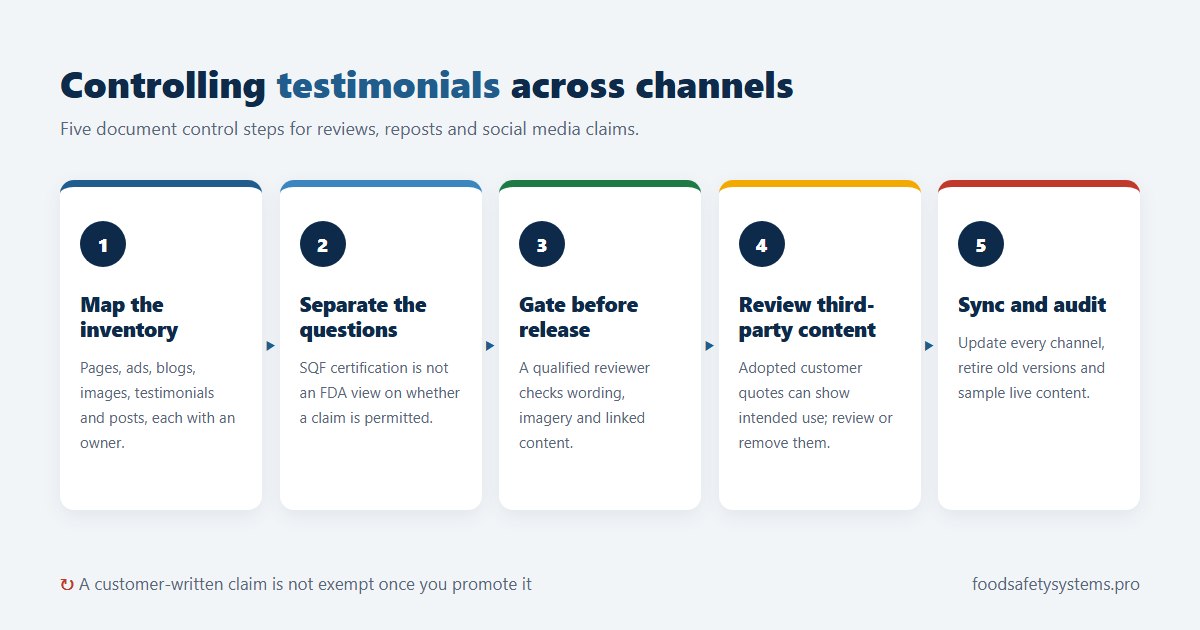
Start by listing every consumer-facing claim. Include product pages, advertising, blog articles, images that contain text, customer testimonials and social media posts. For each asset, record the owner, version, approval status and publication location. Without this inventory, nobody can say which statements are live.
Separate food safety certification from claims compliance
SQF certification is not an FDA determination that a supplement claim is permissible. Therefore, distinguish the requirements of the applicable SQF Code from the FDA requirements that govern intended use and labeling. Our overview of dietary supplement claims review explains where the two meet.
Control dietary supplement testimonials and third-party content
Testimonials, reposted customer reviews and third-party statements that a company adopts in its promotion can contribute to intended-use evidence. FDA’s rule on intended use, 21 CFR 201.128, notes that objective intent may be shown by advertising matter and by oral or written statements. So a customer quote about curing a condition is not exempt simply because a customer wrote it. Set up a process to review problem statements and remove them. In addition, advertising endorsements may fall under the FTC’s Endorsement Guides (16 CFR Part 255).
- Review a testimonial before it is featured, quoted, pinned or shared.
- Check reposts, likes and replies that repeat disease language.
- Treat influencer and affiliate content as company promotion.
- Record the decision: approve, edit, decline or remove.
Introduce documented approval gates
Require evidence that a qualified reviewer evaluated each proposed claim. The review should cover the wording, its supporting context, any imagery and linked content. Keep a record of the decision and the final approved wording. Our guide to dietary supplement disease claims lists the language that should trigger escalation.
Manage changes across channels
When a claim is revised, update the connected landing pages, social content, advertisements and archived templates. Then confirm that obsolete versions are no longer active. Scheduled posts and saved ad templates often bring back old wording, so check them too. For product pages and blogs, see our guide to dietary supplement website claims.
Audit effectiveness and escalate deviations
Sample live content against approved versions, and log any discrepancies and corrective actions. Escalate potentially disease-related claims for regulatory review, and keep evidence that each action was completed. An internal audit program can include these checks on a set schedule.
Testimonial and social media review checklist
- Confirm which regulatory requirements apply to the particular product and operation.
- Inventory the websites, labels, advertisements, testimonials and social accounts in scope.
- Assign accountable reviewers, document decisions and control approved versions.
- Verify corrective actions across all affected channels and retain completion evidence.
Frequently asked questions
Does SQF certification approve dietary supplement marketing claims?
No. SQF is a food safety certification framework; it does not grant FDA approval for promotional claims.
Should customer testimonials be reviewed?
Yes. Testimonials used in marketing can contribute to how the product’s intended use is understood, so review them like any other claim.
What records help a claims review process?
A claims inventory, approved copy, review decisions, revision history, channel mapping and evidence of corrective actions.
How Consultare Inc. Group can help
Consultare Inc. Group supports document control gap reviews, management-system procedures, internal audit preparation and coordination of product-information governance with appropriate regulatory specialists. Deliverables depend on the agreed service scope.
- Document control services: claims inventories and approval gates.
- SQF gap assessments and internal audits: sample live content against approved copy.
- FDA compliance integration: align your SQF system with FDA claims requirements.
- Corrective action support: remove problem claims across every channel.
Need help managing your SQF responsibilities?
Discuss your products, documentation and compliance priorities with the Consultare team in a free consultation, or contact our team.
Start building your compliance system
Prefer to organize your compliance activities yourself? Create a free SystemsBuilder account to manage specifications, controlled documents, assigned actions and records in one structured workflow. Software supports record management; it does not by itself ensure compliance.
Technical sources: 21 CFR 201.128, 21 CFR 101.93, 16 CFR Part 255 and SQFI. Independent educational content: Consultare Inc. Group is not affiliated with or endorsed by FDA, the FTC, SQFI or any company referenced in the underlying regulatory materials. This article does not constitute regulatory approval, certification or legal advice; applicability must be assessed for each product, facility and operation.