
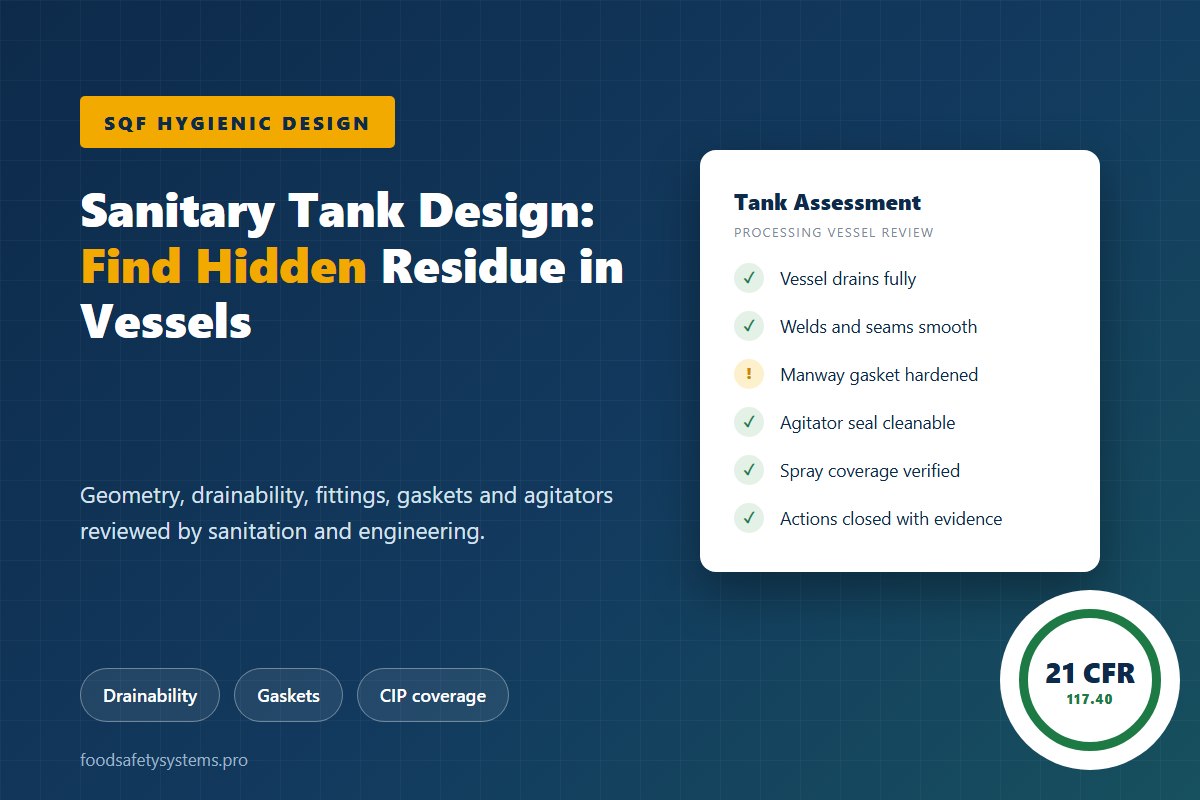
Sanitary tank design decides whether a processing vessel can be cleaned reliably, or only appears clean from the top hatch. Tanks and vessels can hide residue in fittings, outlets, seals and poorly drained sections. Routine cleaning alone may not reveal these weaknesses. As a result, an assessment of the vessel itself is often needed to explain repeat sanitation problems.
Quick answer: a sanitary tank design assessment reviews tank geometry, drainability, fittings, access ports, agitators, gaskets, inspection access and the suitability of the cleaning method for the product. Findings should be evaluated jointly by sanitation and engineering personnel. SQF certification and U.S. FDA current good manufacturing practice (cGMP) requirements are separate obligations to consider where they apply.
Who this guidance is for
This article is for SQF food safety managers, manufacturing and process engineers, and sanitation leads in plants that use mixing, holding, batching or storage tanks. Typical examples include sauces, dairy, beverages, soups, fillings and liquid ingredients.
Why tanks hide sanitation problems
A tank is a closed system for most of the production day. Consequently, operators and auditors rarely see the inside, and cleaning is often automated through spray devices and clean-in-place (CIP) circuits.
Problems usually sit in the places that cleaning solutions reach least well. These include shadowed areas behind agitator shafts, outlet valves, sight glasses, probe ports and dead legs in connected pipework. Gaskets and seals can also harden, crack or trap product over time.
FDA cGMP rules provide helpful context. Holding, conveying and manufacturing systems, including closed and automated systems, must be designed and constructed so they can be maintained in a clean and sanitary condition. Seams on food-contact surfaces must also be smoothly bonded or maintained to minimize accumulation (21 CFR 117.40).
What good sanitary tank design looks like
Every product and process is different, so the review should be risk-based. Still, sites with reliable tank hygiene usually share these features:
- Vessel bottoms and outlets drain fully, with no pooling after cleaning.
- Internal welds and seams are smooth and free of crevices.
- Fittings, ports and sight glasses are cleanable or easy to remove.
- Agitator shafts, seals and mounts can be reached by the cleaning method.
- Gaskets are made of materials suited to the product and cleaning chemicals.
- Inspection access allows staff to verify the internal surfaces safely.
Voluntary design guidance from organizations such as EHEDG and 3-A Sanitary Standards can support engineering decisions. However, it should be kept separate from the requirements that actually apply to the site.
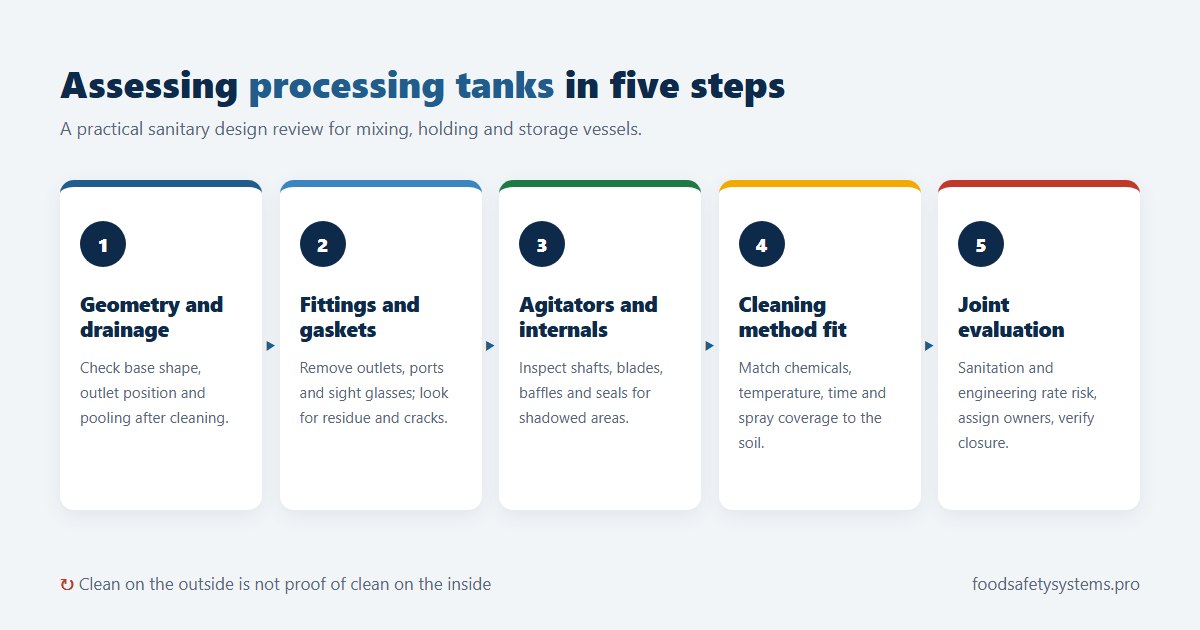
Five steps for a sanitary tank design assessment
1. Review geometry and drainability
Look at the shape of the vessel base, the outlet position and any flat sections. Then check whether rinse water drains completely after cleaning. Pooled liquid is a common sign of a design or installation issue.
2. Inspect fittings, ports and gaskets
Remove and examine outlet valves, probe fittings, manways and sight glasses. Look for residue, damaged gaskets, crevices and threaded connections in product zones.
3. Check agitators and internal parts
Examine agitator shafts, blades, baffles and seals. These parts create shadows that spray devices may not reach. In addition, shaft seals can leak lubricant or trap product.
4. Confirm the cleaning method suits the product
Compare the cleaning procedure with the product’s soil type. Sticky, high-fat or high-sugar products, for example, may need different chemicals, temperatures or contact times. Also check spray device coverage where CIP is used.
5. Evaluate findings with sanitation and engineering
Review results together. Assess severity and likelihood in the actual facility context, then assign responsible personnel and deadlines. Finally, verify completed actions and retain objective evidence that the problem has been addressed.
Common problems found in tanks
- Outlets set slightly above the lowest point, so liquid pools after draining.
- Dead legs in pipework that cleaning flow does not reach.
- Cracked or hardened gaskets on manways and fittings.
- Spray balls that are blocked, damaged or the wrong type for the vessel.
- Agitator seals leaking or holding residue.
- No safe way to inspect inside the tank after cleaning.
Records and evidence to keep
A clear evidence trail makes a sanitary tank design assessment useful long after the review. Keep:
- A tank inventory with product use, cleaning method and critical components.
- Assessment findings with photos, locations and risk ratings.
- Cleaning procedures, CIP parameters and verification results.
- Gasket and seal replacement records.
- Corrective actions with owners, deadlines and closure evidence.
- Records of design changes reviewed through change control.
Our hygiene and sanitation programs page explains how these records fit into the wider sanitation program.
Example scenario: a sauce holding tank
In this illustrative example, a sauce plant sees occasional high ATP readings at the outlet valve of a holding tank. The CIP cycle runs to specification, so the team assumes the readings are sampling errors.
A sanitary tank design assessment shows the outlet sits slightly above the lowest point of the vessel base. As a result, a small pool of rinse water and product remains after every cycle. The team also finds a hardened gasket on the manway.
Engineering corrects the outlet position and the gasket is replaced and added to a planned schedule. Follow-up verification over several weeks confirms the readings have returned to acceptable levels. The corrective action is then closed with evidence.
Sanitary tank design checklist
- Confirm each tank drains fully after cleaning.
- Inspect welds, seams and internal surfaces for crevices.
- Remove and check outlets, ports, sight glasses and gaskets.
- Check agitators, baffles and shaft seals.
- Match chemicals, temperature and contact time to the product soil.
- Verify spray device coverage where CIP is used.
- Record findings, owners and deadlines in an action register.
- Verify closure with objective evidence.
Frequently asked questions
How often should a sanitary tank design assessment be done?
Assess tanks when they are installed or modified, when sanitation failures recur, or when products or cleaning methods change. Periodic reviews can also be built into internal audits.
Can good cleaning make up for poor tank design?
Sometimes, but often at higher cost in time, chemicals and water. Where residue keeps returning, a design or installation fix is usually more reliable.
Does SQF certification approve tank designs?
No. SQF certification assesses the site’s food safety system. It does not approve specific equipment designs.
For the broader equipment picture, see our SQF equipment hygiene article.
How Consultare Inc. Group can help
Consultare Inc. Group can help SQF teams document equipment review findings, identify sanitation program gaps and prioritize improvement actions. Exact deliverables depend on the approved scope. Facility management retains responsibility for approving and implementing changes, and we do not promise certification, regulatory approval or a particular audit outcome.
- SQF gap assessments and internal audits: equipment and sanitation program review.
- Corrective action support: root cause analysis for repeat tank findings.
- FDA compliance integration: align your SQF system with cGMP expectations.
- Audit readiness coaching: organize equipment evidence before the audit.
Need help managing your SQF responsibilities?
Discuss your products, documentation and compliance priorities with the Consultare team in a free consultation, or contact our team.
Start building your compliance system
Prefer to organize your compliance activities yourself? Create a free SystemsBuilder account to manage specifications, controlled documents, assigned actions and records in one structured workflow. Software supports record management; it does not by itself ensure compliance.
Technical sources: 21 CFR 117.40, 21 CFR 117.35 and SQFI. Independent educational content: Consultare Inc. Group is not affiliated with or endorsed by SQFI, FDA, EHEDG or 3-A. This article is not legal advice, regulatory approval, certification or a guarantee of compliance; requirements depend on the facility, food, jurisdiction and applicable program, so confirm current requirements and obtain qualified technical review before implementation.