
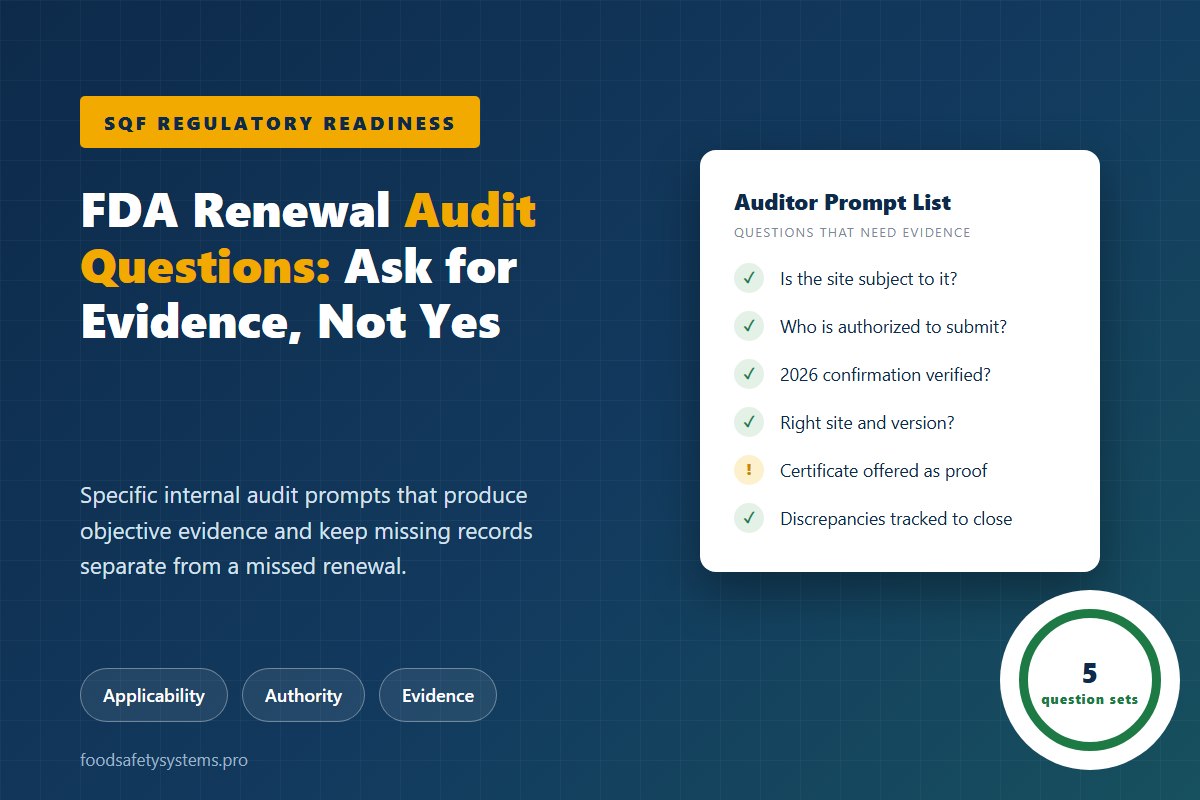
Good FDA renewal audit questions are specific enough to produce objective evidence, because a broad prompt such as “Are FDA requirements met?” is too vague to verify on its own. Internal auditors in SQF facilities get better results by breaking the topic into small, answerable questions. Each answer should point to a record, a person or a decision that the auditor can check.
Quick answer: ask whether the facility is subject to registration, who is authorized to submit the renewal, whether the 2026 confirmation was verified and how discrepancies are tracked. Record the evidence you see. Do not assume a current SQF certificate satisfies FDA registration, and keep missing evidence separate from a confirmed failure to renew.
Who this guidance is for
Internal auditors, SQF practitioners and quality managers who plan or carry out internal audits that cover regulatory obligations, including the 2026 FDA food facility registration renewal.
Why broad audit questions fall short
A broad question invites a broad answer. When an auditor asks “Are FDA requirements met?”, the auditee usually says “yes”, and the conversation ends. Nothing has been verified.
Specific questions work differently. They ask for a named person, a document or a date. As a result, the auditor can compare the answer with objective evidence and record exactly what was seen. This approach also fits the way an internal audit program should work: plan, verify, record and follow up.
A bank of FDA renewal audit questions
Use the questions below as a starting point. Adapt them to your facility, and add the evidence you expect to see next to each one.
Applicability
- Has the site documented whether it is subject to FDA food facility registration?
- Who made that assessment, and when was it last reviewed?
- If the site claims an exemption, where is the reasoning recorded?
Authority and responsibility
- Who is the named renewal owner?
- Who is authorized to submit the renewal, and is a backup named?
- How is that authority documented?
Verification of the 2026 renewal
- Was the 2026 renewal confirmation obtained and reviewed?
- Does the confirmation identify this facility and its registered address?
- Is it a renewal, rather than an earlier update?
Document version and site identity
- Is the record filed in the defined location and marked as current?
- Are older confirmations marked as superseded?
- Is the facility information consistent with the DUNS-linked details?
Escalation and corrective action
- How are discrepancies reported and to whom?
- Are open issues tracked with an owner and a due date?
- Was closure verified with evidence?
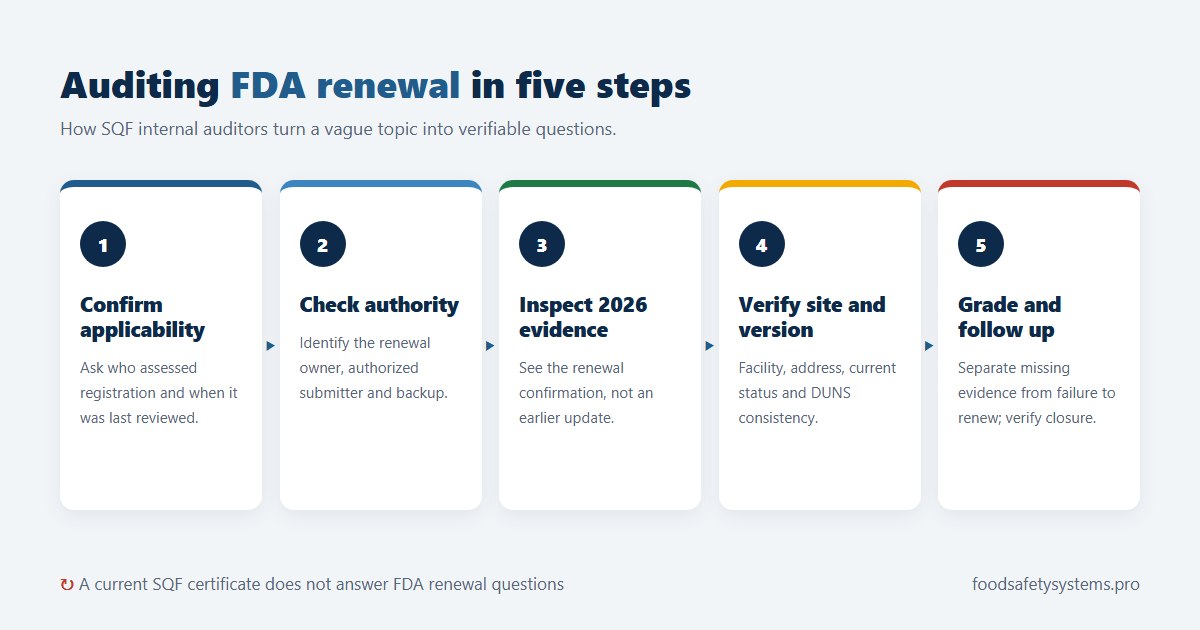
Separate missing evidence from a missed renewal
Findings should separate missing evidence from a confirmed failure to renew. These are different problems. A missing record may mean the renewal was completed but not filed. On the other hand, a confirmed failure to renew is a regulatory issue that needs prompt escalation.
Therefore, write each finding so it states what was verified. For example: “The 2026 renewal confirmation was not available at the time of audit; renewal status not yet confirmed.” That wording is accurate and actionable. It avoids declaring a legal failure the auditor has not confirmed. Our post on preparing FDA registration monitoring records for SQF audits shows how sites can prepare the evidence before the audit.
Do not let the SQF certificate answer the question
Auditors should avoid assuming that a current SQF certificate satisfies FDA registration. SQF certification shows conformity with a certification program. FDA registration is a separate legal obligation for covered facilities. Consequently, the certificate cannot be accepted as evidence for any of the questions above.
2026 FDA regulatory context
Section 415 of the Federal Food, Drug, and Cosmetic Act (21 U.S.C. 350d) requires facilities subject to registration to renew during October 1 through December 31 of each even-numbered year, as set out in 21 CFR Part 1, Subpart H. The 2026 deadline is December 31.
A prior registration update does not count as the biennial renewal. FDA currently recognizes DUNS as an acceptable Unique Facility Identifier and does not charge a renewal fee. Applicability and exemptions require facility-specific assessment.
Who does what during the audit
- Internal auditor: asks the questions, inspects the evidence and writes precise findings.
- Renewal owner: answers on applicability, status and responsibilities.
- Document controller: shows where records are kept and how versions are marked.
- Management: receives findings and makes sure corrective actions are resourced.
Common audit mistakes
- Accepting a verbal “yes, it’s done” without seeing the confirmation.
- Accepting an update confirmation as proof of renewal.
- Writing “FDA noncompliance” when only the record was missing.
- Closing a finding without checking the evidence of correction.
Example workflow: one audit trail
An internal auditor at a beverage plant audits regulatory obligations in mid-November. She asks the renewal owner who is authorized to submit, and he names the plant manager and a backup. Next, she asks to see the 2026 confirmation. The folder contains only a 2026 update confirmation from June.
She records the finding as missing renewal evidence, with status unconfirmed. The renewal owner then checks the FDA account and confirms the renewal has not been submitted. The finding is escalated and the authorized submitter completes the renewal within the window. Finally, the auditor verifies the new confirmation, checks the facility details and closes the finding through the CAPA process.
Practical readiness checklist
- Confirm facility applicability and responsibility.
- Inspect the relevant renewal evidence.
- Check document version and site identity.
- Write findings that separate missing evidence from failure to renew.
- Verify issue escalation and corrective action closure.
Frequently asked questions
Can an internal auditor confirm that a facility is legally compliant?
An internal auditor records the evidence seen and reports gaps. Questions of legal applicability should go to the renewal owner and, where needed, qualified regulatory advice.
How should a missing renewal record be written up?
State what was not available and that renewal status is unconfirmed. Then escalate so the owner can establish whether the renewal was actually submitted.
Does a current SQF certificate answer FDA renewal audit questions?
No. SQF certification is separate from FDA registration, so the certificate is not evidence of the 2026 renewal.
How Consultare Inc. Group can help
Consultare Inc. Group supports food businesses with internal auditing and compliance records, tailored to the agreed engagement scope.
- SQF gap assessments and internal audits: SQF internal auditing.
- SQF audit readiness coaching: audit checklists and auditor coaching.
- FDA compliance integration: compliance record review.
- Corrective action support: CAPA verification.
Need help managing your SQF responsibilities?
Discuss your products, documentation and compliance priorities with the Consultare team in a free consultation, or contact our team.
Start building your compliance system
Prefer to organize your compliance activities yourself? Create a free SystemsBuilder account to manage specifications, controlled documents, assigned actions and records in one structured workflow. Software supports record management; it does not by itself ensure compliance.
Official references: FDA biennial registration renewal user guide, FDA renewal reminder, FDA online registration of food facilities, 21 U.S.C. 350d and 21 CFR Part 1, Subpart H. Independent educational content: Consultare Inc. Group is not affiliated with or endorsed by FDA or SQFI and does not act on behalf of FDA. This article does not constitute legal advice or an official statement of FDA policy, and we do not promise certification, regulatory approval or an audit outcome. Requirements may change and their applicability depends on each facility’s operations; verify current requirements through official FDA sources.