
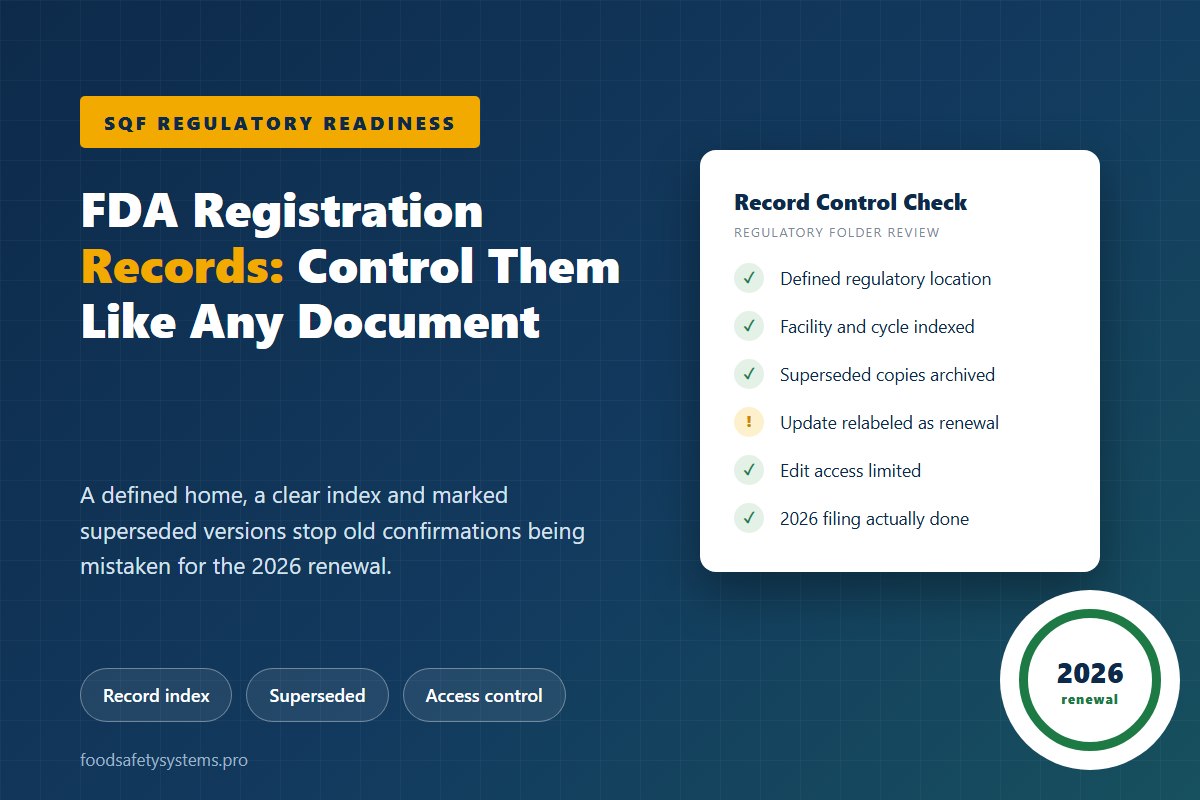
FDA registration records need the same discipline as any other controlled document: a defined home, a clear index and a way to stop older confirmations from being mistaken for proof of the latest renewal. An SQF documentation system already has these tools. Applied to registration evidence, they help personnel find the current record quickly and trust what they find.
Quick answer: keep the current FDA renewal confirmation in a defined regulatory folder, identify the physical site and review date, mark superseded confirmations and retain historical versions according to internal policy. File SQF certification evidence separately. Remember that document control supports traceability, but it cannot replace actually completing the 2026 FDA filing.
Who this guidance is for
Document controllers, SQF practitioners, regulatory coordinators and IT or records staff who manage compliance files at food facilities that may be required to register with FDA.
Why FDA registration records need document control
Registration evidence builds up over time. A typical file may hold confirmations from earlier renewal cycles, update confirmations after address or contact changes and correspondence about the account. Without control, all of these look alike.
The risk is simple. Someone opens the folder, sees a confirmation and assumes the facility is current. If that record is from 2024, or reflects an update rather than a renewal, the assumption is wrong. A controlled approach makes the current record obvious and the older ones clearly historical.
Setting up a home for FDA registration records
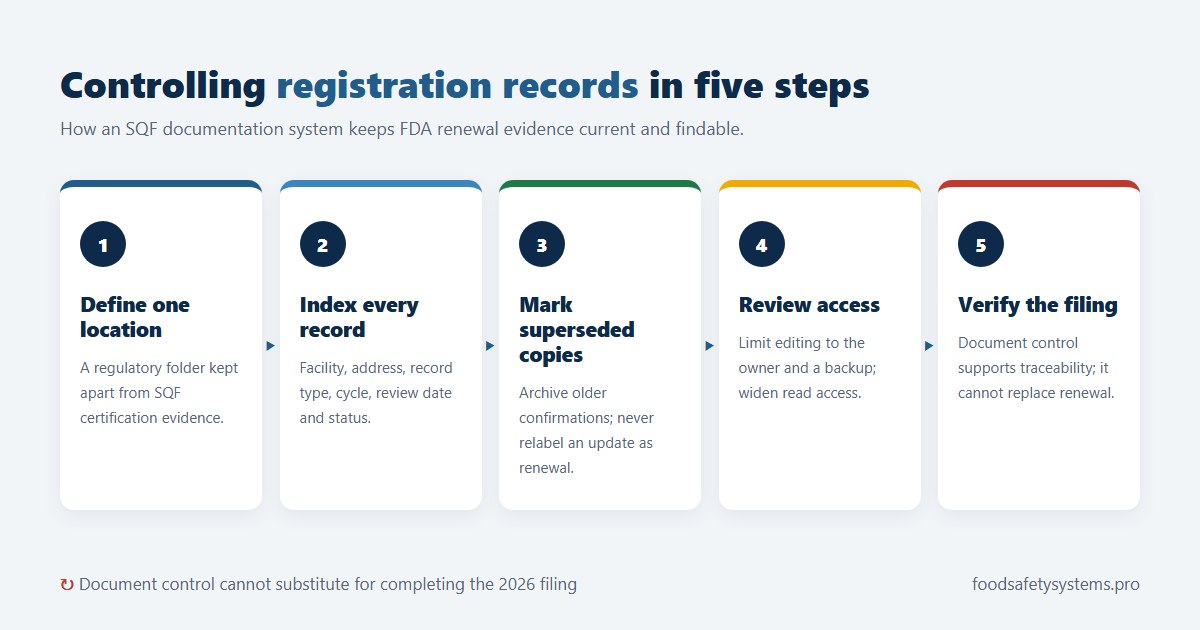
For applicable facilities, define one regulatory location for current renewal evidence. Keep it separate from SQF certification evidence, such as certificates and audit reports. The location can be a controlled folder in your document system or a record type in compliance software. What matters is that everyone knows where it is.
Your existing document control procedure can usually absorb this with a short addition. For example, add “FDA registration records” as a record category, name its owner and set the review frequency.
Building a useful record index
An index lets people confirm status without opening every file. For each registration record, capture:
- The facility name and physical address.
- The record type: renewal, update or other correspondence.
- The renewal cycle it relates to, such as 2026.
- The date it was filed and the date it was last reviewed.
- The status: current or superseded.
- The person who reviewed it.
With this index, an internal auditor can answer “Is the 2026 renewal on file?” in seconds.
Managing superseded confirmations
Older confirmations still have value as history, so do not simply delete them. Instead, mark them as superseded and move them to an archive area. Retain them according to your record retention requirements and internal policy.
In addition, never relabel an update confirmation as a renewal. If the facility updated its registration earlier in 2026, file that record as an update. The 2026 renewal confirmation then goes in as a separate, current record once it is completed.
Access permissions and record completeness
Registration records can include account information and contact details. Therefore, review who can view, edit and delete them. Limit editing to the record owner and a backup. Read access can be wider, so internal auditors and managers can verify status.
Completeness matters just as much. Check that each record shows the facility, the cycle and the review date. A confirmation with no site identity is weak evidence at a multi-site business.
FDA registration renewal requirements for 2026
Under 21 U.S.C. 350d and 21 CFR Part 1, Subpart H, food facilities required to register with FDA must renew their registration during October 1 through December 31 of each even-numbered year. The 2026 deadline is December 31.
Earlier registration updates do not replace renewal; updates are a separate obligation when required information changes, generally within 60 days under 21 CFR 1.234. FDA currently recognizes DUNS as an acceptable Unique Facility Identifier, and no FDA renewal fee is charged. Applicability and exemptions must be assessed for each facility.
Common mistakes
- Storing confirmations in personal email inboxes instead of the controlled location.
- Keeping several unlabeled confirmations side by side.
- Treating a well-organized file as proof that the 2026 filing was made.
- Leaving the index unchanged after a renewal or update.
- Giving broad edit access to sensitive registration records.
Example workflow: one renewal, filed correctly
A snack manufacturer completes its 2026 renewal in early November. The authorized submitter saves the confirmation to the regulatory folder and notifies the document controller.
The document controller adds an index entry for the facility, the 2026 cycle and the filing date. Then she marks the 2024 renewal confirmation and a spring 2026 update confirmation as superseded and moves them to the archive. Next, the reviewer checks the facility name and address against the record and signs off. During the next internal audit, the auditor finds the current record in under a minute. If the site later changes its name or address, it follows its SQF regulatory change control process to decide whether an update is needed.
Practical readiness checklist
- Define a location for current FDA renewal evidence.
- Identify the facility and renewal cycle in the record index.
- Mark superseded confirmations appropriately.
- Keep update and renewal confirmations clearly distinct.
- Review access permissions and record completeness.
- Confirm that the 2026 filing itself was completed, not just filed away.
Frequently asked questions
Should we delete older FDA registration confirmations?
Generally no. Mark them as superseded, archive them and retain them according to your internal record retention policy.
Can our SQF document system prove the 2026 renewal was done?
Only if the current renewal confirmation is actually in it. Document control supports traceability, but it cannot substitute for completing the 2026 FDA filing.
Where should FDA registration records sit in an SQF system?
In a defined regulatory category, separate from SQF certification evidence such as certificates and audit reports.
How Consultare Inc. Group can help
Consultare Inc. Group supports food businesses with documentation systems and compliance records, tailored to the agreed engagement scope.
- Document control services: SQF documentation systems and record indexes.
- SQF gap assessments and internal audits: internal audit support.
- FDA compliance integration: compliance record review.
- Corrective action support: corrective action tracking and closure.
Need help managing your SQF responsibilities?
Discuss your products, documentation and compliance priorities with the Consultare team in a free consultation, or contact our team.
Start building your compliance system
Prefer to organize your compliance activities yourself? Create a free SystemsBuilder account to manage specifications, controlled documents, assigned actions and records in one structured workflow. Software supports record management; it does not by itself ensure compliance.
Official references: FDA biennial registration renewal user guide, FDA renewal reminder, FDA online registration of food facilities, 21 U.S.C. 350d and 21 CFR Part 1, Subpart H. Independent educational content: Consultare Inc. Group is not affiliated with or endorsed by FDA or SQFI and does not act on behalf of FDA. This article does not constitute legal advice or an official statement of FDA policy, and we do not promise certification, regulatory approval or an audit outcome. Requirements may change and their applicability depends on each facility’s operations; verify current requirements through official FDA sources.