
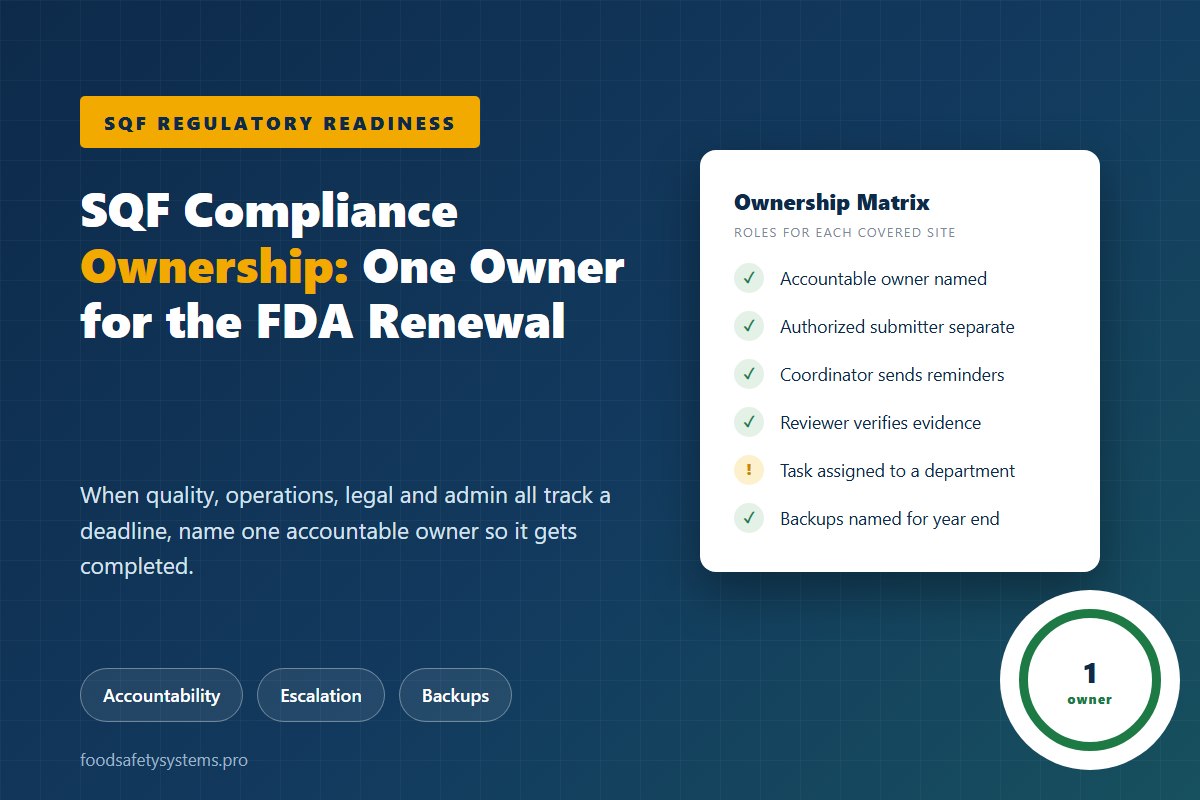
SQF compliance ownership matters most when several departments touch the same deadline: quality, operations, legal and administration may all support regulatory compliance, yet without one clear owner a task can be tracked by many teams and completed by none. The 2026 FDA food facility registration renewal is a good example. Everyone knows it is coming, but each team may assume another is handling it.
Quick answer: name one accountable owner for the renewal at each covered site. Then separate the person authorized to submit, the coordinator who sends reminders and the reviewer who verifies evidence. SQF management controls can support these roles, but they do not change who has FDA submission authority. Covered facilities must complete the 2026 biennial renewal by December 31.
Who this guidance is for
Site leaders, SQF practitioners, quality and operations managers, legal and administrative staff, and anyone who shares responsibility for regulatory deadlines at a food facility.
Why shared tasks slip between departments
Cross-functional work has a familiar weakness. Each department sees part of the task. Quality tracks the date because it maintains the compliance register. Administration may hold the FDA account login. Legal may review regulatory submissions. Operations knows when facility details change.
Because each team contributes, each can reasonably believe the task is covered. Reminders go out, status updates circulate and the deadline appears on several calendars. However, nobody has been asked to finish it. Strong SQF compliance ownership fixes this by making one person accountable for the outcome, not just for a piece of the process.
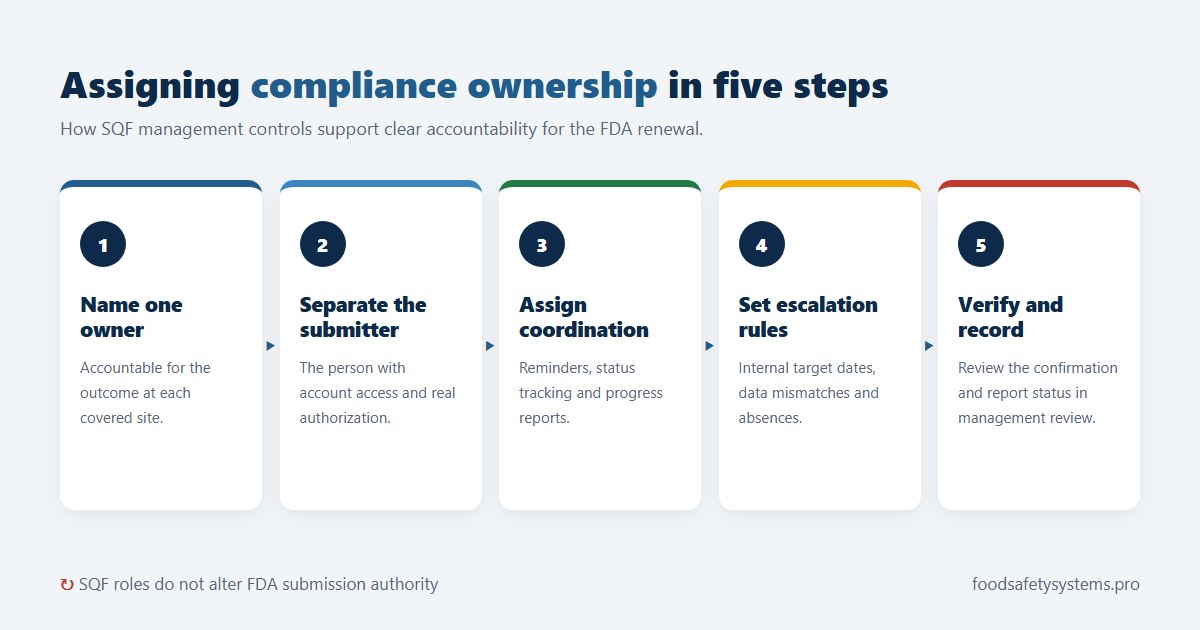
Building SQF compliance ownership with a responsibility matrix
A responsibility matrix can distinguish the person authorized to renew a registration from the coordinator who sends reminders and the reviewer who verifies evidence. For the 2026 renewal, a simple matrix might look like this:
- Accountable owner: answers for the outcome; usually a site leader or senior quality manager.
- Authorized submitter: holds account access and the authority to submit the renewal.
- Coordinator: sends reminders, tracks status and reports progress.
- Evidence reviewer: checks the confirmation, facility identity and filing.
- Consulted departments: legal, administration or operations, as needed.
Name a backup for the owner and the submitter. Staff absences late in the year are a common reason deadlines slip. Our post on assigning FDA renewal responsibilities gives more detail on each role.
Keep SQF roles and FDA authority distinct
SQF management controls are useful here. Job descriptions, organizational charts and management reviews all reinforce who does what. Our guide to defining organizational structure with clear roles and responsibilities shows how to document them.
However, an SQF role description does not create FDA submission authority. Under 21 CFR 1.230, when an individual other than the owner, operator or agent in charge submits the renewal, the submission must identify the individual who authorized it. Therefore, the matrix should reflect actual authorization, not just job titles.
Set escalation rules before they are needed
Ownership also means knowing when to raise a concern. Agree in advance what triggers escalation. For example, escalate if the renewal is not submitted by an internal target date, if facility details do not match the DUNS-linked record, or if the submitter is unavailable.
Escalation should go to the accountable owner first and then to senior management. Reporting renewal status in your management reviews keeps leadership informed without adding a separate process.
FDA registration renewal requirements for 2026
Section 415 of the Federal Food, Drug, and Cosmetic Act (21 U.S.C. 350d) and 21 CFR Part 1, Subpart H require food facilities subject to registration to renew between October 1 and December 31 of every even-numbered year. The 2026 deadline is December 31.
An earlier update does not replace renewal. FDA currently recognizes DUNS as an acceptable Unique Facility Identifier and does not charge a renewal fee. Applicability and exemptions depend on the individual facility.
Records that show ownership works
- The approved responsibility matrix, with names and backups.
- Evidence of authorization for the submitter.
- Reminder and status records from the coordinator.
- The 2026 renewal confirmation and the reviewer’s sign-off.
- Management review minutes that note the renewal status.
Common ownership mistakes
- Assigning the task to a department rather than a named person.
- Making the coordinator responsible for the outcome without giving them authority.
- Listing a submitter who has left the company or lost account access.
- Assuming the SQF practitioner can submit because they manage compliance.
- Having no backup for the owner or submitter during year-end holidays.
Example workflow: from shared task to clear owner
A frozen food company runs two departments that both track regulatory dates. In October, quality and administration each send reminders about the FDA renewal. By mid-November, neither has submitted it.
The site leader steps in and approves a one-page matrix. She becomes the accountable owner. The office manager, who holds account access and authorization, is named submitter. The quality coordinator keeps reminders and status reporting, and the SQF practitioner reviews the evidence. The submitter completes the renewal the following week. Next, the reviewer verifies the facility details and files the confirmation. Finally, the matrix is added to the controlled document system and reviewed at the next management review.
Practical readiness checklist
- Assign a renewal owner for each covered site.
- Identify the authorized submitter separately.
- Set escalation and evidence review responsibilities.
- Name backups for the owner and submitter.
- Confirm completion by December 31, 2026 and retain the record.
Frequently asked questions
Who should own the FDA renewal in an SQF facility?
One named person, usually a site leader or senior quality manager, should be accountable for the outcome. Other people can support the task, but ownership should not be shared.
Does our SQF organizational chart give staff authority to submit?
No. SQF management controls support accountability, but they do not alter FDA submission authority. Authorization must reflect the owner, operator or agent in charge.
What if two departments both think they own the task?
Resolve it in writing. Approve a responsibility matrix that names one accountable owner and clarifies the supporting roles.
How Consultare Inc. Group can help
Consultare Inc. Group supports food businesses with management systems and compliance coordination, tailored to the agreed engagement scope.
- SQF post-certification compliance management: SQF management system and management review support.
- FDA compliance integration: compliance role mapping.
- SQF gap assessments and internal audits: internal audit readiness.
- SQF audit readiness coaching: coaching for owners and coordinators.
Need help managing your SQF responsibilities?
Discuss your products, documentation and compliance priorities with the Consultare team in a free consultation, or contact our team.
Start building your compliance system
Prefer to organize your compliance activities yourself? Create a free SystemsBuilder account to manage specifications, controlled documents, assigned actions and records in one structured workflow. Software supports record management; it does not by itself ensure compliance.
Official references: FDA biennial registration renewal user guide, FDA renewal reminder, FDA online registration of food facilities, 21 U.S.C. 350d and 21 CFR Part 1, Subpart H. Independent educational content: Consultare Inc. Group is not affiliated with or endorsed by FDA or SQFI and does not act on behalf of FDA. This article does not constitute legal advice or an official statement of FDA policy, and we do not promise certification, regulatory approval or an audit outcome. Requirements may change and their applicability depends on each facility’s operations; verify current requirements through official FDA sources.