
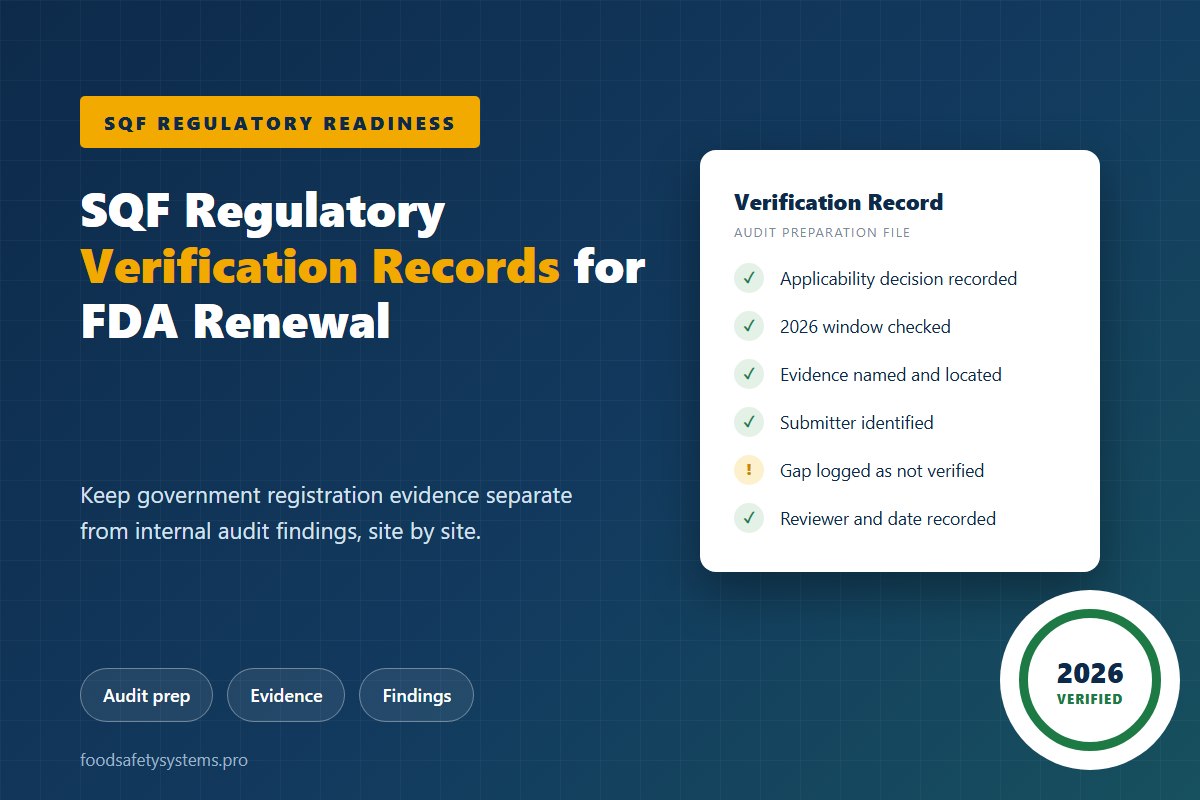
SQF regulatory verification records show, site by site, what government registration evidence was checked during audit preparation and what the reviewer actually found. An SQF audit preparation file often holds checklists, certificates, audit reports and legal compliance documents. Within that file, FDA renewal evidence should be clearly identified, linked to the right facility and kept apart from internal audit findings.
Quick answer: for each facility, record whether FDA registration applies, whether a 2026 renewal confirmation was seen, who the responsible submitter is and any open discrepancy. If a document is missing, write that the evidence was not verified. Do not assert that the registration has expired unless that has been confirmed. SQF certification does not replace the required FDA renewal.
Who this guidance is for
This guide is for SQF practitioners, internal auditors and quality managers who assemble audit preparation files, especially at companies with several facilities.
What SQF regulatory verification records are
A verification record is the reviewer’s written account of a check. It is different from the source document. The renewal confirmation is the source; the verification record says that someone looked at it, when, for which site and with what result.
Keeping these two apart makes audit preparation cleaner. Government registration evidence answers a legal question. Internal audit findings, by contrast, evaluate how well your own system works. Mixing them in one list tends to blur both. For the wider picture of audit evidence, see our guide to FDA registration monitoring and SQF audit evidence.
FDA registration renewal requirements for 2026
Under section 415 of the Federal Food, Drug, and Cosmetic Act (21 U.S.C. 350d) and 21 CFR Part 1, Subpart H, food facilities required to register must renew between October 1 and December 31 of every even-numbered year. The 2026 deadline is December 31.
An earlier update does not replace renewal. FDA currently accepts a DUNS number as the Unique Facility Identifier, and renewal carries no FDA fee. Registration is not FDA approval of a facility or its products. Applicability and exemptions require a facility-specific review.
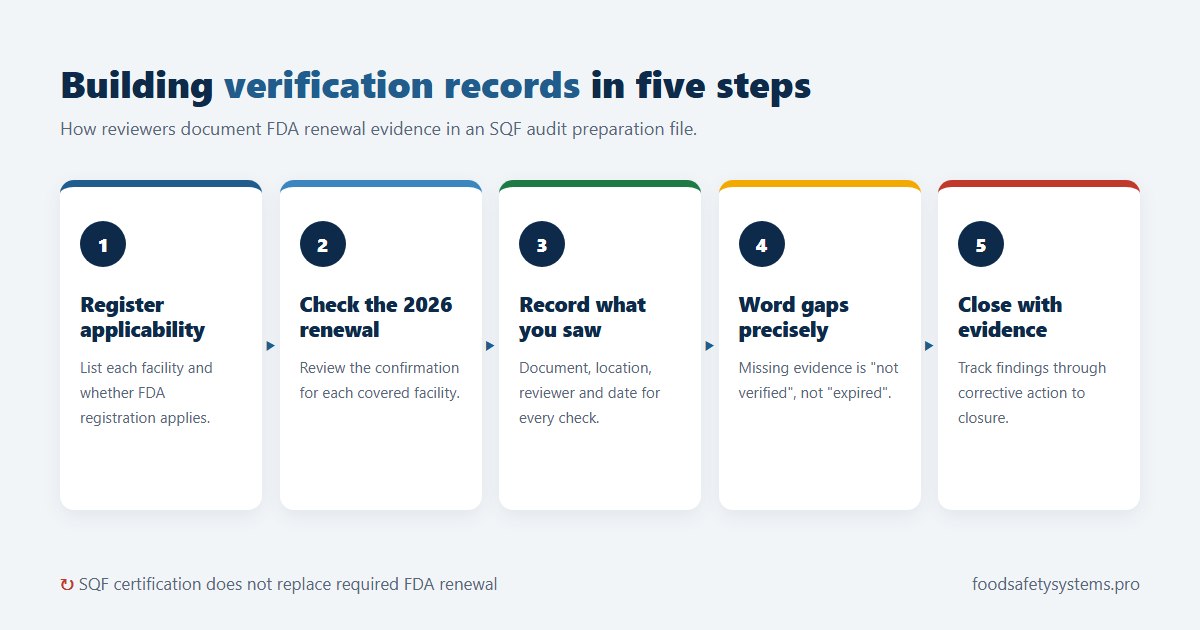
What each verification record should contain
- Facility identity: site name and address as registered.
- Applicability decision: whether registration applies, and the basis.
- Renewal period checked: the 2026 window, October 1 to December 31.
- Evidence seen: the document reviewed and where it is stored.
- Responsible submitter: the person with authority to file.
- Result: verified, not verified, or discrepancy found.
- Reviewer and date: who performed the check and when.
Separate documentary gaps from confirmed noncompliance
This is the most important discipline in the record. A missing confirmation in the file is a documentary gap. It means the reviewer could not verify the renewal. It does not, on its own, prove that the facility failed to renew.
Therefore, word findings precisely. “Renewal confirmation for Site B was not available for review during the November file check” is accurate. “Site B’s registration has expired” is a conclusion that needs separate confirmation. Overstated findings create confusion and can trigger the wrong response.
Once the gap is logged, the owner should locate the confirmation or establish the facts. If the facility did not renew, that becomes a confirmed issue with its own corrective action. Our article on running an SQF internal audit program covers how to grade and follow up findings.
Where the records should live
Give FDA registration evidence a fixed, predictable home. A dedicated regulatory section in the audit preparation file, with one row or folder per facility, works well. Each row should link to the controlled copy of the confirmation rather than to a personal inbox or a shared desktop.
In addition, cross-reference the internal audit report to that section instead of copying documents into it. As a result, the audit report stays focused on system performance, while the regulatory section stays focused on legal evidence. When the next renewal cycle starts, the same structure can simply be reused.
Who does what
- Reviewer or internal auditor: checks evidence and writes the verification record.
- Facility owner: supplies the confirmation or explains the gap.
- SQF practitioner: maintains the audit preparation file and its structure.
- Management: reviews open discrepancies and approves closure.
Common mistakes
- Filing FDA confirmations loose in a general certificates folder.
- Listing a missing document as an expired registration.
- Recording “verified” without naming the document checked.
- Treating the SQF certificate as evidence of FDA renewal.
- Closing a finding before the corrective action is confirmed.
Example workflow
Six weeks before its SQF recertification audit, a processor with two plants builds its preparation file. The internal auditor opens a regulatory verification tab with one row per facility. For Plant A, she reviews the 2026 renewal confirmation and records it as verified, with the file location.
For Plant B, no confirmation is on file. She records “not verified” and opens an action for the plant’s submitter. Two days later, the submitter provides the confirmation, which had been saved to a personal inbox. The auditor updates the row, notes the filing weakness and raises a small corrective action to fix where confirmations are stored.
SQF regulatory verification records checklist
- Maintain an applicability register by facility.
- Verify a 2026 confirmation wherever registration applies.
- Separate documentary gaps from confirmed noncompliance.
- Keep the records under your record retention rules.
- Track findings through corrective action closure.
Frequently asked questions
Should FDA registration evidence sit inside the internal audit report?
It is clearer to keep it in its own section or register and cross-reference it. That way, legal evidence and system findings stay distinct.
What if a site is not required to register?
Record the applicability decision and its basis. A documented “not applicable” is far stronger than a blank row.
Will an SQF auditor check FDA registration?
Audit scope depends on the certification body and the SQF Code. Regardless, FDA renewal is a separate legal obligation, so keep the evidence ready for your own review.
How Consultare Inc. Group can help
Consultare Inc. Group provides food safety and regulatory compliance coordination, tailored to the agreed engagement scope. We do not promise certification, regulatory approval or an audit outcome.
- SQF audit readiness coaching: organize your preparation file.
- Document control: keep regulatory evidence controlled and findable.
- Compliance reviews and internal audits: precise, evidence-based findings.
- Corrective action support: close findings with verified evidence.
Need help managing your SQF responsibilities?
Discuss your products, documentation and compliance priorities with the Consultare team in a free consultation, or contact our team.
Start building your compliance system
Prefer to organize your compliance activities yourself? Create a free SystemsBuilder account to manage specifications, controlled documents, assigned actions and records in one structured workflow. Software supports record management; it does not by itself ensure compliance.
Regulatory references: FDA 2026 Biennial Renewal User Guide, FDA 2026 renewal reminder, FDA Food Facility Registration, 21 U.S.C. 350d and 21 CFR Part 1, Subpart H. Independent educational content: Consultare Inc. Group is not affiliated with, endorsed by or authorized to act on behalf of the U.S. Food and Drug Administration (FDA) or the Safe Quality Food Institute (SQFI). This article is not legal advice or an official statement of FDA policy. Requirements may change, and applicability depends on each facility; verify current requirements with official FDA sources.