
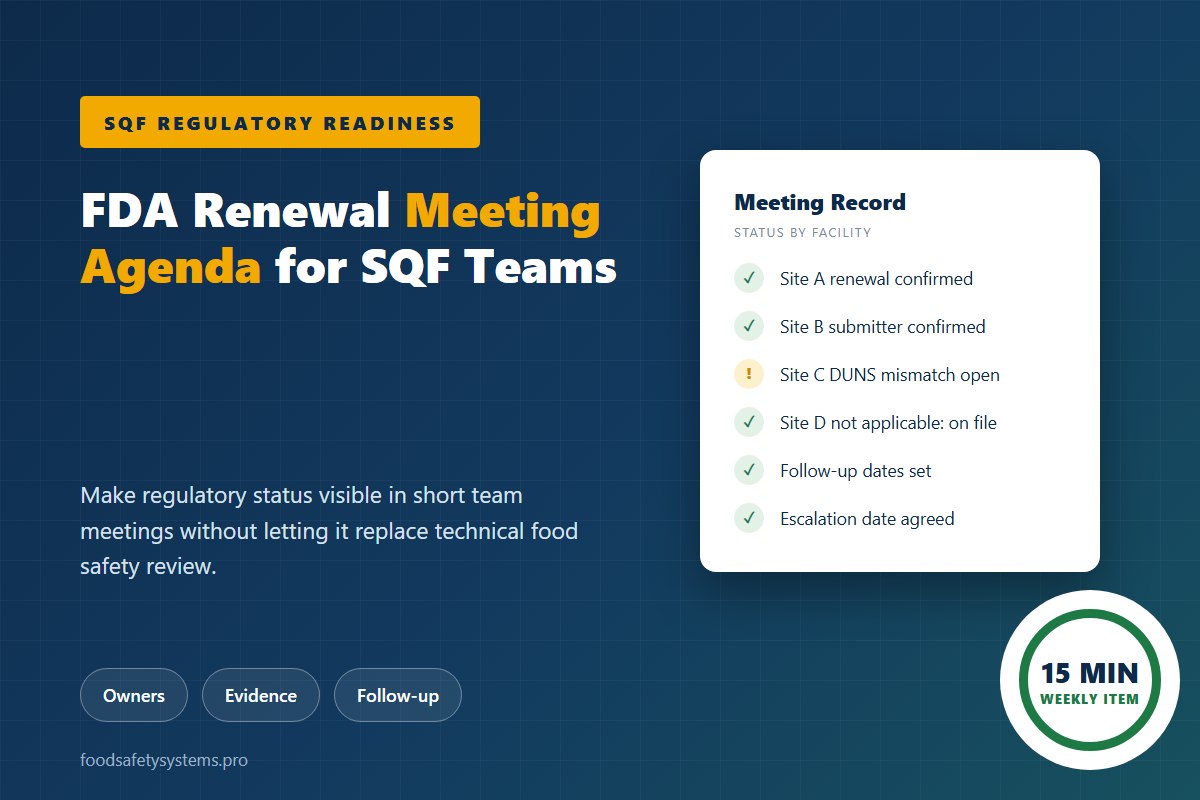
A short FDA renewal meeting agenda helps SQF teams surface blocked regulatory tasks and resolve them before the December 31, 2026 deadline. The goal of these meetings is to make factual status and ownership visible. Attendance alone proves nothing, so completion should never be inferred from the fact that a meeting took place.
Quick answer: hold brief, regular compliance meetings during the renewal window. Cover each covered site, its authorized submitter, open DUNS corrections, evidence received and escalation dates. Record decisions so that confirmed renewals are clearly separated from pending submissions and nonapplicable sites. SQF oversight coordinates the work, but the FDA renewal remains a separate legal filing.
Who this guidance is for
This guide is for SQF practitioners, plant managers and compliance coordinators who run regular team meetings, whether as stand-ups, compliance huddles or weekly operations reviews.
Why use team meetings for regulatory tasks
Most SQF sites already hold short, recurring meetings to review food safety issues. Adding FDA renewal status to that rhythm costs little. More importantly, it puts blocked tasks in front of people who can remove the block.
For example, a submitter may be waiting on account access, a corrected DUNS address or a manager’s sign-off. In a written tracker, that wait can last weeks. In a meeting, it gets an owner and a date within minutes.
However, a meeting is a coordination tool, not a verification step. The meeting record should reflect evidence that already exists, not opinions about progress. Formal reporting to senior management is a different activity, covered in our guide to FDA renewal status reporting for SQF management review.
The 2026 FDA renewal requirement
Section 415 of the Federal Food, Drug, and Cosmetic Act (21 U.S.C. 350d) and 21 CFR Part 1, Subpart H require covered facilities to renew their FDA Food Facility Registration between October 1 and December 31 of each even-numbered year. The deadline for 2026 is December 31.
A prior update does not replace the renewal. FDA currently accepts a DUNS number as the Unique Facility Identifier and does not charge a renewal fee. Registration is not FDA approval, and applicability and exemptions require a facility-specific assessment.
A practical FDA renewal meeting agenda
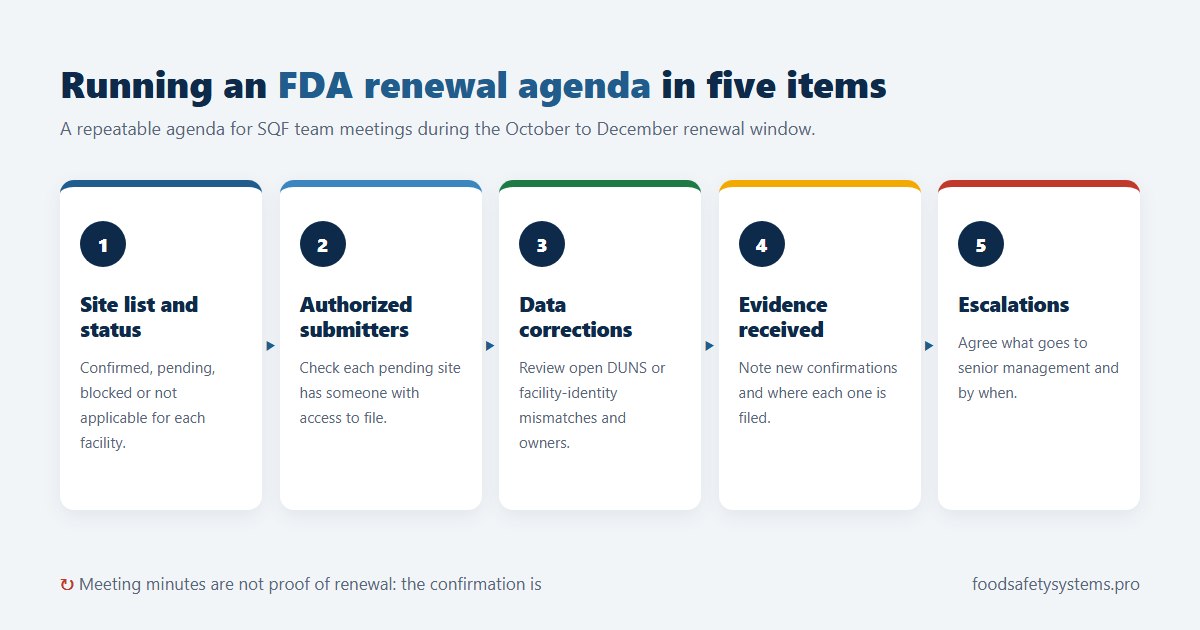
Keep the FDA renewal meeting agenda short and repeatable. Ten to fifteen minutes is usually enough when the tracker is prepared in advance. A workable structure looks like this:
- Site list and status. Read the status of each facility: confirmed, pending, blocked or not applicable.
- Authorized submitters. Confirm that each pending site has someone with access and authority to file.
- Data corrections. Review open DUNS or facility-identity mismatches and who is fixing them.
- Evidence received. Note which renewal confirmations arrived since the last meeting and where they are filed.
- Escalations. Agree which items go to senior management and by what date.
Who does what
- Meeting lead (often the SQF practitioner): prepares the tracker, runs the agenda and keeps the record.
- Facility owners: report status for their sites and bring evidence, not estimates.
- Authorized submitters: confirm access and file the renewal.
- Senior management: resolves escalated blocks, such as access approvals or resourcing.
Recording meeting outcomes
The meeting record matters more than the conversation. For each site, record the status, the evidence seen, the owner of any open action and the follow-up date. Use plain categories so that no one has to interpret them later.
In particular, keep three groups distinct: renewals confirmed by a filed confirmation, submissions still pending, and sites assessed as not applicable. A site should move to “confirmed” only when the confirmation is on file. Store the records under your record retention rules so the trail is available at audit.
Common mistakes
- Recording “on track” without saying what evidence supports it.
- Letting the meeting replace the tracker rather than review it.
- Leaving follow-up dates blank or setting them after December 31.
- Assuming a site is not applicable without a documented assessment.
- Using the meeting to discuss food safety hazards and losing the regulatory items, or the reverse.
Keep technical food safety review separate
Regulatory status should be visible, but it should not crowd out technical review. Hazard analysis, verification results and deviations still need their own time and their own records. If both topics share a meeting, give each a fixed slot. That way, an urgent renewal question does not displace a sanitation finding, and vice versa.
Example workflow
A food manufacturer adds a five-minute FDA renewal item to its weekly SQF team meeting from October onwards. In the first meeting, two of four sites are pending, one is blocked by a DUNS address mismatch and one was assessed as not applicable last cycle.
The team assigns the DUNS correction to the site’s office manager with a follow-up date in mid-November. Over the next few weeks, confirmations arrive and the coordinator files each one before changing its status. Any item still open at the escalation date goes to the plant manager, and from there into corrective action if a process gap caused the delay.
FDA renewal meeting checklist
- List facilities and their status before the meeting.
- Assign owners for every open issue.
- Set follow-up dates well before December 31.
- Record evidence-based completion decisions.
- Escalate blocked items on the agreed date.
Frequently asked questions
How often should the renewal item be on the agenda?
Weekly during the renewal window works for most sites. Facilities with many open issues may review it more often as the deadline approaches.
Can meeting minutes prove that a facility renewed?
No. Minutes show what the team discussed and decided. The proof of renewal is the confirmation for that specific facility.
Does SQF certification require these meetings?
FDA renewal is a legal obligation separate from SQF certification. The meetings are simply a practical way to use existing SQF routines to keep that obligation on track.
How Consultare Inc. Group can help
Consultare Inc. Group supports food businesses with practical food safety and regulatory coordination, tailored to the agreed engagement scope. We do not promise certification, regulatory approval or an audit outcome.
- Compliance huddle training: run short, structured team meetings.
- Post-certification compliance management: ongoing oversight of recurring obligations.
- Document tracking and control: keep confirmations and meeting records organized.
- Corrective action support: follow blocked items through to closure.
Need help managing your SQF responsibilities?
Discuss your products, documentation and compliance priorities with the Consultare team in a free consultation, or contact our team.
Start building your compliance system
Prefer to organize your compliance activities yourself? Create a free SystemsBuilder account to manage specifications, controlled documents, assigned actions and records in one structured workflow. Software supports record management; it does not by itself ensure compliance.
Regulatory references: FDA 2026 Biennial Renewal User Guide, FDA reminder on 2026 renewal, FDA Food Facility Registration, 21 U.S.C. 350d and 21 CFR Part 1, Subpart H. Independent educational content: Consultare Inc. Group is not affiliated with, endorsed by or authorized to act on behalf of the U.S. Food and Drug Administration (FDA) or the Safe Quality Food Institute (SQFI). This article is not legal advice or an official statement of FDA policy. Requirements may change, and applicability depends on each facility; verify current requirements with official FDA sources.