
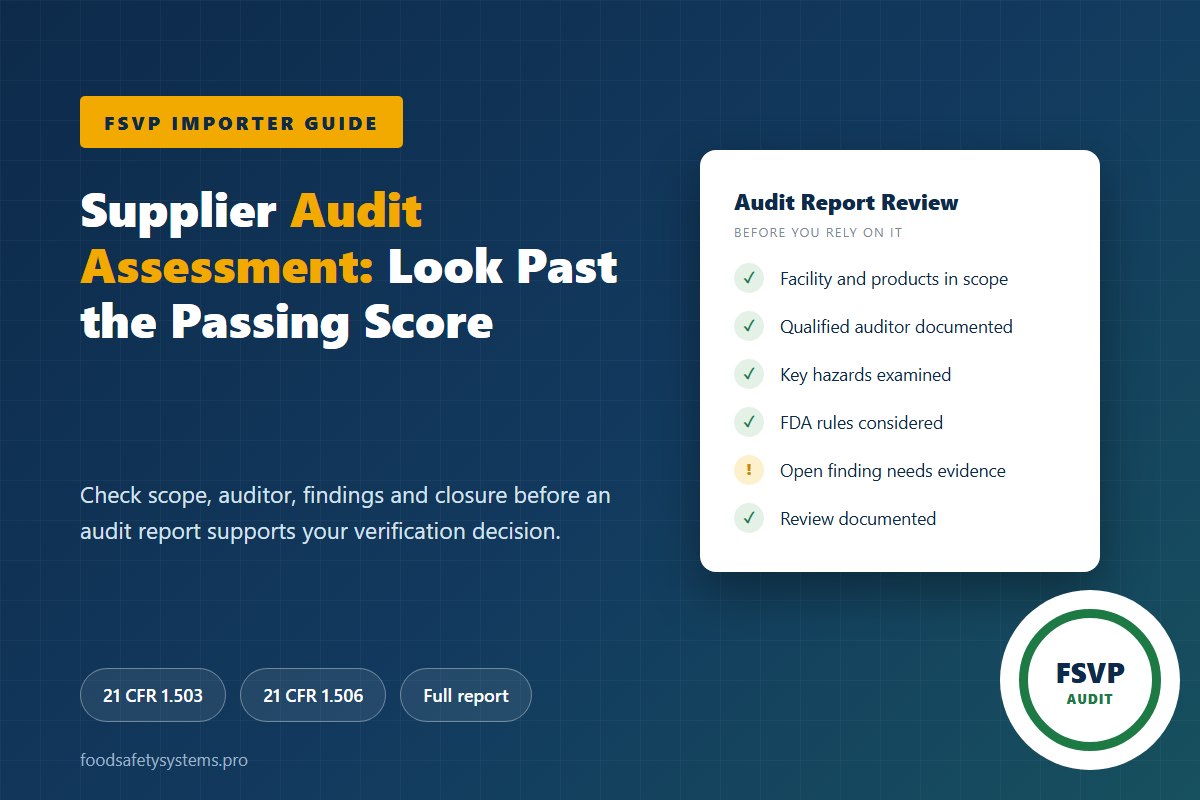
A supplier audit assessment asks what an audit actually showed about a supplier’s food safety controls, not just whether the supplier passed. A passing score does not tell you whether the relevant biological, chemical, allergen or physical hazards were examined. The value of an audit depends on its scope, the evidence reviewed, the observations, any significant findings and the supplier’s corrective action response.
Quick answer: under 21 CFR 1.506, an onsite audit is one possible FSVP verification activity. An audit used for FSVP must be performed by a qualified auditor. If the food is subject to FDA food safety regulations, the audit must consider those regulations and review the supplier’s written food safety plan, if any, and its implementation for the hazard being controlled.
Why a certificate is not an audit assessment
Teams that track only certification status may miss control weaknesses that matter for the products they import. A certificate confirms that a site was audited against a scheme on certain dates. However, it does not show whether your product was in scope, which hazards were examined or how findings were closed.
The importer decides which verification activities fit and how often, based on the food’s risk and the supplier’s performance under 1.505. An audit report is evidence for that decision. It does not replace it.
What FSVP expects from an onsite audit
Several requirements apply to audits used as FSVP verification:
- Qualified auditor. Under 21 CFR 1.503(b), the auditor must have technical expertise from education, training or experience necessary to perform the auditing function.
- Regulatory content. When FDA food safety regulations apply to the food, the audit must consider them and review the written food safety plan and its implementation for the hazard being controlled.
- Documentation. You must retain the audit procedures, audit dates, conclusions, corrective actions for significant deficiencies and documentation that a qualified auditor performed the audit.
- Independence. No financial conflicts of interest may influence results, and payment must not be related to the outcome.
Where the foreign supplier controls a hazard with a reasonable probability of serious adverse health consequences or death, an onsite audit is required before initial import and at least annually, unless an adequate written determination supports another approach. Not every imported food requires an annual audit; the right approach depends on the circumstances and any exemptions or modified provisions.
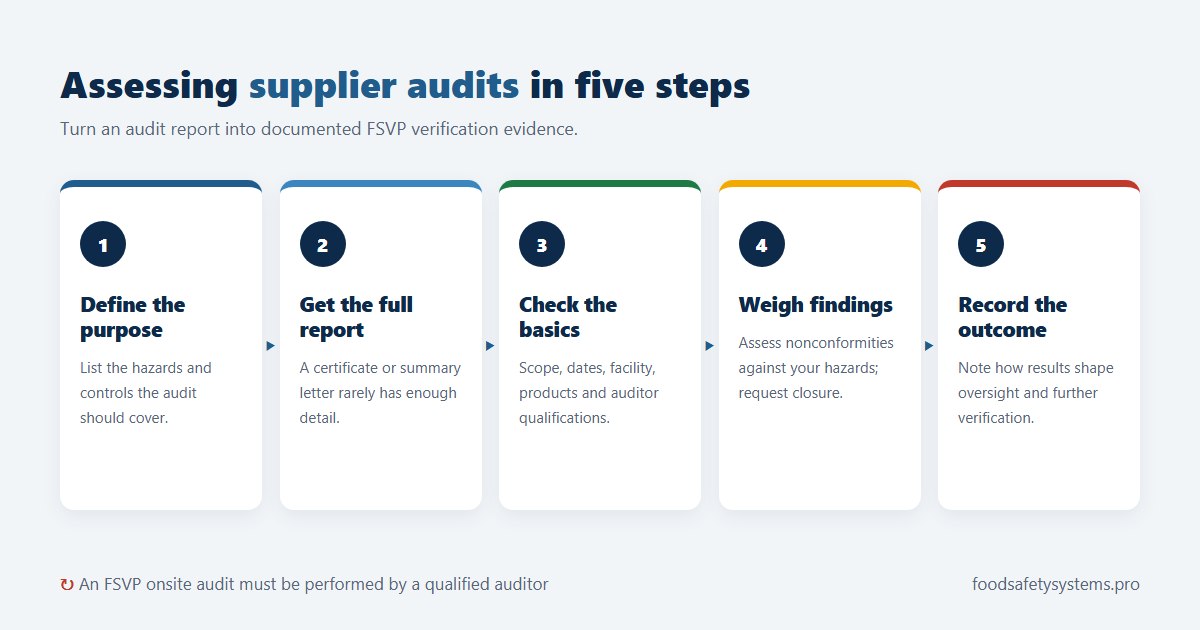
How to run a supplier audit assessment
Begin with the purpose of the audit and the hazards or controls that need assurance. Then review the report against that purpose.
- Review the hazard analysis and supplier evaluation. List the hazards and controls the audit should cover.
- Get the full audit report. A certificate or summary letter rarely contains enough detail.
- Check scope, date, facility and auditor. Confirm the report covers your product and site and that the auditor was qualified.
- Assess findings in context. Weigh nonconformities against the hazards in your food and request closure evidence.
- Document the conclusion. Record how the results inform supplier oversight and whether more verification is needed.
What good audit evidence looks like
A useful report names the facility address, the products and processes in scope, and the audit dates. It describes the evidence examined, not only a score. It also shows how significant deficiencies were corrected and verified. For example, a finding on allergen changeover in a shared line matters far more for an allergen-sensitive product than a minor housekeeping note.
Common gaps in supplier audit files
- Only a certificate is on file, with no report to assess findings.
- Audit scope, date, facility or auditor qualifications are unclear.
- Significant findings remain open without documented follow-up.
- The verification plan does not explain whether an onsite audit is needed.
- The audit did not consider the FDA regulations that apply to the food.
Example scenario: a high score with a key finding
Illustrative example. An importer of refrigerated ready-to-eat hummus receives a GFSI-benchmarked certificate with a high score. The supplier audit assessment requests the full report. It shows a minor nonconformity on environmental monitoring in the packing room, with a corrective action listed as “training planned”. Because Listeria monocytogenes is a hazard requiring a control for this food, the team asks for closure evidence and recent monitoring results. It documents its review and keeps the supplier under closer follow-up until the evidence arrives. Our audit corrective action article covers what good closure evidence looks like.
How SQF and GFSI audits fit in
FSVP is a U.S. importer obligation, and SQF certification does not satisfy it by itself. A supplier’s SQF or other GFSI audit report can be one input to supplier evaluation and verification. To use it as an FSVP onsite audit, however, you need to confirm that it meets the FSVP conditions above. On the SQF side, the same review strengthens your approved supplier program and raw material controls. See FSVP verification activities for how audits compare with testing and record review.
Supplier audit assessment checklist
- Confirm audit scope covers the facility and the products you import.
- Verify auditor qualifications and independence.
- Check whether the audit examined controls for the hazards requiring a control.
- Confirm consideration of applicable FDA food safety regulations.
- Assess material nonconformities and the supplier’s response.
- Document your supplier audit assessment and any additional verification.
- Track open findings to verified closure.
Frequently asked questions
Can a GFSI certification audit count as an FSVP onsite audit?
It can be used if it meets the FSVP conditions, including a qualified auditor, consideration of applicable FDA regulations and the required documentation. Assess each report rather than assuming it qualifies.
Do we need an annual audit for every foreign supplier?
No. The annual expectation applies to certain serious hazards controlled by the foreign supplier, unless an adequate written determination supports another approach.
What should we keep after reviewing an audit report?
Keep the audit documentation listed in 1.506(e)(1)(i)(D) and your documented review and assessment of the results.
How Consultare Inc. Group can help
Consultare Inc. Group provides audit-report assessments, food safety evidence review and documentation-gap analysis, tailored to the agreed engagement scope.
- Third-party audits: understand audit scope and findings.
- Supplier verification support: audit-based verification plans.
- Corrective action support: closure evidence that holds.
- COA and certification verification: certificate scope and validity.
Importers that need dedicated program support can also visit FSVP Services, our sister site.
Need help managing your SQF responsibilities?
Discuss your products, documentation and compliance priorities with the Consultare team in a free consultation, or contact our team.
Start building your compliance system
Prefer to organize your compliance activities yourself? Create a free SystemsBuilder account to manage specifications, controlled documents, assigned actions and records in one structured workflow. Software supports record management; it does not by itself ensure compliance.
Technical sources: 21 CFR 1.503, 21 CFR 1.505, 21 CFR 1.506 and FDA’s FSVP final rule page. Independent educational content, not legal advice, FDA approval or a compliance guarantee. Consultare Inc. Group is not affiliated with or endorsed by FDA or SQFI. FSVP obligations vary by food, importer and applicable exemptions or modified provisions; confirm current requirements and have specific conclusions reviewed by an appropriately qualified individual.