
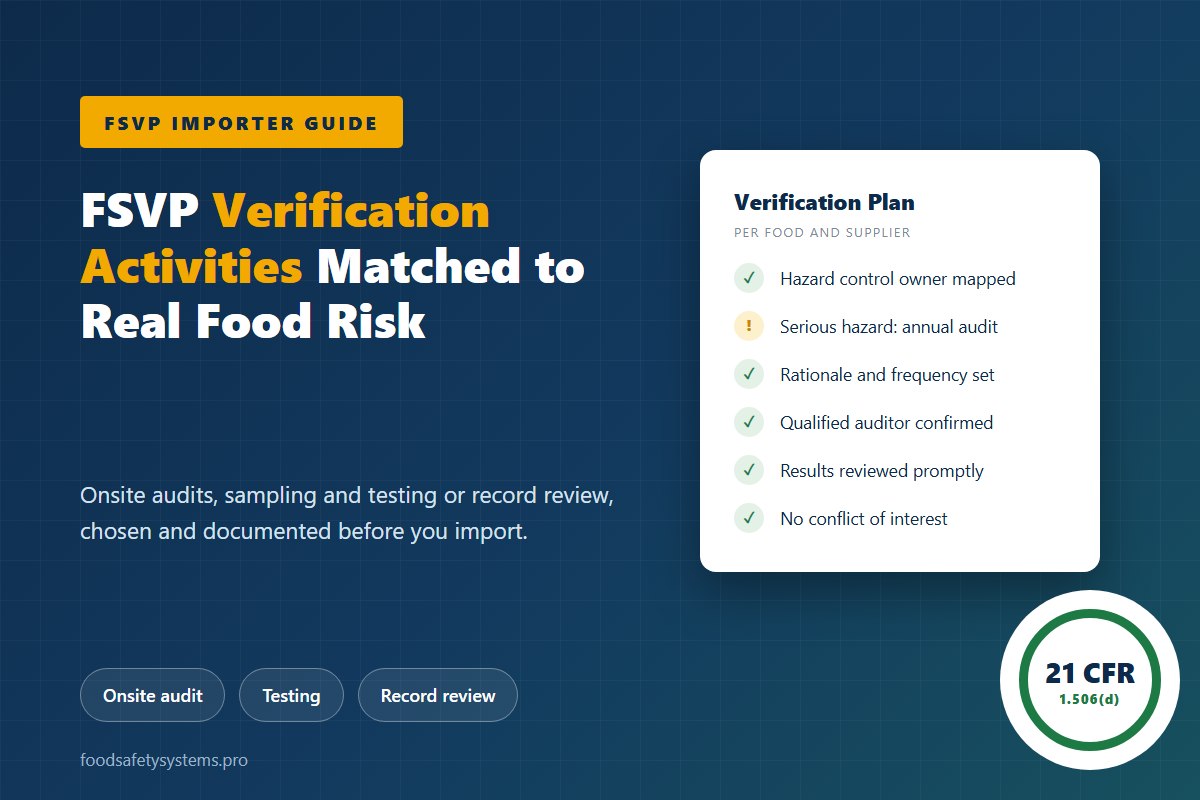
FSVP verification activities should match the hazards that actually need control, the entity that controls them and how well the supplier performs. A standard annual checklist applied to every supplier can miss real differences in food risk. Depending on the circumstances, onsite audits, sampling and testing, or record reviews give very different levels of assurance.
Quick answer: under 21 CFR 1.506, importers covered by the standard provisions must determine and document, before importing, which verification activities and frequency give adequate assurance that hazards requiring a control are significantly minimized or prevented. The choice must rest on the evaluation of the food and supplier under 1.505. The activities must then be performed or documented, and their results reviewed.
The four types of FSVP verification activities
Section 1.506(d)(1)(ii) lists the options:
- Onsite audits of the foreign supplier, performed by a qualified auditor.
- Sampling and testing of the food.
- Review of the foreign supplier’s relevant food safety records.
- Other appropriate activities based on supplier performance and the risk of the food.
Verification must address the entity that actually controls each hazard. For example, if the foreign supplier’s raw material supplier controls a hazard, the activities should reach that control, not only the final manufacturer.
When an annual onsite audit applies
Section 1.506(d)(2) covers certain serious hazards. When the foreign supplier controls a hazard with a reasonable probability that exposure will cause serious adverse health consequences or death, the importer must conduct, or obtain documentation of, an onsite audit before initially importing the food and at least annually thereafter. The exception is an adequate written determination that other verification activities, less frequent audits, or both give adequate assurance. That determination must be based on the 1.505 evaluation.
Certain inspection results may be substituted for an onsite audit if the inspection took place within 1 year of the date the audit would have been required. These include written results of an appropriate FDA, federal, state, local, tribal or territorial inspection, or of an inspection by the food safety authority of a country whose system FDA has officially recognized as comparable or determined to be equivalent, within the scope of that recognition.
How to select FSVP verification activities step by step
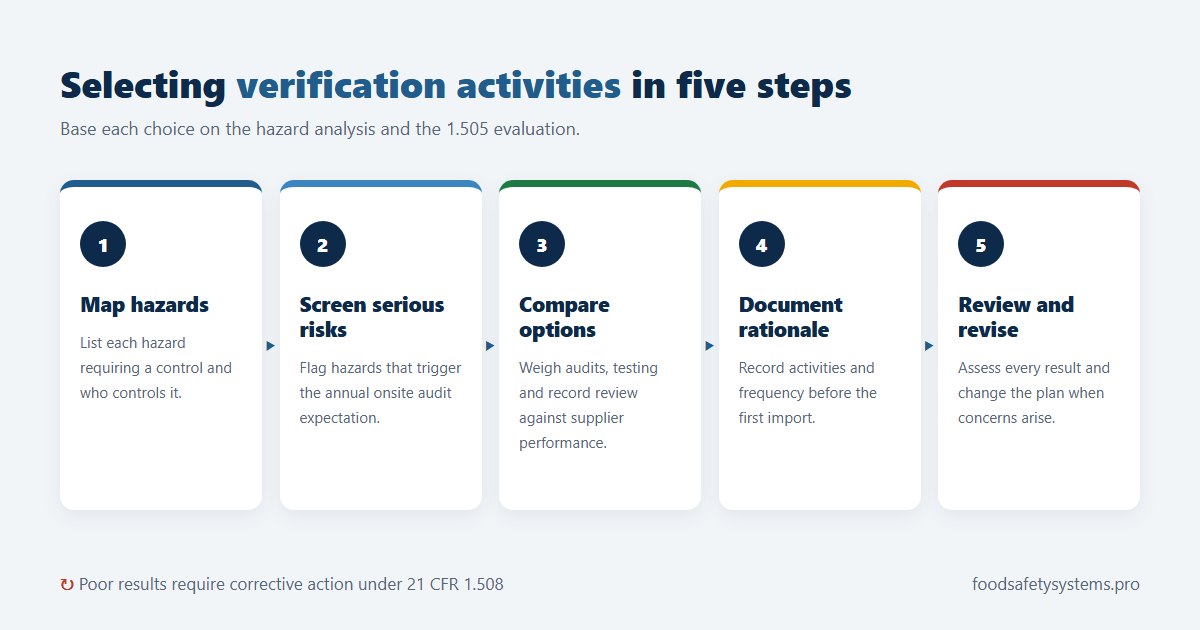
- Map hazards to responsible parties. List each hazard requiring a control and who controls it.
- Screen for serious hazards. Identify any hazard that triggers the annual onsite audit expectation.
- Compare suitable options. Weigh audits, testing and record review against the hazard and supplier performance.
- Document the rationale and frequency. Record the decision before the first import.
- Review results and revise. Assess every result promptly and change the plan when concerns arise.
What good verification records contain
Section 1.506(e)(1) lists the documentation for each activity. Audit records include procedures, dates, conclusions, corrective actions for significant deficiencies and proof the auditor was qualified. Testing records include the food and lot, number of samples, tests and methods, dates, results, corrective actions, the laboratory and proof a qualified individual conducted the testing. Record reviews include dates, the general nature of records reviewed, conclusions, corrective actions and proof a qualified individual did the review.
Two further rules shape credibility. First, under 1.506(e)(2)(ii), you may not rely on the foreign supplier or its employees to perform verification activities, except for sampling and testing. Second, under 1.506(e)(4), there must be no financial conflicts of interest that influence results, and payment must not depend on the outcome.
Common gaps in verification plans
- Supplier certificates are on file, but no actual verification activity is defined.
- Audit, test or record-review results are missing or were never assessed.
- Frequency is undocumented or no longer fits the risk.
- A serious hazard exists, but there is no annual audit and no written determination.
- The supplier’s own staff performed a record review counted as verification.
Example scenario: two suppliers, two plans
Illustrative example. An importer buys dried pasta from one supplier and ready-to-eat soft cheese from another. For the cheese, the supplier controls Listeria monocytogenes, a hazard that can cause serious adverse health consequences. The team therefore plans an onsite audit by a qualified auditor before the first import and annually after that. For the pasta, the team documents a rationale for periodic record review and certificate checks instead. Both rationales are written down before import, and both are reviewed when results arrive.
Linking verification to your SQF system
FSVP is a U.S. importer obligation, and SQF certification does not satisfy it by itself. Still, an SQF site’s raw material controls and supplier monitoring can be designed to produce FSVP-quality records. A supplier’s SQF or other GFSI audit report may support an onsite audit decision, but only if you confirm it meets the FSVP audit requirements, such as a qualified auditor and consideration of applicable FDA rules. Our supplier audit assessment article explains how to review those reports. For seafood, note that FSVP does not apply to fish and fishery products from foreign suppliers that are required to comply with, and are in compliance with, 21 CFR Part 123; see our seafood import verification guide.
FSVP verification activities checklist
- Base each plan on the hazard analysis and the 1.505 evaluation.
- Identify who controls each hazard requiring a control.
- Apply the annual onsite audit rule for serious supplier-controlled hazards, or document an adequate alternative.
- Record the chosen FSVP verification activities and frequency before import.
- Keep the documentation fields required for each activity type.
- Promptly review and document results, and act under 1.508 when assurance is inadequate.
- Check independence and conflicts of interest.
Frequently asked questions
Does every imported food need an annual onsite audit?
No. The annual audit expectation applies when the foreign supplier controls a hazard with a reasonable probability of serious adverse health consequences or death, unless an adequate written determination supports another approach.
Can the foreign supplier test its own product for us?
Yes, sampling and testing is the one activity the foreign supplier may perform. Other verification activities cannot rely on the supplier or its employees.
What happens if verification results are poor?
You must promptly review the results. If they do not give adequate assurance, take appropriate corrective action under 21 CFR 1.508.
How Consultare Inc. Group can help
Consultare Inc. Group supports risk-based verification planning, records assessments and technical follow-up, tailored to the agreed engagement scope.
- Supplier verification support: risk-based verification plans.
- Validation and verification: confirm controls work.
- COA and certification verification: test and certificate review.
- Approved supplier program: link verification to approval.
For dedicated importer program support, visit our sister site FSVP Services.
Need help managing your SQF responsibilities?
Discuss your products, documentation and compliance priorities with the Consultare team in a free consultation, or contact our team.
Start building your compliance system
Prefer to organize your compliance activities yourself? Create a free SystemsBuilder account to manage specifications, controlled documents, assigned actions and records in one structured workflow. Software supports record management; it does not by itself ensure compliance.
Technical sources: 21 CFR 1.505, 21 CFR 1.506, 21 CFR 1.508 and FDA’s FSVP final rule page. Independent educational content, not legal advice, FDA approval or a compliance guarantee. Consultare Inc. Group is not affiliated with or endorsed by FDA or SQFI. FSVP obligations vary by food, importer and applicable exemptions or modified provisions; confirm current requirements and have specific conclusions reviewed by an appropriately qualified individual.