
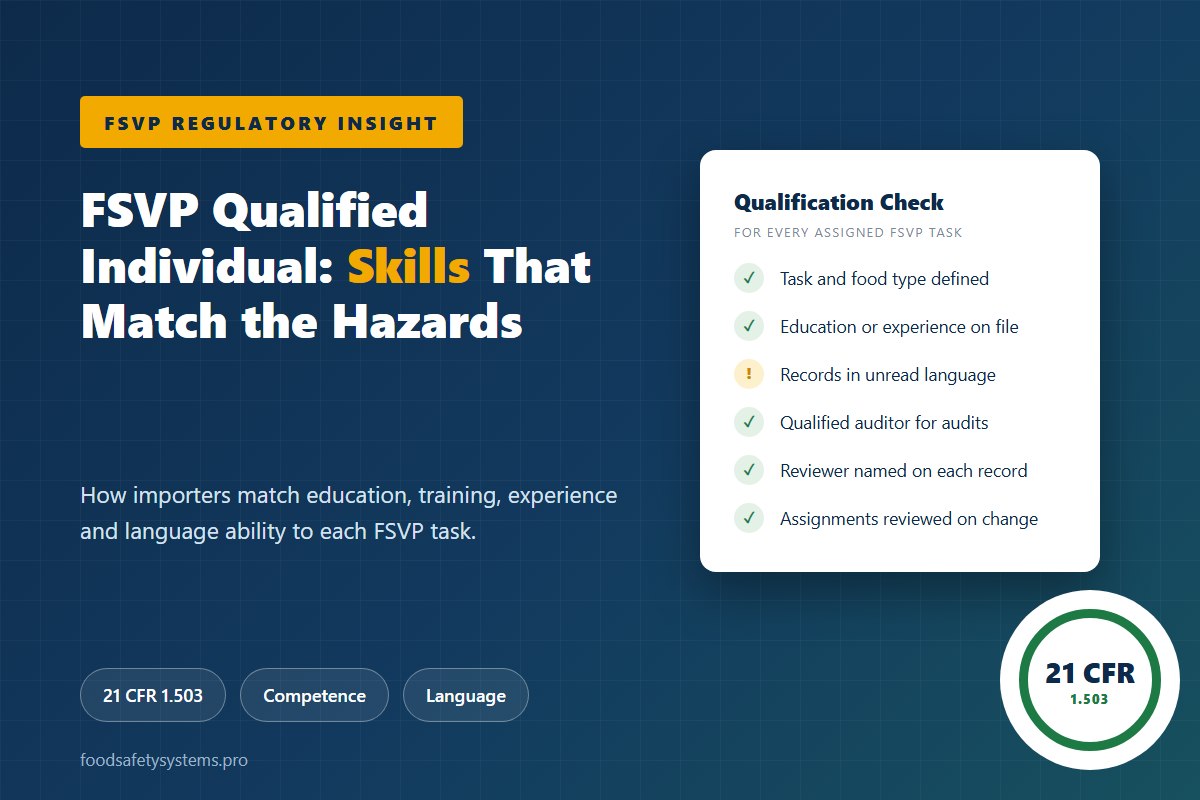
Your FSVP qualified individual must understand the hazards in the foods you import, and a certificate alone cannot prove that. Hazards vary widely across ready-to-eat products, spices, ingredients and processed foods. Sound technical conclusions require the right knowledge, adequate supplier evidence and an understanding of the actual process.
Quick answer: under 21 CFR 1.503, a qualified individual must develop your FSVP and perform each required activity. That person needs the education, training or experience, or a combination, necessary for the assigned activities, and must be able to read and understand the language of any records reviewed. No single credential is mandated for every FSVP task.
Who this guidance is for
U.S. food importers, food brand owners and supplier quality decision makers, including SQF certified sites that import foods and assign FSVP tasks to quality staff.
What the FSVP rule says about the qualified individual
The FSVP rule defines a qualified individual by competence for a specific activity, not by job title. The person may be, but does not have to be, an employee of the importer. A government employee, including a foreign government employee, may also be a qualified individual.
Onsite audits have an extra layer. They must be performed by a qualified auditor, who is a qualified individual with technical expertise needed for auditing. Therefore, the person who reviews records may not be the right person to audit a supplier, and vice versa.
A qualified individual also appears throughout the rule. Hazard analysis, supplier evaluation, verification activities and the review of other entities’ work all reference one. In addition, when you rely on another entity’s hazard analysis or evaluation, you must document that a qualified individual performed it.
Match qualifications to the assigned activity
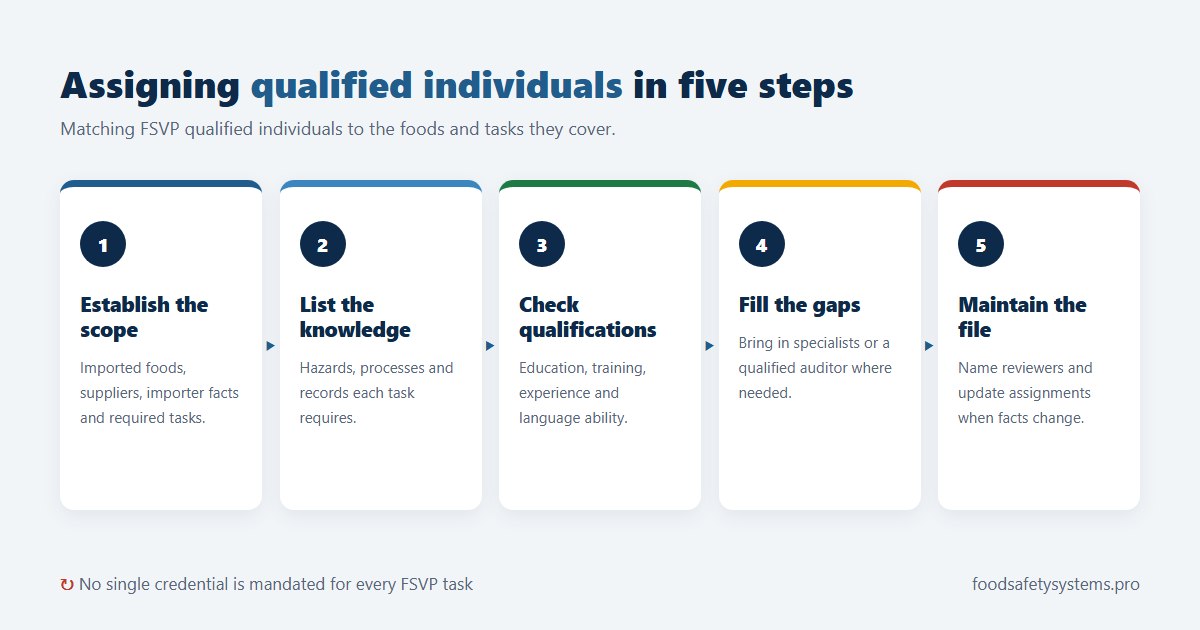
Qualification is activity-specific. A person who can competently review allergen changeover records for a bakery ingredient may not be equipped to judge a thermal process for a low-acid sauce. Start by listing each FSVP task and the knowledge it needs:
- Hazard analysis: knowledge of biological, chemical and physical hazards for the food type and its process.
- Supplier evaluation and reevaluation: ability to judge supplier practices, compliance history and performance data.
- Records review: understanding of the controls in the records and the language they are written in.
- Sampling and testing: familiarity with sample plans, methods and result interpretation.
- Onsite audits: auditing expertise, as required for a qualified auditor.
Our article on imported food hazard analysis shows the depth of hazard knowledge a reviewer needs.
Common gaps in qualified individual files
- The same generic hazard analysis is used for very different products.
- Technical reviewers are not identified on evaluations or reviews.
- Supplier process information is incomplete, so the reviewer cannot judge the control.
- Qualifications on file do not match the tasks assigned.
- No one on the team can read the language of key supplier records.
- A customs role or a professional credential is assumed to establish FSVP responsibility.
Practical steps for importers
Begin with a focused review of the commercial arrangements, product and supplier scope, and existing technical records. Confirm any exemption or modified requirement before applying the standard FSVP process.
- Establish: identify the imported foods, their suppliers, the relevant importer facts and the qualified individual tasks required.
- Check: compare contracts, entry data, technical evidence and reviewer qualifications against the applicable FSVP requirements.
- Resolve: obtain missing evidence, involve specialists where needed, and document importer-approved decisions and next steps.
- Maintain: update records when facts change, control versions and keep FSVP information retrievable on request.
Example scenario: one reviewer, three very different foods
Consider a hypothetical importer that brings in dried spices, a canned vegetable product and a ready-to-eat cheese. One quality manager with a general food safety background signs every FSVP review. Supplier records for the cheese arrive in a language the manager does not read.
During a program review, the importer maps each task to the knowledge required. As a result, it keeps the manager for the spice records review and brings in an outside specialist for the thermal process questions. It also engages a reviewer who reads the cheese supplier’s language. Each review now records who performed it, what information was considered and what remains open for importer authorization.
Records to keep
- Evidence of each qualified individual’s education, training or experience for the assigned tasks.
- Evidence of language ability where records are not in English.
- Names of the people who performed each hazard analysis, evaluation and verification activity.
- Documentation that another entity used a qualified individual when you rely on its work.
- Qualified auditor evidence for any onsite audit.
FSVP records must also be signed and dated when the FSVP is first completed and whenever it is modified, as set out in 21 CFR 1.510. Our training needs assessment page can help you document competence gaps.
Where the SQF practitioner fits
Many SQF sites ask their SQF practitioner or quality team to handle supplier approval for imported materials. That can work well, provided each person’s competence matches the FSVP task. However, FSVP is a U.S. importer obligation, and SQF certification or an SQF practitioner role does not satisfy FSVP by itself.
A supplier’s SQF or other GFSI certificate and audit report can be one input to supplier evaluation. The qualified individual still has to judge how that evidence relates to the hazards in the imported food. For more on aligning both systems, see our guide to SQF supplier approval for imported ingredients.
FSVP qualified individual checklist
- Every FSVP task has a named qualified individual.
- Qualification evidence matches the food type and activity assigned.
- Reviewers can read the language of the records they review.
- Onsite audits are performed by a qualified auditor.
- Reliance on other entities’ work documents their qualified individual.
- Assignments are reviewed when foods, suppliers or processes change.
Frequently asked questions
Does the FSVP qualified individual need a specific certificate?
No. The rule requires education, training or experience, or a combination, necessary for the assigned activity. A course certificate can support qualification, but it does not prove competence for every food or task.
Can a consultant be our qualified individual?
Yes. A qualified individual may be, but is not required to be, an employee of the importer. However, the importer keeps its FSVP responsibilities and final decisions.
Is the qualified individual the same as the FSVP importer?
No. The importer is generally the U.S. owner or consignee of the food at entry. The qualified individual performs FSVP activities on the importer’s behalf.
How Consultare Inc. Group can help
Consultare Inc. Group can scope qualified technical reviews, organize hazard and supplier evidence and support FSVP documentation. We provide independent advisory services and do not act as the FSVP importer or accept its regulatory responsibility.
- Supplier verification support: technical review coordination and evidence requests.
- Food safety training: build documented competence for assigned tasks.
- Supplier regulatory compliance: clarify importer roles and obligations.
- FDA compliance integration: align your SQF system with FSVP duties.
For importer-focused FSVP program support, see our sister site FSVP Services.
Need help managing your SQF responsibilities?
Discuss your products, documentation and compliance priorities with the Consultare team in a free consultation, or contact our team.
Start building your compliance system
Prefer to organize your compliance activities yourself? Create a free SystemsBuilder account to manage specifications, controlled documents, assigned actions and records in one structured workflow. Software supports record management; it does not by itself ensure compliance.
Technical sources: 21 CFR Part 1, Subpart L (especially §§ 1.500, 1.503 and 1.504) and FDA’s FSVP key requirements. Independent educational content: Consultare Inc. Group is not affiliated with or endorsed by FDA or SQFI. This article is not legal advice, FDA endorsement, import authorization or a guarantee of compliance. FSVP obligations depend on the actual importer, food, facts and any applicable exemption, and conclusions should be reviewed by a qualified individual.