
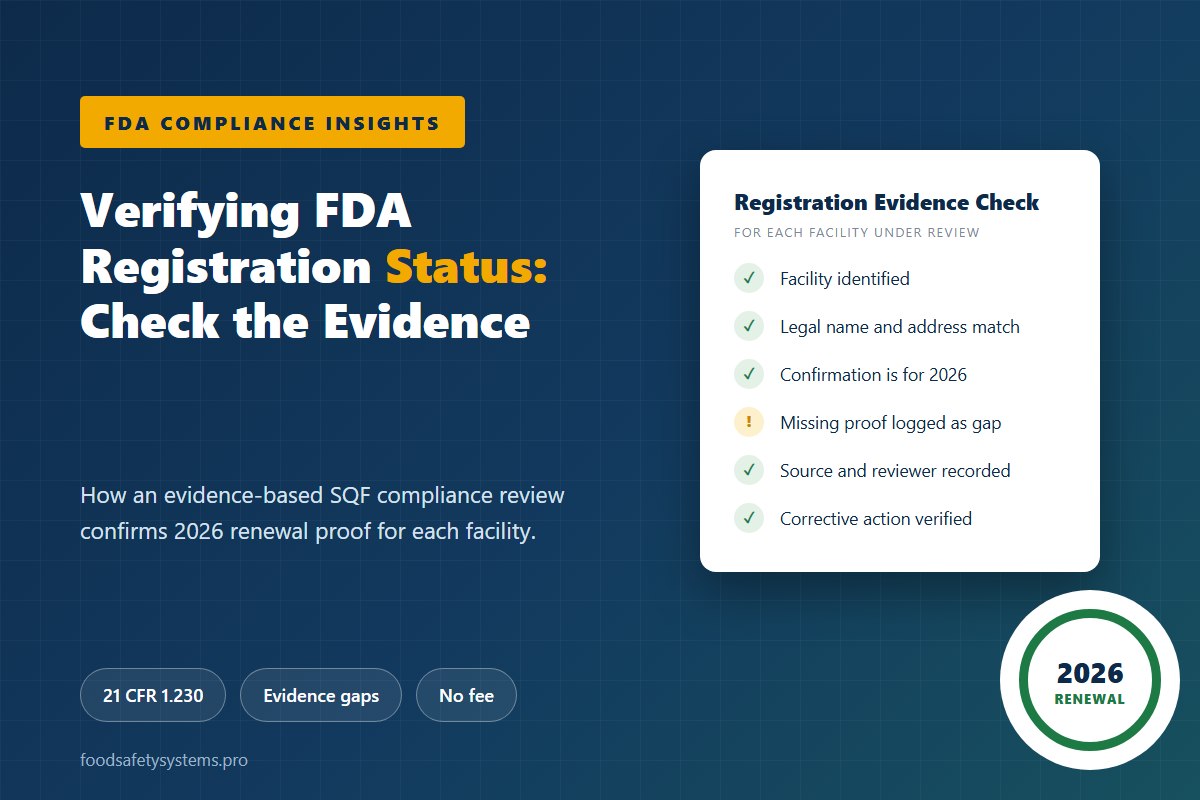
Verifying FDA registration status during an SQF compliance review means checking the underlying evidence, not the status line on a tracker. An internal review may find FDA registration listed as “complete” without a retrievable 2026 renewal confirmation. In that case, the record shows intent rather than proof. Effective verification goes back to the source documents for each facility.
Quick answer: for each applicable facility, compare the official registration information with the site’s legal name and address, confirm that the evidence relates to the 2026 renewal period, and record any unresolved issues. A valid SQF certificate supports the food safety system, but it is not FDA registration evidence.
Who this guidance is for
SQF practitioners, internal auditors, regulatory and quality managers, and site leaders who review compliance obligations as part of their SQF system oversight.
Why a “complete” status is not enough
Compliance trackers often record a task as finished once someone reports it done. However, a reviewer cannot rely on that entry alone. The confirmation must be retrievable, it must match the facility, and it must belong to the correct renewal period. Otherwise, the review cannot show that the obligation was met. Our record retention requirements page explains how to keep this kind of evidence accessible.
Verifying FDA registration status with an evidence-based SQF review
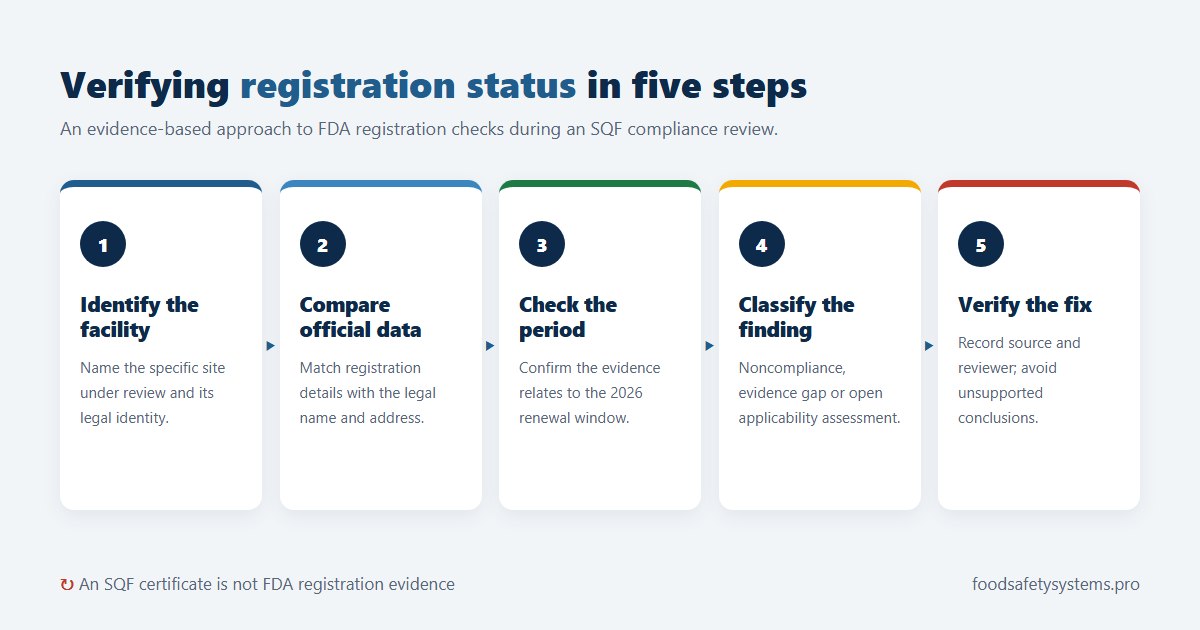
Treat registration status like any other audit sample. First, identify the specific facility under review. Next, compare the official registration information with the site’s legal name and address. Then confirm that the renewal confirmation relates to the 2026 period rather than an earlier cycle or a mid-cycle update.
Findings should state clearly what kind of issue the reviewer found:
- Regulatory noncompliance: a required renewal was not completed.
- Evidence gap: the renewal may have been completed, but the site cannot retrieve proof.
- Open applicability assessment: the site has not yet confirmed whether, or how, the requirement applies.
This distinction matters. It keeps conclusions accurate and points each finding to the right owner. Our internal audit program guide covers how to plan and document this kind of verification.
2026 FDA Food Facility Registration context
Under 21 U.S.C. 350d and 21 CFR Part 1, Subpart H, facilities subject to FDA Food Facility Registration must renew between October 1 and December 31 of each even-numbered year (21 CFR 1.230). The 2026 renewal period closes on December 31, 2026.
A prior registration update is not the same as a biennial renewal. FDA currently recognizes the DUNS number as an acceptable Unique Facility Identifier, and FDA charges no fee for renewal. Facility applicability and exemptions still require individual assessment.
Keep SQF certification and FDA registration separate
A valid SQF certificate is valuable evidence for the food safety system. Still, it does not show that a facility renewed its FDA registration. Reviewers should therefore file the two types of evidence separately and avoid treating one as proof of the other.
Close findings without unsupported conclusions
When the review finds a gap, record the evidence source and the reviewer. Then assign a corrective action and verify it with objective evidence. Avoid conclusions the evidence cannot support, such as calling a facility noncompliant when the real issue is a missing file. Our CAPA process guide explains how to confirm that a fix actually worked.
Readiness checklist
- Identify the specific facility under review.
- Compare renewal evidence with the applicable period and facility identity.
- Document the evidence source and the reviewer.
- Classify each finding as noncompliance, evidence gap or open applicability assessment.
- Verify corrective action without making unsupported conclusions.
Frequently asked questions
Does an SQF certificate prove FDA registration?
No. An SQF certificate supports the food safety system, but it is not FDA registration evidence. Reviewers need the facility’s own renewal confirmation for the 2026 period.
Does an earlier registration update count as the 2026 renewal?
No. A registration update made earlier in the year is not the same as a biennial renewal. The renewal must take place between October 1 and December 31, 2026.
What should a reviewer do if the confirmation cannot be found?
Record it as an evidence gap, name the evidence source checked and the reviewer, and assign an owner to retrieve or resolve it. Do not assume noncompliance without evidence.
How Consultare Inc. Group can help
Consultare Inc. Group supports food businesses with SQF oversight and regulatory readiness, tailored to each facility.
- SQF internal audit support: evidence-based compliance reviews.
- Compliance verification: align SQF records with FDA obligations.
- Document control: retrievable registration evidence.
- Corrective action review: verified closure of review findings.
Need help managing your SQF responsibilities?
Discuss your products, documentation and compliance priorities with the Consultare team in a free consultation, or contact our team.
Start building your compliance system
Prefer to organize your compliance activities yourself? Create a free SystemsBuilder account to manage specifications, controlled documents, assigned actions and records in one structured workflow. Software supports record management; it does not by itself ensure compliance.
Technical sources: FDA Food Facility Registration User Guide: Biennial Registration Renewal, FDA reminder on biennial renewal requirements, FDA Online Registration of Food Facilities, 21 U.S.C. 350d and 21 CFR Part 1, Subpart H. Independent educational content: Consultare Inc. Group is not affiliated with, endorsed by or authorized to act on behalf of FDA or SQFI. This article does not constitute legal advice or an official statement of FDA policy. Requirements may change and their applicability depends on each facility; verify current requirements with official FDA sources and qualified regulatory professionals.