
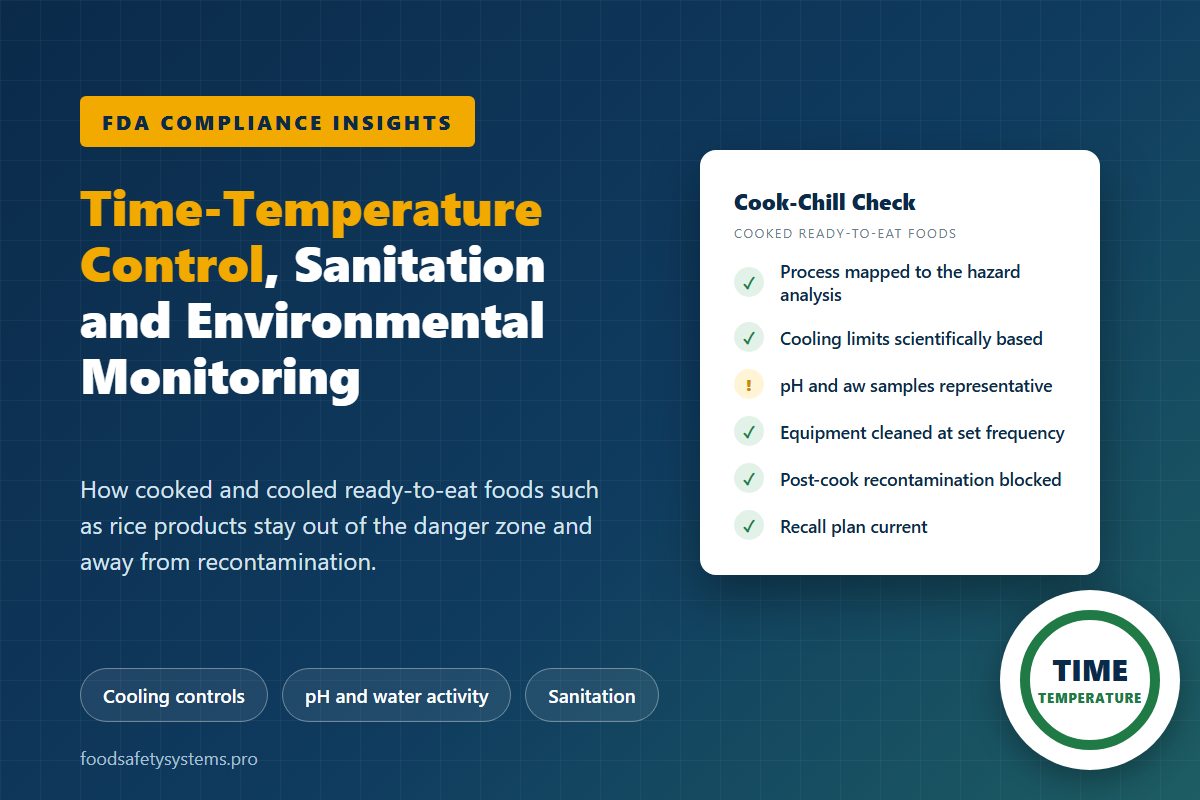
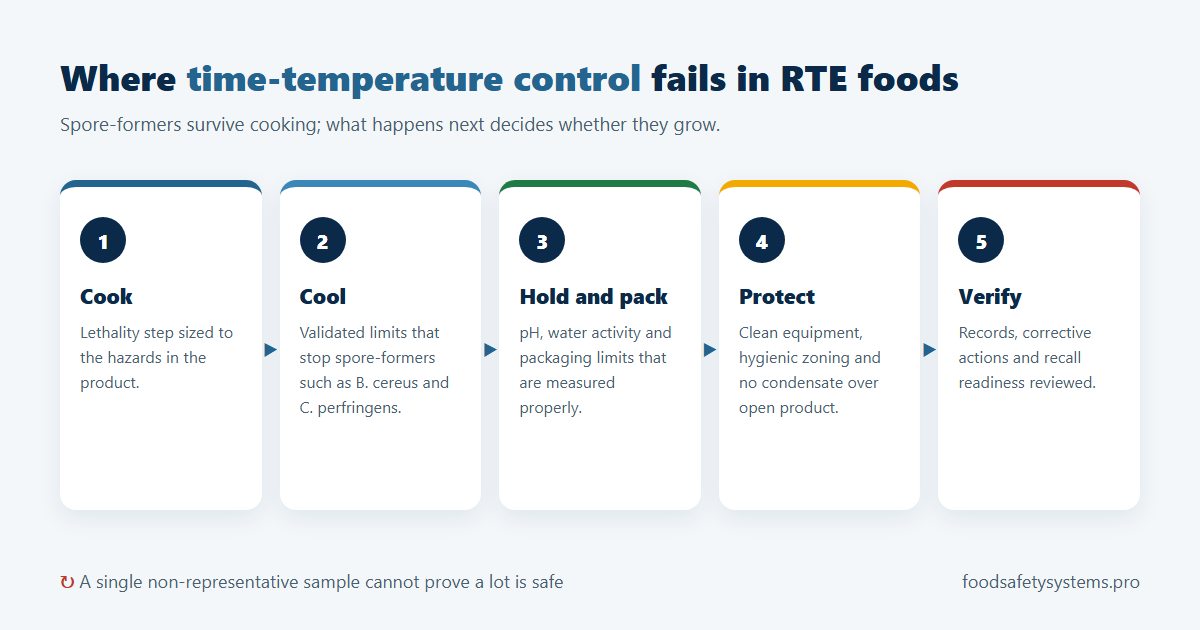
Time-temperature control is the main defense against pathogen growth and toxin formation in ready-to-eat foods that are cooked, cooled, handled and packaged. Rice-based and other high-moisture RTE products need particular attention to cooling, pH, water activity, packaging conditions, sanitation and environmental exposure. Cooking kills vegetative cells, but spore-forming bacteria such as Bacillus cereus and Clostridium perfringens can survive and multiply if the product cools too slowly. An effective SQF system connects these risks to validated controls, monitoring, verification and corrective action.
FDA warning letters to RTE manufacturers often cite cooling limits with no scientific basis, pH checks taken from a single unrepresentative sample, and condensate or pests near exposed product. The seven areas below show what to review.
Review the hazard analysis against the actual process
Map every step from receiving through cooking, cooling, packaging, storage and distribution. Evaluate the relevant biological hazards, including spore-forming pathogens, environmental pathogens and the hazards of reduced-oxygen packaging where it applies. A hazard analysis written for a different line or recipe will miss the risks that matter.
Establish scientifically supported time-temperature control
Decide whether cooking, holding, cooling and refrigerated storage controls address the hazards you identified. Critical limits and monitoring frequency must rest on appropriate scientific or regulatory support and reflect the actual product and process. Widely used cooling benchmarks, such as cooling cooked food from 135°F to 70°F within 2 hours and to 41°F or below within a total of 6 hours in the FDA Food Code, are a useful reference, but a manufacturer should validate the limits it uses. Our guide to validation and verification of control measures explains how.
Validate pH and water activity controls
Where you rely on pH or water activity as a control, set product-specific limits and show that your measurement method and sampling plan represent the product or batch. A single non-representative sample cannot show that a whole lot is under control. Calibrate meters and record the calibration.
Strengthen sanitation and environmental monitoring
Clean and sanitize food-contact equipment, utensils, trays and production surfaces at suitable frequencies. Where environmental pathogens are a hazard requiring a preventive control, set up environmental monitoring and response procedures. See our guides to hygiene and sanitation programs and Listeria environmental monitoring.
Prevent recontamination after processing
Review employee handling, equipment design, hygienic zoning, cleaning practices and packaging operations. Controls should cover the gap between the lethality step and the moment the product is sealed in its package.
Maintain facility, pest and condensation controls
Inspect overhead structures, hoods, ducts, pipes, refrigeration equipment, drains and pest entry points. Prevent condensate, overspray, pests and other environmental conditions from reaching exposed product or food-contact surfaces. Our facility design, maintenance and pest control guide covers the SQF expectations.
Verify corrective actions and recall readiness
Document product assessment, root cause, correction, corrective action, verification and effectiveness. Confirm that the food safety plan and recall procedures are complete, current and implemented, and test them with annual mock recalls.
How Consultare Inc. Group can help
Consultare Inc. Group supports SQF gap assessments, hazard analysis and food safety plan review, process control and cooling assessment, sanitation and environmental monitoring program review, pest and facility condition assessments, internal audits, mock recall exercises and corrective action planning. Recommendations can be turned into a prioritized action plan and supporting procedures, within the agreed engagement scope.
Need help managing your SQF responsibilities?
Whether you are preparing for SQF certification, reviewing time-temperature controls, strengthening sanitation or improving environmental monitoring and corrective actions, book a free consultation to discuss your products, processes, food safety system and audit-readiness priorities. You can also contact our team.
Start building your compliance system
Prefer to organize your compliance activities yourself? Create a free SystemsBuilder account and begin building a structured system for your compliance documentation and processes. The right time to strengthen process controls, sanitation and documentation is before a compliance gap becomes a business problem.
Technical sources: 21 CFR Part 117 and the FDA Food Code. This article is educational; specific requirements depend on your products, process, certification scope and applicable regulations.