
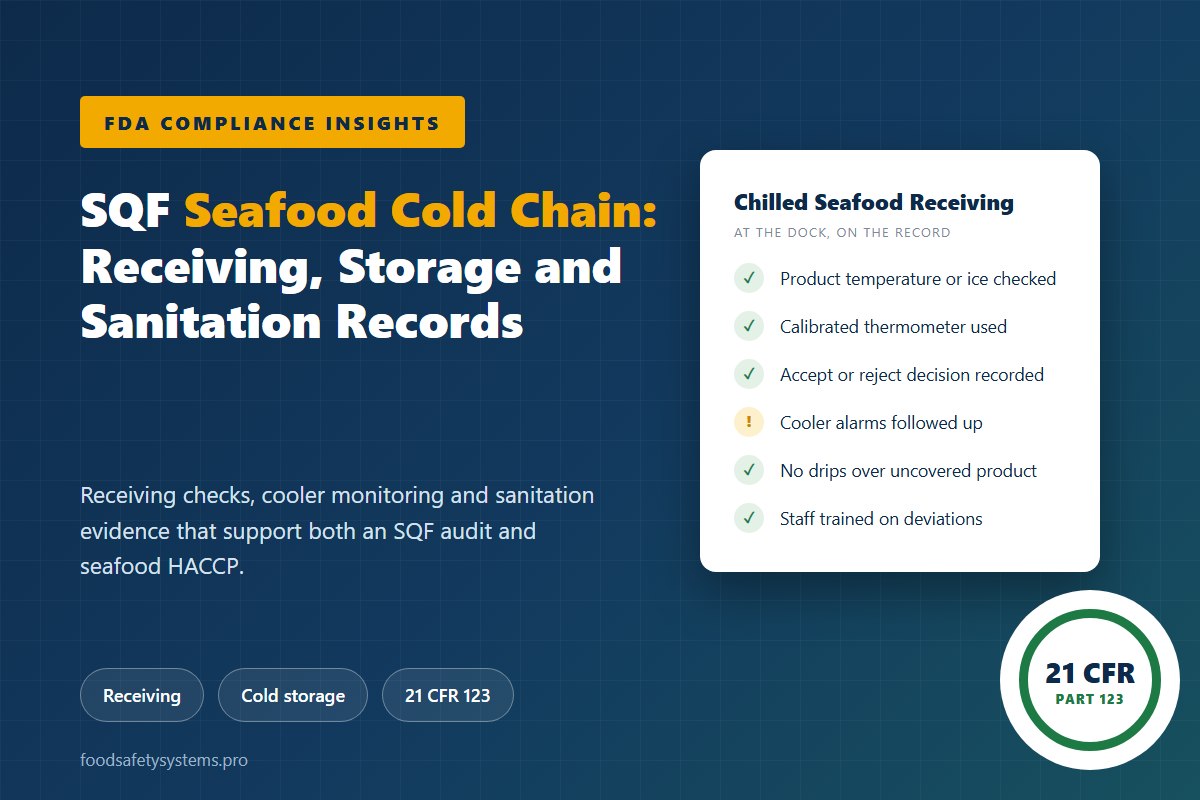
The seafood cold chain is only as strong as its weakest record: refrigerated seafood safety depends on reliable receiving and storage controls, hygienic conditions, trained people and complete documentation. FDA seafood HACCP enforcement keeps showing how a written plan falls short when critical limits, monitoring or corrective actions are inadequate or not carried out. Businesses should review the requirements that apply to their actual products, processes and regulatory roles rather than assume one certification or quality system covers every obligation.
Quick answer: an SQF food safety system benefits from documented, risk-based receiving and cold storage controls, verified sanitation, competent employees and effective corrective actions. SQF certification is separate from FDA seafood HACCP obligations under 21 CFR Part 123.
Who this guidance is for
Seafood processors and distributors operating an SQF food safety system, SQF practitioners, warehouse managers and internal audit teams.
Connect the SQF food safety plan to seafood hazards
Review the process flow for receiving, chilled storage, handling and distribution of refrigerated seafood. The SQF food safety plan should reflect the relevant biological hazards, such as pathogen growth, histamine formation in scombroid species and Clostridium botulinum in reduced-oxygen packaged fish, and how the site controls them. Our seafood HACCP histamine control guide covers species-specific hazards.
Make seafood cold chain receiving checks match the delivery method
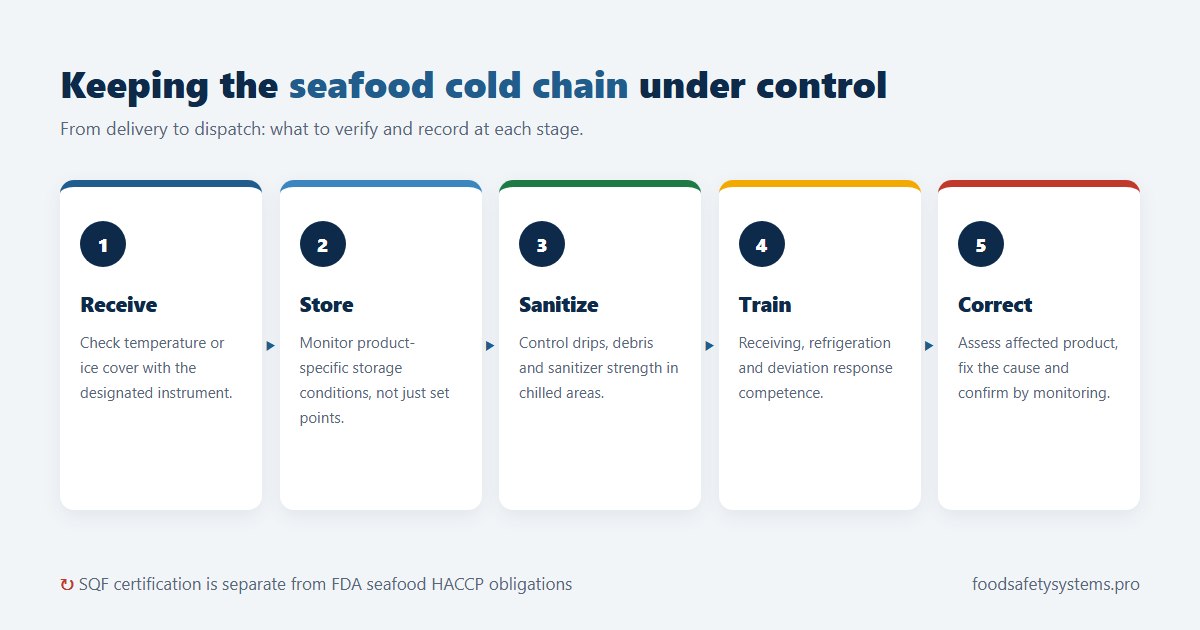
Define what employees verify when product arrives under refrigeration or on ice: product or ambient temperature, transit temperature records, or adequate ice coverage. Make sure staff use the designated, calibrated instruments and record the result at the time of the check rather than relying on a verbal confirmation from the driver.
Verify storage performance, not just cooler settings
A cooler set point does not prove product temperature. Establish product-specific storage requirements, continuous or periodic monitoring as appropriate, checks of ice coverage where ice is used, and documented follow-up when conditions deviate, including alarm response outside working hours.
Control sanitation and condensation sources
Look for uncovered food, overhead condensation drips, debris, unverified sanitizer concentration and weak cleaning practices. Record checks at frequencies suited to the process and risk. Seafood HACCP processors must also monitor and record the key sanitation conditions listed in 21 CFR 123.11. See our SQF hygiene and sanitation programs page for the evidence auditors expect.
Document staff competence and responsibilities
Identify required training for receiving, refrigeration, sanitation, hazard awareness and deviation response, and verify that employees follow current procedures. Under Part 123, certain HACCP tasks must be done by a person trained in seafood HACCP.
Close corrective actions with evidence
Assess affected product, correct the contributing cause, document management review and confirm effectiveness through follow-up monitoring. Our CAPA process guide explains how to show a fix actually worked.
Seafood cold chain checklist
- Confirm the product, facility activity and applicable FDA or certification framework.
- Verify that procedures match actual receiving, storage and handling conditions.
- Assign monitoring responsibilities, acceptance criteria and record review.
- Escalate missing records, deviations and potentially affected product for documented evaluation.
- Keep sanitation and personnel training evidence appropriate to the site.
- Track corrective action owners, deadlines, completion evidence and effectiveness checks.
Frequently asked questions
Does SQF certification replace FDA seafood HACCP?
No. SQF is a voluntary certification program; U.S. seafood HACCP requirements under 21 CFR Part 123 must be considered separately where they apply.
What evidence matters for chilled seafood receiving?
Documented shipment condition checks, temperature data or ice coverage as appropriate, the accept or reject decision, and the response to any deviation.
How can an SQF audit identify recurring cold chain problems?
Compare procedures with actual records and practices, trend exceptions such as temperature excursions, and verify that corrective actions address the underlying causes.
How Consultare Inc. Group can help
Consultare Inc. Group provides professional food safety and regulatory compliance support for seafood businesses, tailored to the agreed engagement scope.
- SQF gap assessments and internal audits: receiving and storage control mapping.
- HACCP implementation support: seafood food safety plan review.
- FDA compliance integration: align your SQF system with Part 123.
- Corrective action support: verification that cold chain fixes hold.
Need help managing your SQF responsibilities?
Discuss your products, documentation and compliance priorities with the Consultare team in a free consultation, or contact our team.
Start building your compliance system
Prefer to organize your compliance activities yourself? Create a free SystemsBuilder account to manage specifications, controlled documents, assigned actions and records in one structured workflow. Software supports record management; it does not by itself ensure compliance.
Technical sources: 21 CFR Part 123 and SQFI. Independent educational content: Consultare Inc. Group is not affiliated with or endorsed by FDA. This article does not constitute regulatory approval, certification or legal advice; applicability must be assessed for each product, facility and operation.