
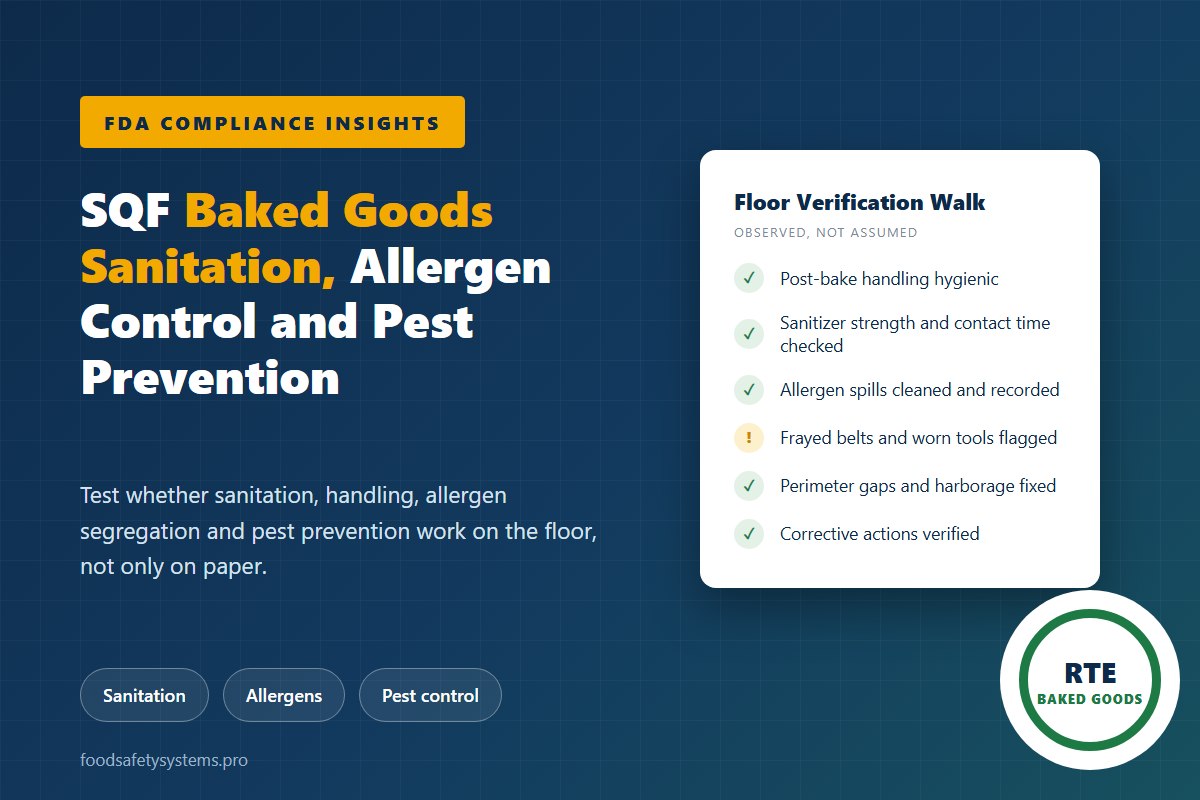
Baked goods sanitation under SQF is proven on the production floor, not in the policy binder. For baked goods and other ready-to-eat (RTE) foods, a working food safety system depends on consistent hygiene, allergen segregation, equipment maintenance, pest prevention and verification. These practices let a site demonstrate operational control and walk into a certification audit with confidence.
Quick answer: an SQF bakery strengthens food safety by testing whether sanitation, employee handling, allergen controls, pest prevention and corrective actions are performed and verified under real operating conditions.
Verify post-process hygiene
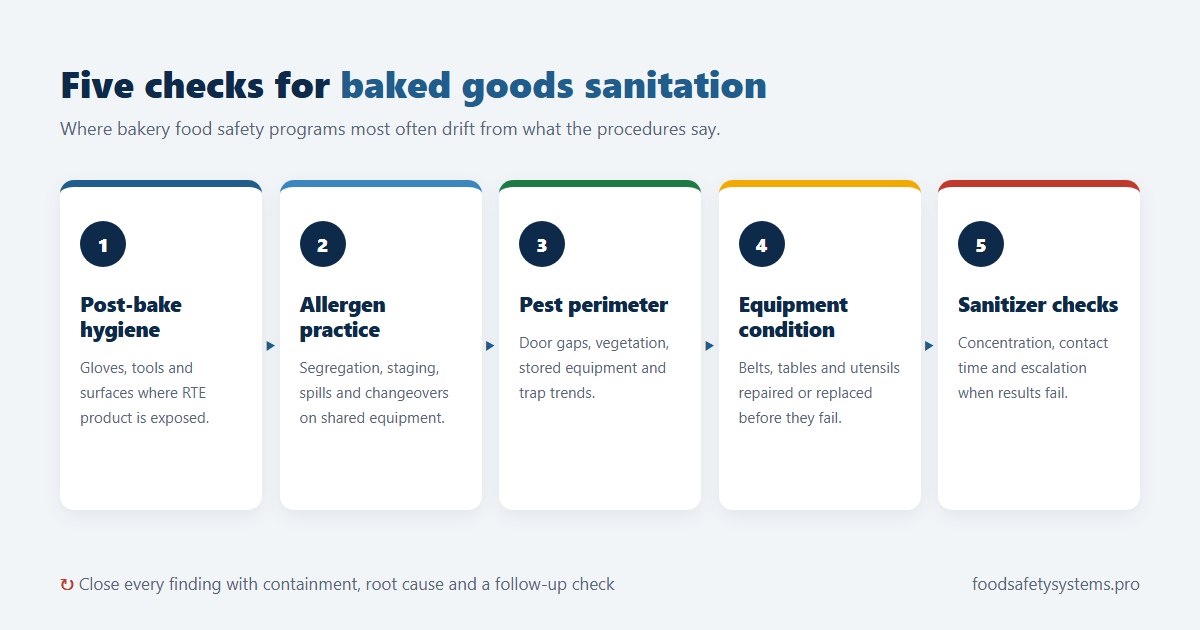
Baking is a kill step, so the biggest sanitation risk sits after the oven. Examine exposed RTE handling and packaging steps: glove-use procedures, cleaning tools, food-contact surfaces and whether people follow the documented requirements. Our guide to ready-to-eat food safety covers post-process contamination in more depth.
Make allergen controls operational
Map allergens across shared equipment, staging, storage and changeovers. Verify spill response, segregation, cleaning and employee practices against the site allergen program. For allergen matrices, sequencing and label checks, see our companion article on bakery allergen management.
Control pests at the facility perimeter
Bakeries attract stored-product insects, rodents and birds. Inspect vegetation, stored equipment, door gaps, receiving areas and pest monitoring trends, and assign owners to close entry points and remove harborage. Trend data matters more than single trap counts. Read more on SQF pest control, facility design and maintenance.
Maintain cleanable, serviceable equipment
Inspect belts, tables, utensils and other food-contact surfaces for damage, fraying and hard-to-clean features, and document repair and replacement decisions. Worn equipment is both a physical hazard and a sanitation problem.
Verify sanitizing effectiveness
Confirm chemical concentration, contact time, solution preparation, monitoring frequency and escalation when results fall outside acceptance criteria. A sanitizer that is mixed too weak, or wiped off too soon, gives a clean-looking surface that is not sanitized. Our SQF sanitation requirements guide explains how to verify and record it.
Close corrective actions with evidence
Record immediate containment, root cause, affected-product review, repairs, follow-up inspection and effectiveness checks. An auditor will ask how you know the problem has not come back.
Baked goods sanitation checklist
- Confirm the regulatory and certification scope that applies to the facility and products.
- Compare written procedures with direct observation and records.
- Document responsible persons, monitoring frequencies and escalation thresholds.
- Review deviations, corrective actions and objective evidence of effectiveness.
Frequently asked questions
Does a written policy alone demonstrate compliance?
No. Procedures must be implemented, monitored and verified. Applicable requirements depend on the product and operation, including FDA preventive controls under 21 CFR Part 117 where they apply.
Do all bakeries need the same sanitation and allergen controls?
No. Controls depend on the hazards, process, ingredients, facility and applicable regulatory or certification requirements.
What records help demonstrate improvement?
Monitoring logs, training records, maintenance tickets, corrective actions, verification results and management review.
How Consultare Inc. Group can help
Consultare Inc. Group provides practical, professional food safety and regulatory compliance support for bakeries. Services and deliverables depend on the agreed scope.
- SQF gap assessments and internal audit preparation: sanitation, allergen and pest program reviews.
- Hygiene and sanitation programs: hygienic equipment and cleaning verification.
- Corrective action support: CAPA implementation with effectiveness checks.
Need help managing your SQF responsibilities?
Discuss your products, documentation and compliance priorities with the Consultare team in a free consultation, or contact our team.
Start building your compliance system
Prefer to organize your compliance activities yourself? Create a free SystemsBuilder account to manage specifications, controlled documents, assigned actions and records in one structured workflow. Software supports record management; it does not by itself ensure compliance.
Technical sources: SQFI and 21 CFR Part 117. Independent educational content: Consultare Inc. Group is not affiliated with or endorsed by FDA. This article does not constitute regulatory approval, certification or legal advice; applicability must be assessed for each product, facility and operation.