
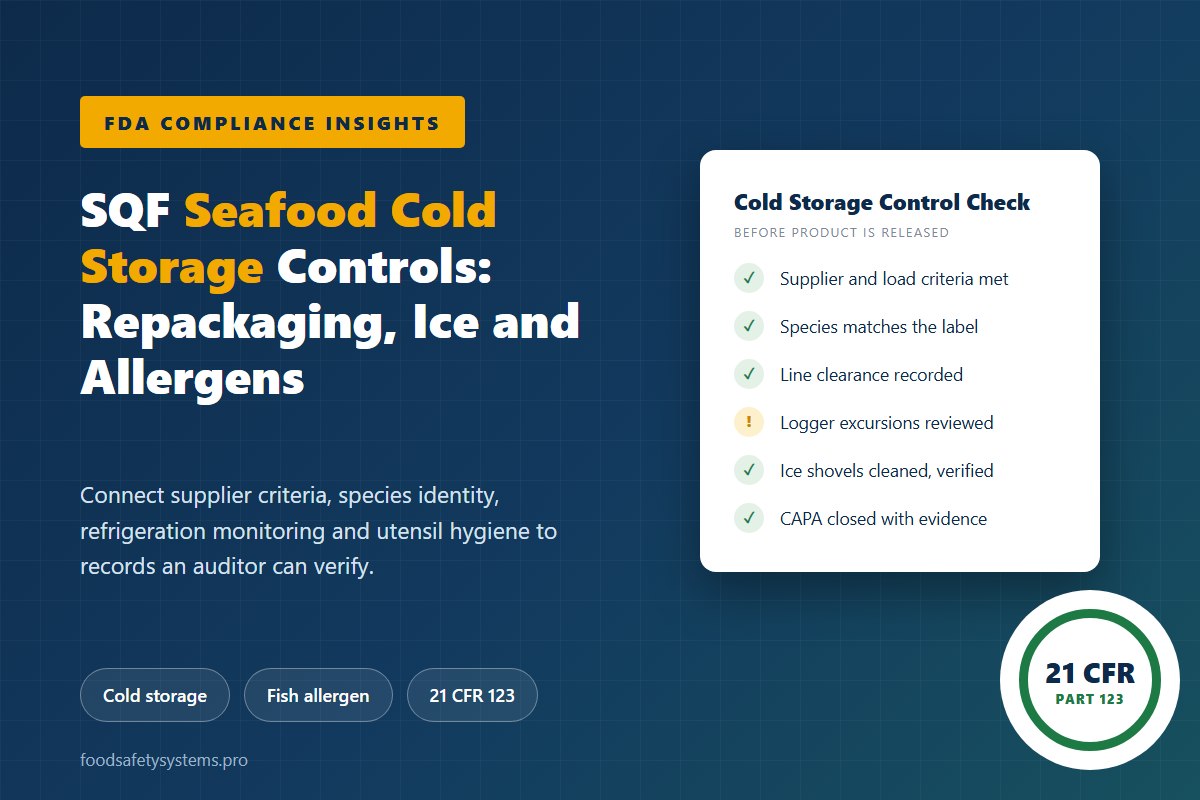
Effective seafood cold storage controls depend on more than a cold-room set point: they connect product risk assessments to what really happens at receiving, during repackaging and while fish is held under refrigeration. A written procedure alone does not prove control. Instead, product-specific evidence, trained personnel and corrective action records show whether the system works. SQF certification requirements, in turn, must be assessed against the applicable SQF Code and the site’s certified scope.
Quick answer: an SQF-aligned seafood storage system uses documented supplier and transport criteria, controlled repackaging with clear allergen identification, effective sanitation and verified cold-room monitoring. These are management-system lessons drawn from FDA seafood HACCP enforcement themes, not FDA findings of an SQF violation. SQF certification does not replace the FDA seafood HACCP requirements in 21 CFR Part 123.
Who this guidance is for
Seafood distributors, cold storage warehouses and repackers that operate an SQF food safety system, together with their SQF practitioners, warehouse supervisors and internal auditors.
Align supplier approval with receiving decisions
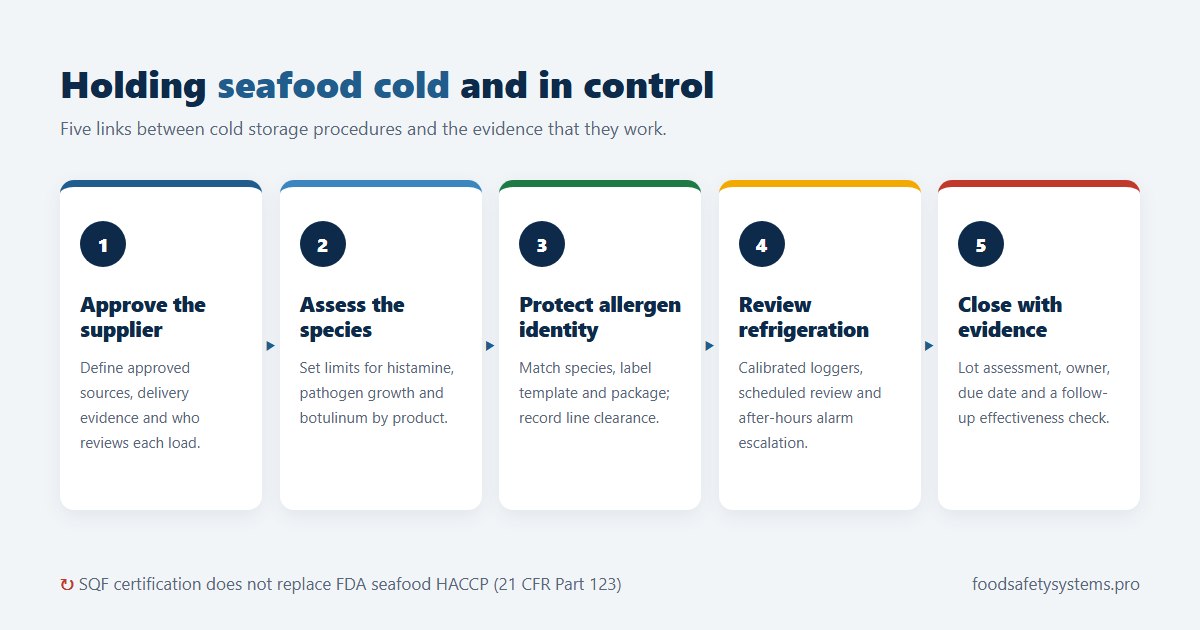
Receiving staff can only make sound decisions when they know what “acceptable” looks like. Therefore, define approved suppliers, the delivery evidence each load must carry and who reviews it. This matters most for fishery products whose safety depends on refrigeration. Our sibling guide on seafood import verification and receiving checks explains acceptance criteria and supplier evidence in more detail.
Evaluate species-specific hazards in seafood cold storage controls
Not every fish carries the same risk. Scombroid species such as tuna and mackerel can form histamine when temperatures are abused. Meanwhile, vacuum-packed fish may need controls for Clostridium botulinum toxin formation, and most products need controls for pathogen growth. As a result, storage limits, monitoring frequencies and holding times should reflect each species and package type. Our seafood HACCP histamine control guide covers these hazards in depth.
Protect allergen identity during repackaging
Fish is a major food allergen in the United States, and labels must declare the specific species. Consequently, a species mix-up during repackaging can create both a mislabeled product and an undeclared allergen. To reduce this risk:
- Confirm that the species name on incoming cartons matches the product and the supplier documents.
- Control label templates so only approved, species-specific versions are available.
- Perform and record line clearance between species and between label runs.
- Check finished packages against the label and the product before release.
For documentation practices, see our allergen identification and documentation page.
Verify refrigeration monitoring
A data logger records temperatures; it does not respond to them. For that reason, define monitoring frequencies, use calibrated devices and assign someone to review logger data on a set schedule. In addition, set clear escalation rules for excursions, including alarms outside working hours. Each response should be proportionate to the product’s risk.
Keep ice tools and utensils hygienic
Ice shovels, scoops and similar utensils touch product or the ice that covers it. They are therefore food-contact surfaces and potential contamination routes. Identify them in the sanitation program, set cleaning and storage requirements, and verify that the criteria are met. Seafood HACCP processors must also monitor the sanitation conditions listed in 21 CFR 123.11, including the condition and cleanliness of food-contact surfaces.
Close nonconformities with evidence
A corrective action is only complete when it is proven to work. Record the investigation, the assessment of affected lots, the action owner and the due date. Afterwards, schedule follow-up checks that confirm the problem has not returned. Our CAPA process guide shows how to document effectiveness.
Seafood cold storage checklist
- Identify the product, process, responsible operator and applicable FDA requirements.
- Maintain written hazard analyses, procedures and records appropriate to the activity.
- Confirm that transport evidence and receiving decisions address temperature-related hazards.
- Verify monitored refrigeration conditions and investigate deviations promptly.
- Review species identification, allergen labeling and segregation in repackaging.
- Document sanitation observations, corrective actions and effectiveness checks.
Frequently asked questions
Can SQF replace seafood HACCP?
No. A certification program does not remove applicable FDA seafood HACCP obligations under 21 CFR Part 123. Both must be managed where they apply.
Why is fish species identification important?
Different species present different hazards. In addition, an incorrect species name can lead to an undeclared fish allergen on the label.
Are cold-room data loggers sufficient by themselves?
No. The system also needs review procedures, escalation criteria, retained monitoring records and documented responses to deviations.
How Consultare Inc. Group can help
Consultare Inc. Group provides professional food safety and regulatory compliance support for seafood businesses, tailored to the agreed engagement scope.
- SQF gap assessments and internal audits: receiving and cold storage procedure review.
- Allergen control verification: species labeling and repackaging checks.
- Hygiene and sanitation programs: utensil and food-contact surface verification.
- Corrective action support: corrective-action planning and effectiveness checks.
Need help managing your SQF responsibilities?
Discuss your products, documentation and compliance priorities with the Consultare team in a free consultation, or contact our team.
Start building your compliance system
Prefer to organize your compliance activities yourself? Create a free SystemsBuilder account to manage specifications, controlled documents, assigned actions and records in one structured workflow. Software supports record management; it does not by itself ensure compliance.
Technical sources: 21 CFR Part 123, FDA Fish and Fishery Products Hazards and Controls Guidance and SQFI. Independent educational content: Consultare Inc. Group is not affiliated with or endorsed by FDA, SQFI or any companies referenced in the underlying regulatory materials. This article does not constitute regulatory approval, certification or legal advice; applicability must be assessed for each product, facility and operation.