
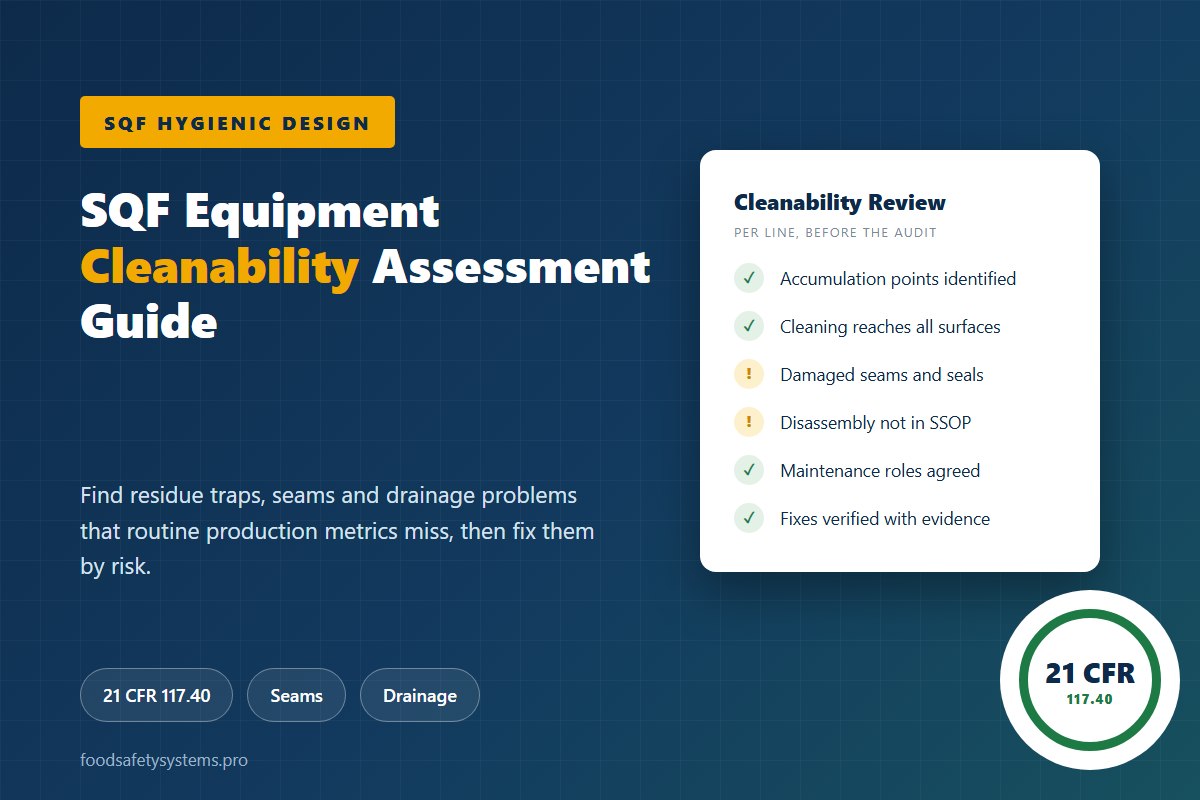
An SQF equipment cleanability assessment looks past throughput and uptime to ask a simpler question: can this equipment actually be cleaned, inspected and kept clean? Equipment that performs efficiently may still hide residue in seams, hollow frames or worn seals. During certification preparation, a systematic look at equipment construction uncovers problems that routine production metrics miss.
Quick answer: a cleanability assessment identifies where food, residue, moisture or allergens can accumulate, checks whether cleaning and inspection can reach those surfaces, and turns findings into prioritized, owned and verified actions. It works best as a joint effort between food safety, sanitation, operations and maintenance.
Why equipment cleanability matters
Even a well-written food safety program is hard to apply consistently when equipment has inaccessible surfaces, damaged seals or unsuitable materials. Poorly controlled surroundings, such as nearby drains or overhead drips, add to the problem. Consequently, the same sanitation failure can appear week after week, despite retraining and extra cleaning.
The business impact goes beyond the technical finding. Repeated re-cleaning, uncertain corrective action closure, avoidable downtime and gaps in audit evidence all consume resources. Addressing root causes, by contrast, supports more reliable operations and clearer accountability. These problems rarely improve through documentation alone; the underlying equipment conditions need to be understood and fixed.
What good looks like in an SQF equipment cleanability assessment
A strong assessment is risk-based. It considers the food, the process, product exposure, cleaning frequency and observed performance before deciding on corrective action. In practice, the review team should:
- Identify where food, residues, moisture or allergens could accumulate.
- Check whether routine cleaning and inspection can reach the relevant surfaces.
- Evaluate layout, personnel movement, utilities and maintenance interfaces around the equipment.
- Review records of sanitation failures, equipment repairs and recurring observations.
- Separate applicable requirements from voluntary technical guidance.
That last point matters. In the United States, FDA cGMP rules in 21 CFR 117.40 expect equipment and utensils to be adequately cleanable, food-contact surfaces to be corrosion-resistant, and seams on food-contact surfaces to be smoothly bonded or maintained to minimize accumulation. Hygienic design guidance from organizations such as EHEDG and 3-A Sanitary Standards is voluntary, yet it can help teams judge what “cleanable” looks like for specific equipment.
Common equipment cleanability problems
Most issues fall into a few familiar patterns. Look in particular for:
- Hard-to-reach assemblies that are skipped or only partly cleaned.
- Open or damaged seams, rough welds and crevices on or near food-contact surfaces.
- Ineffective drainage that leaves water standing inside equipment or frames.
- Components that require disassembly, but where the procedure does not say so or the tools are not available.
- Worn gaskets, seals and belts that trap residue.
- Unclear split of duties between maintenance and sanitation teams.
Verify that cleaning methods suit the equipment, and confirm that maintenance and sanitation agree on who does what. Our article on SQF equipment hygiene covers related cleaning and supplier controls.
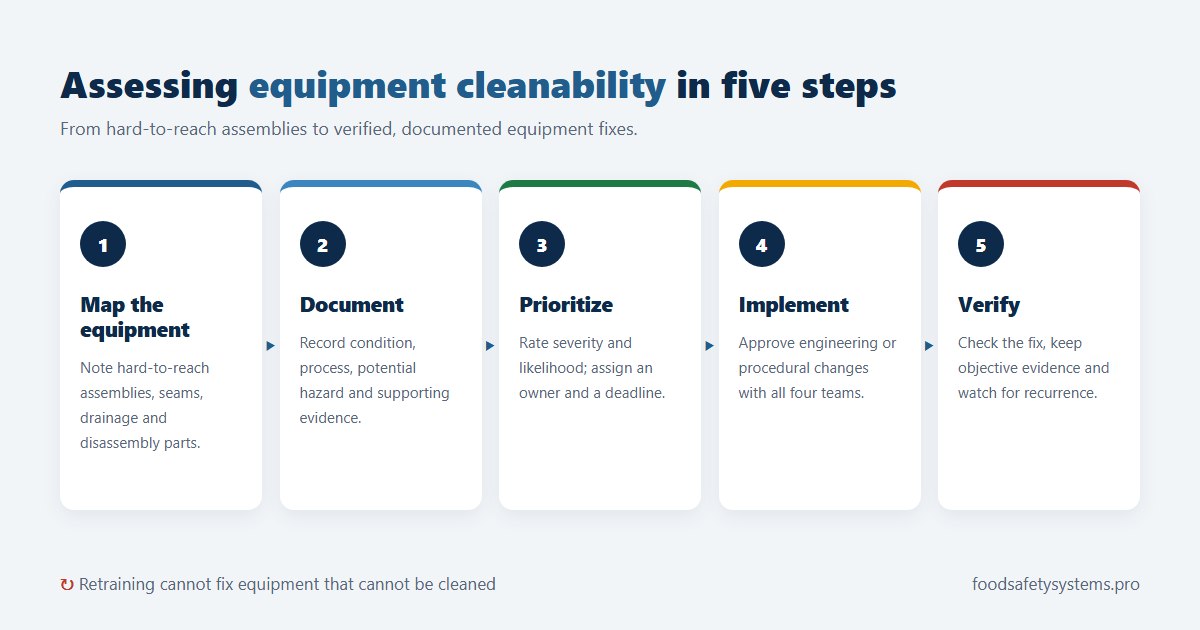
Five steps from observation to verified fix
1. Map the equipment. Walk each line and note hard-to-reach assemblies, seams, drainage points and parts that need disassembly. Include the areas around the equipment, not just the machine itself.
2. Document the condition. Record the observed condition, the affected process, the potential hazard and any supporting evidence, such as swab results or sanitation inspection records.
3. Prioritize by risk. Assess severity and likelihood in the real facility context. Then assign a responsible person and an action deadline. Exposed ready-to-eat product or allergen changeovers usually justify faster action.
4. Implement the change. Approve suitable engineering or procedural changes with input from food safety, sanitation, operations and maintenance. Where the permanent fix takes time, document interim controls.
5. Verify and retain evidence. Check the completed action and keep objective evidence that the problem was solved. Afterwards, watch for recurrence in follow-up inspections.
Records and evidence to keep
- An equipment cleanability register listing each finding, its risk rating, owner and due date.
- Photos and location notes for each observed condition.
- Work orders, modification approvals and sanitation release after maintenance.
- Updated cleaning procedures where disassembly or methods changed.
- Verification results, such as inspections or swabs, before and after the change.
Example scenario: a conveyor that keeps failing inspection
A snack manufacturer’s pre-operational inspections repeatedly fail on one conveyor. Sanitation crews have been retrained twice, but residue keeps appearing under the belt return. During a cleanability assessment, the team finds that the belt cannot be lifted without tools, so crews clean around it.
The team rates the issue high because the line handles several allergen profiles. As an interim step, the sanitation procedure now requires belt release with the right tool, and the supervisor verifies it. Maintenance then fits quick-release tensioners. After the change, pre-op inspections pass consistently, and the register records the evidence trail from finding to verified closure.
When to ask for outside support
- The same sanitation or equipment condition keeps recurring despite earlier corrective actions.
- An expansion, equipment purchase or process change creates uncertainty about hygienic design expectations.
- Your team needs help coordinating evidence, responsibilities and closure before a customer or certification audit.
- Staff would benefit from structured training on contamination prevention and corrective action documentation.
Equipment cleanability checklist
- List equipment by line and note product exposure and allergen use.
- Inspect seams, welds, gaskets, frames and drainage points.
- Confirm cleaning procedures state disassembly steps and tools.
- Agree maintenance and sanitation responsibilities in writing.
- Rank findings and assign owners and due dates.
- Verify each fix and trend recurring observations.
Frequently asked questions
How is a cleanability assessment different from a sanitation audit?
A sanitation audit checks whether cleaning was done well. A cleanability assessment asks whether the equipment design allows effective cleaning in the first place.
Should new equipment be assessed before installation?
Yes, where possible. Reviewing cleanability during purchasing and installation is usually cheaper than modifying equipment after it is in production.
Are EHEDG or 3-A guidelines mandatory for SQF?
They are voluntary technical guidance. Nevertheless, they can help teams define and justify what adequate cleanability means for specific equipment.
How Consultare Inc. Group can help
Consultare Inc. Group (CIG) helps organize SQF-focused readiness reviews, facility observations, documentation gaps and corrective action follow-up. Typical activities include a kickoff to define the problem, review of procedures and evidence, observations where agreed, a prioritized improvement register and action tracking. Exact deliverables depend on the approved scope. We do not promise certification, regulatory approval or an audit outcome.
- SQF gap assessments and internal audits: equipment and facility observations ranked by risk.
- Corrective action support: improvement registers with owners and closure evidence.
- Hygiene and sanitation programs: cleaning procedures that reflect equipment design.
- Food safety training: contamination prevention and corrective action documentation.
Need help managing your SQF responsibilities?
Discuss your products, documentation and compliance priorities with the Consultare team in a free consultation, or contact our team.
Start building your compliance system
Prefer to organize your compliance activities yourself? Create a free SystemsBuilder account to manage specifications, controlled documents, assigned actions and records in one structured workflow. Software supports record management; it does not by itself ensure compliance.
Technical sources: 21 CFR 117.40, EHEDG, 3-A Sanitary Standards and SQFI. Independent educational content: Consultare Inc. Group is not affiliated with or endorsed by SQFI or FDA. This article is not legal advice, regulatory approval, certification or a guarantee of compliance. Requirements depend on the facility, food, jurisdiction and applicable program; confirm current requirements and obtain qualified technical review before implementation.