
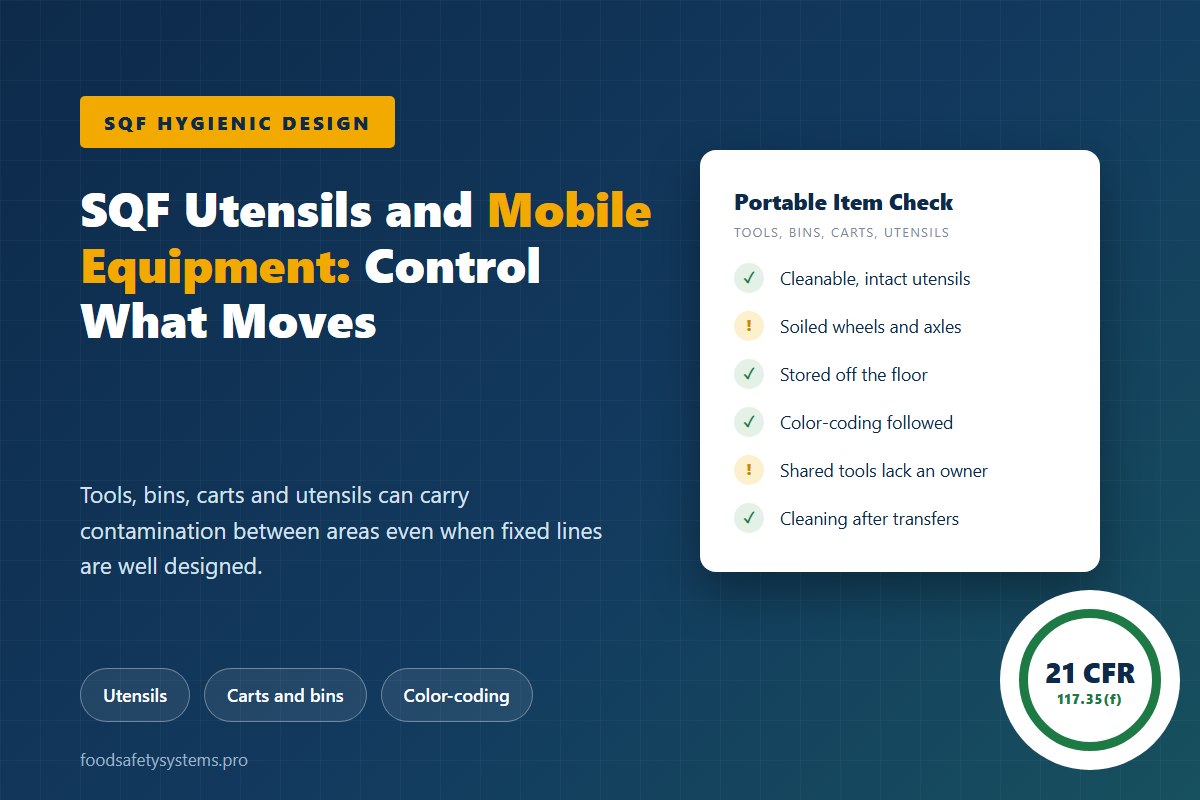
SQF utensils and mobile equipment often get less attention than fixed processing lines, yet they travel everywhere. Portable tools, bins, carts, scoops and utensils can carry contamination between areas even when fixed equipment is well designed. Their materials, storage and cleaning methods therefore deserve the same practical scrutiny as any production line.
Quick answer: control utensils and mobile equipment by choosing cleanable materials, keeping them in good repair, storing cleaned items so they stay clean, separating them by area or use (for example, with color-coding), and defining who cleans them after they move between areas. Then verify those controls on the floor.
Why portable items create hidden risk
A fixed slicer stays in one zone. A cart, a shovel or a tote bin, however, can move from raw material receiving to a high-care area in minutes. Every move is a chance to transfer soil, microorganisms or allergens. In addition, portable items are easy to damage, easy to misplace and easy to store in the wrong spot.
As a result, a well-written sanitation program can still fail when the tools themselves are worn, hard to clean or poorly controlled. These problems rarely improve through documentation alone. Instead, the physical condition and the movement of items need to be understood and addressed.
What good looks like for SQF utensils and mobile equipment
- Cleanable design. Smooth, non-absorbent, durable materials with no hollow handles or crevices that trap residue.
- Good repair. Food-contact utensils without cracks, chips, loose rivets or frayed bristles.
- Cleanable wheels and handles. Carts and racks whose wheels, axles and handles can be reached and cleaned.
- Protected storage. Cleaned items stored off the floor where appropriate, in a way that keeps food-contact surfaces protected.
- Segregation. Color-coding or other controls that keep tools in their assigned area or for their assigned use.
- Clear responsibility. Defined sanitation duties after items move between areas.
In the United States, FDA cGMP rules support the same direction. 21 CFR 117.40 expects equipment and utensils to be adequately cleanable and maintained. Likewise, 21 CFR 117.35 expects cleaned and sanitized portable equipment and utensils to be stored in a location and manner that protects food-contact surfaces from allergen cross-contact and contamination. SQF certification is separate from these FDA requirements, so consider both where they apply.
Common problems with utensils and mobile equipment
- Utensils with damaged edges, cracked plastic or worn coatings still in use.
- Carts with wheels and axles packed with debris, rolling from raw to finished-product areas.
- Cleaned tools stored on the floor, on dirty hooks or next to waste containers.
- Color-coding that exists on paper but is not followed or has faded on the tools.
- Bins used for both product and waste, or for different allergen profiles, without controlled cleaning in between.
- No clear owner for cleaning shared items such as ladders, pallet jacks or maintenance tool carts.
Where portable items cross hygienic zones, the risk rises. Our guide to SQF hygienic zoning explains how traffic controls help keep high-risk areas protected.

A five-step review routine
1. Inventory the items. List utensils, tools, bins, carts and other mobile equipment by area and use. Include maintenance tools that enter production areas.
2. Document the condition. For each item or group, record the observed condition, the affected process, the potential hazard and available evidence, such as inspection findings or swab results.
3. Prioritize by risk. Assess severity and likelihood in your actual facility. Items that touch exposed product or move between zones usually come first. Then assign an owner and an action deadline.
4. Implement controls. Approve suitable changes with input from food safety, sanitation, operations and maintenance. Typical options include replacing damaged tools, adding storage racks, refreshing color-coding or defining cleaning after transfers.
5. Verify and recheck. Confirm that the change is in place and working. Keep objective evidence, and recheck during routine inspections to catch drift.
Records and evidence to keep
- A utensil and mobile equipment register showing area, use, color code and owner.
- Inspection records for condition, including when damaged items were removed.
- Cleaning procedures that cover portable items and transfers between areas.
- Storage and segregation rules, with photos of correct storage.
- Corrective actions and verification results for repeat findings.
Keeping these records consistent with the rest of your sanitation evidence helps auditors follow the story. See our hygiene and sanitation programs page for how the pieces fit together.
Example scenario: the wandering cart
A ready-meal producer finds inconsistent environmental results in its packing room. During a walkthrough, the team notices that a stainless cart used to move ingredients from the dry store also delivers trays to packing. The cart’s wheels are visibly soiled, and nobody is assigned to clean it.
The team rates the finding high because packing handles exposed cooked product. They assign the cart to the dry store only and add a dedicated, color-coded cart for packing. Sanitation adds wheel cleaning to the packing room schedule. Over the following weeks, inspections confirm the carts stay in their areas, and the register records the change and the verification results.
SQF utensils and mobile equipment checklist
- Inventory portable items by area and use.
- Remove or repair damaged food-contact utensils.
- Check that wheels, handles and frames can be cleaned.
- Store cleaned items off the floor where appropriate and protect food-contact surfaces.
- Apply and maintain color-coding or other segregation controls.
- Define cleaning duties after items move between areas.
- Verify controls during routine inspections and trend repeat findings.
Frequently asked questions
Is color-coding required for SQF?
Color-coding is one common way to segregate tools, not the only one. What matters is that your chosen control works and that staff follow it consistently.
Do maintenance tools need sanitation controls?
Yes, where they enter production areas or touch food-contact surfaces. Define how they are cleaned, stored and checked before use in those areas.
How often should utensils be inspected for damage?
Base the frequency on risk, use and wear. High-use food-contact tools typically need checks before or during each shift.
How Consultare Inc. Group can help
Consultare Inc. Group (CIG) can help SQF teams build review checklists, evaluate sanitation program gaps, document responsibilities and organize corrective action closure. Exact deliverables depend on the approved scope. We do not promise certification, regulatory approval or an audit outcome; facility management retains responsibility for approving and implementing changes.
- SQF gap assessments and internal audits: utensil and mobile equipment controls reviewed on the floor.
- Hygiene and sanitation programs: cleaning and storage procedures for portable items.
- Allergen control measures: segregation of tools and bins by allergen profile.
- Corrective action support: tracking repeat findings to verified closure.
Need help managing your SQF responsibilities?
Discuss your products, documentation and compliance priorities with the Consultare team in a free consultation, or contact our team.
Start building your compliance system
Prefer to organize your compliance activities yourself? Create a free SystemsBuilder account to manage specifications, controlled documents, assigned actions and records in one structured workflow. Software supports record management; it does not by itself ensure compliance.
Technical sources: 21 CFR 117.35, 21 CFR 117.40 and SQFI. Independent educational content: Consultare Inc. Group is not affiliated with or endorsed by SQFI or FDA. This article is not legal advice, regulatory approval, certification or a guarantee of compliance. Requirements depend on the facility, food, jurisdiction and applicable program; confirm current requirements and obtain qualified technical review before implementation.