
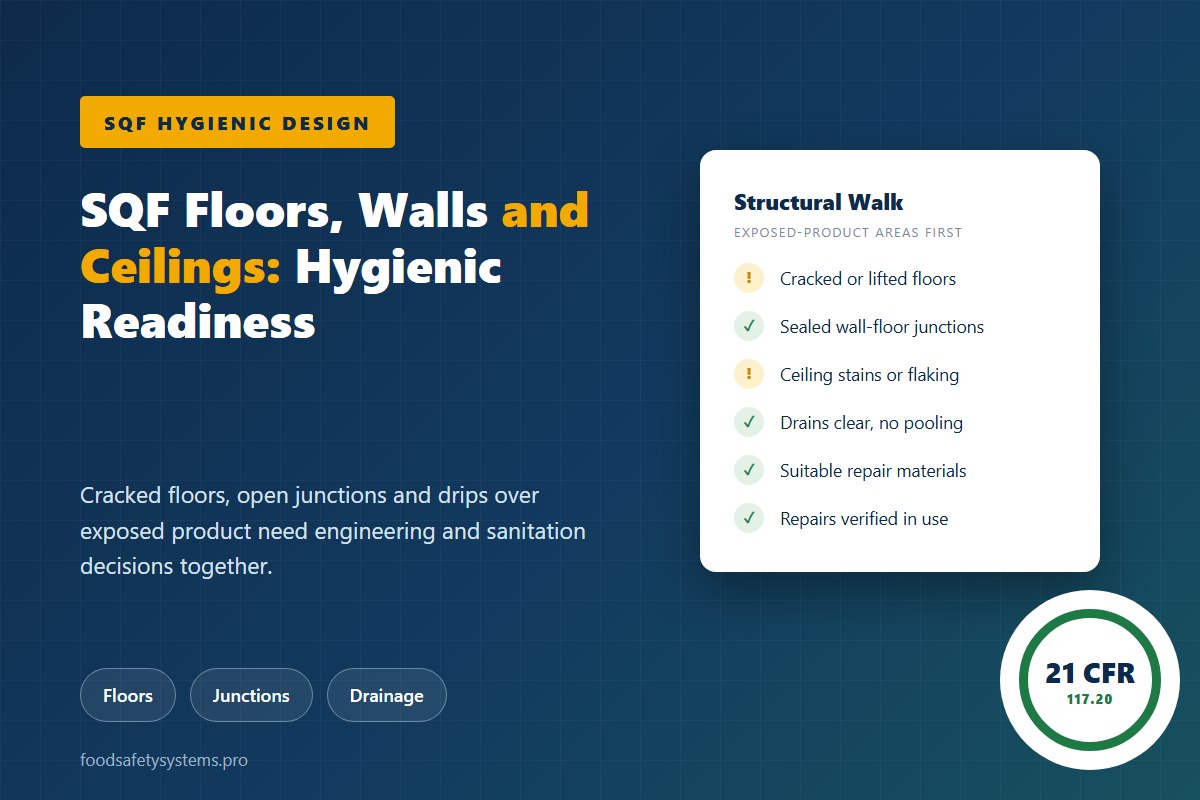
Cracked floors, deteriorating wall junctions and condensation above exposed product turn SQF floors, walls and ceilings into repeat sanitation and audit concerns. Unlike a dirty surface, a damaged one cannot be cleaned back into shape. These issues usually need coordinated engineering and sanitation decisions, not just another round of cleaning.
Quick answer: hygienic floors, walls and ceilings are intact, cleanable, well drained and in good repair, with sealed junctions and no drips over exposed product. Inspect them systematically, rank defects by product exposure, fix them with suitable materials and verify repairs under real operating conditions.
Why structural surfaces matter for SQF readiness
Floors, walls and ceilings form the shell around every process. When that shell breaks down, it creates harborage for residue, moisture and microorganisms. For example, a cracked floor tile can hold water under the surface, a gap at a wall-floor junction can trap debris, and flaking ceiling paint can fall onto open product.
Even a well-written food safety program struggles in these conditions. Consequently, teams face repeated re-cleaning, uncertain corrective action closure and difficult audit discussions. Addressing root causes, by contrast, supports reliable operations and clearer accountability. Our page on facility design, maintenance and pest control covers the wider facility program; this article focuses on the condition of the building surfaces themselves.
What good looks like for SQF floors, walls and ceilings
- Floors that are intact, impervious where wet processing occurs, and sloped so water reaches drains instead of pooling.
- Walls with smooth, cleanable finishes and sealed junctions at floors, doors and penetrations.
- Ceilings that are cleanable, free of flaking material and protected from leaks and condensation.
- Drainage that works, with grates and channels that can be cleaned and inspected.
- Repairs made with materials suitable for a food environment, not temporary fixes that become permanent.
- Access that allows cleaning and inspection behind and around equipment.
In the United States, FDA cGMP rules point the same way. 21 CFR 117.20 expects plants to be built so that floors, walls and ceilings can be adequately cleaned, kept clean and kept in good repair, and so that drip or condensate from fixtures, ducts and pipes does not contaminate food, food-contact surfaces or packaging. In addition, 21 CFR 117.35 requires buildings and fixtures to be kept clean and in adequate repair. SQF certification is a separate, voluntary program, so review both where they apply.
Common structural problems
- Cracked or missing floor tiles, failing resin coatings and eroded grout.
- Open joints at wall-floor junctions, around pipes and at door frames.
- Damaged wall panels with exposed insulation or gaps behind them.
- Water ingress from roofs, walls or poorly sealed penetrations.
- Standing water from poor floor slope or blocked drains.
- Ceilings with flaking paint, stains, mold or condensation.
Drains and floor cracks in wet areas deserve special attention because they can harbor Listeria. See our guide to Listeria environmental monitoring for how monitoring data can point to structural problems.
A five-step structural review
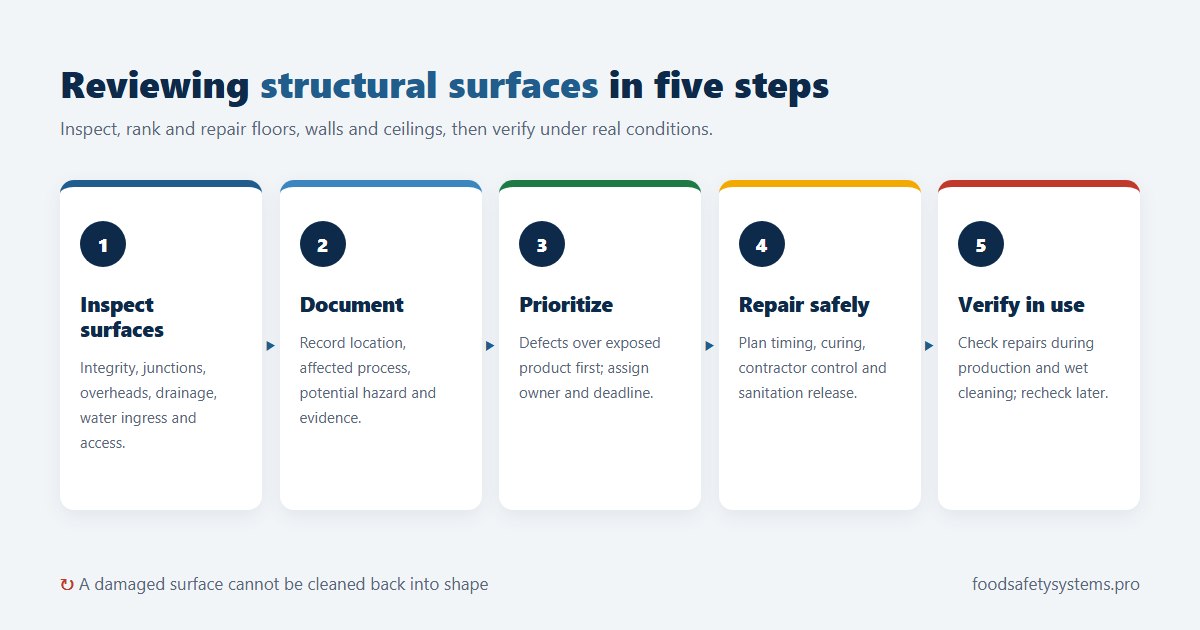
1. Inspect surfaces. Walk each area and check surface integrity, junctions, overhead conditions, drainage, water ingress, earlier repairs and cleaning access. Prioritize areas with exposed product.
2. Document the condition. Record what you see, where it is, which process it affects, the potential hazard and any supporting evidence, such as swab results or sanitation inspection findings.
3. Prioritize by risk. Assess severity and likelihood in your actual facility. A ceiling defect over open product ranks higher than the same defect over sealed packaging storage. Next, assign an owner and a deadline.
4. Implement repairs. Approve suitable engineering or procedural changes with food safety, sanitation, operations and maintenance input. Plan repair timing, material curing and sanitation release so the repair does not create a new risk.
5. Verify under operating conditions. Check completed repairs during normal production, including wet cleaning. Keep objective evidence, and recheck periodically for recurrence.
Records and evidence to keep
- A facility condition register listing defects, location, risk rating, owner and due date.
- Dated photos before and after repair.
- Work orders, contractor controls and post-repair sanitation release records.
- Interim controls used until permanent repairs are complete.
- Verification results and follow-up inspection notes.
Example scenario: a failing floor near a fryer
A prepared-foods plant notices that sanitation crews struggle to clean the floor around a fryer. On closer inspection, the resin coating has lifted, and water collects underneath it. Environmental swabs from the area show intermittent positives for indicator organisms.
The team rates the defect high because product is exposed nearby and the area is wet-cleaned daily. As an interim control, they increase cleaning frequency and add a squeegee step. Maintenance then schedules a coating replacement during a planned shutdown, with a full sanitation release afterwards. Follow-up swabs and inspections over the next month show stable results, and the register links the finding, the repair and the verification.
SQF floors, walls and ceilings checklist
- Inspect floors for cracks, lifted coatings, eroded grout and poor slope.
- Check wall finishes and seal junctions at floors, doors and penetrations.
- Look for flaking material, stains, leaks and condensation on ceilings.
- Confirm drains work and can be cleaned and inspected.
- Replace temporary repairs with suitable permanent materials.
- Rank defects by product exposure and assign owners and due dates.
- Verify repairs under operating conditions and recheck for recurrence.
Frequently asked questions
Can we keep producing while structural repairs are pending?
Often yes, if you assess the risk and put documented interim controls in place. However, defects over exposed product may need faster action or production changes.
How do we keep repairs from creating new hazards?
Plan the work with food safety input. Protect product and equipment, control contractors, allow coatings to cure and complete a sanitation release before production restarts.
How often should structural surfaces be inspected?
Set a frequency based on risk and area use. Wet, high-care and exposed-product areas typically need more frequent checks than dry storage.
How Consultare Inc. Group can help
Consultare Inc. Group (CIG) supports SQF readiness gap reviews, documented facility condition assessments, action registers and corrective action follow-up. Exact deliverables depend on the approved scope. We do not promise certification, regulatory approval or an audit outcome; facility management retains responsibility for approving and implementing changes.
- SQF gap assessments and internal audits: documented facility condition reviews ranked by risk.
- GMP implementation: building and maintenance practices that support hygienic surfaces.
- Corrective action support: repair registers with owners and closure evidence.
- Audit readiness coaching: preparing teams to explain facility conditions and actions.
Need help managing your SQF responsibilities?
Discuss your products, documentation and compliance priorities with the Consultare team in a free consultation, or contact our team.
Start building your compliance system
Prefer to organize your compliance activities yourself? Create a free SystemsBuilder account to manage specifications, controlled documents, assigned actions and records in one structured workflow. Software supports record management; it does not by itself ensure compliance.
Technical sources: 21 CFR 117.20, 21 CFR 117.35 and SQFI. Independent educational content: Consultare Inc. Group is not affiliated with or endorsed by SQFI or FDA. This article is not legal advice, regulatory approval, certification or a guarantee of compliance. Requirements depend on the facility, food, jurisdiction and applicable program; confirm current requirements and obtain qualified technical review before implementation.