

SQF overhead contamination prevention starts with looking up. Condensation, dust, leaking utilities and poorly maintained overhead fixtures can threaten exposed food and food-contact surfaces. Yet these risks are easy to overlook when inspection programs focus only on equipment at floor level.
Quick answer: map overhead structures above exposed product, inspect ceilings, pipes, cable trays, lights, insulation and HVAC condensate, rank conditions by contamination significance, and apply controls such as repairs, insulation, drip trays, rerouting or cleaning access. Then verify that the controls work during normal production.
Why overhead risks are easy to miss
Most sanitation programs are built around what crews can reach from the floor. Overhead areas, by contrast, need ladders, lifts or shutdowns, so they are cleaned and inspected less often. Meanwhile, cold pipes sweat, insulation degrades, dust settles on cable trays and fixtures age. Eventually, something drips or falls.
Because overhead problems are intermittent, they can also be hard to prove. A drip may only form during humid weather, after a washdown or when a refrigeration unit defrosts. As a result, the same finding can reappear audit after audit unless the root cause is understood and fixed.
What good looks like in SQF overhead contamination prevention
- Known overhead layout. The team knows which utilities, ducts and fixtures run above exposed product and food-contact surfaces.
- Condensation control. Cold surfaces are insulated, ventilated or otherwise controlled so drips do not reach product.
- Clean and intact structures. Ceilings, pipes, cable trays and lights are free of flaking material, dust build-up and leaks.
- Protected lighting. Light fixtures over exposed food are shatter-resistant or otherwise protected.
- Access for cleaning. Overhead areas are included in the master sanitation schedule, with safe access methods.
In the United States, FDA cGMP rules support these points. 21 CFR 117.20 expects plants to be built so that drip or condensate from fixtures, ducts and pipes does not contaminate food, food-contact surfaces or packaging, and calls for shatter-resistant bulbs and fixtures or other protection over exposed food. In addition, 21 CFR 117.80 expects food to be protected from contaminants that may drip, drain or be drawn into it. SQF certification remains separate from these FDA obligations.
Common overhead problems
- Condensation on uninsulated chilled water or refrigerant lines above open product.
- Damaged or saturated pipe insulation that sheds fibers or drips.
- Dust and debris on cable trays, beams and the tops of equipment.
- HVAC units with blocked condensate drains or leaking drip pans.
- Ceiling leaks after heavy rain or roof work.
- Unprotected light fixtures or cracked lenses over production lines.
Overhead conditions often show up in sanitation and pest findings too. Our page on facility design, maintenance and pest control covers the wider building program, while our guide to SQF sanitation requirements explains how overhead cleaning fits the master schedule.
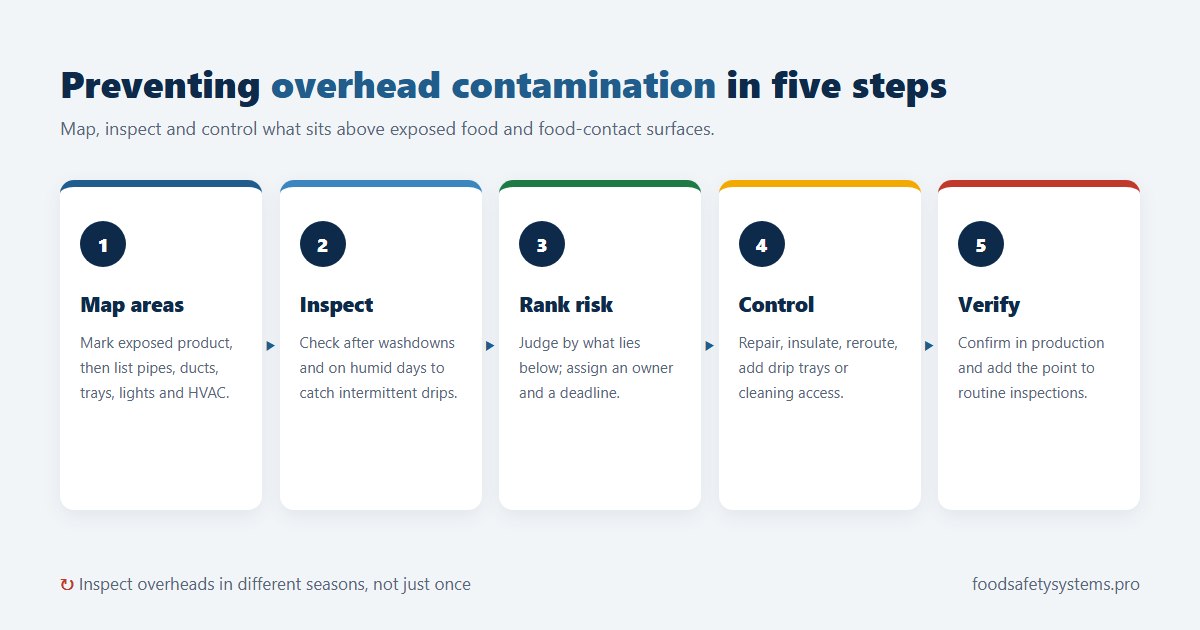
A five-step overhead review
1. Map exposed-product areas. Mark where product or food-contact surfaces are exposed. Then list what runs overhead in each area: pipes, ducts, cable trays, lights and HVAC units.
2. Inspect overhead conditions. Check ceilings, pipes, cable trays, lights, insulation and HVAC condensate. Inspect at different times, such as after washdowns or during humid weather, to catch intermittent drips.
3. Rank by contamination significance. Assess severity and likelihood based on what lies below. A drip over an open mixer ranks higher than one over a sealed pallet. Assign an owner and a deadline.
4. Select and implement controls. With food safety, sanitation, operations and maintenance input, choose suitable controls. Options include repairs, new insulation, rerouting, drip trays, protective covers or added cleaning access.
5. Verify and monitor. Confirm the control works during normal production. Keep objective evidence, and add the area to routine overhead inspections so recurrence is caught early.
Records and evidence to keep
- An overhead map or list for each exposed-product area.
- Overhead inspection records with dates, conditions and photos.
- Master sanitation schedule entries for overhead cleaning.
- Work orders for insulation, piping and HVAC repairs, with sanitation release.
- Product disposition decisions when an overhead event may have affected product.
- Verification and follow-up results.
Example scenario: summer condensation over a mixing area
A bakery ingredient blender notices water spots on a mixer lid each summer. During an overhead review, the team traces them to an uninsulated chilled water line running directly above the mixer. The problem only appears on humid days, so earlier inspections missed it.
The team rates the finding high because the mixer is open during charging. As an interim control, operators cover the mixer and check the line before each batch. Maintenance then insulates the pipe and adds a drip tray. Follow-up checks during the next humid spell show no condensation, and the overhead inspection record now includes that line as a monitored point.
SQF overhead contamination prevention checklist
- Identify exposed-product areas and map overhead utilities and fixtures.
- Inspect for condensation, leaks, dust, flaking material and damaged insulation.
- Check HVAC condensate drains and drip pans.
- Confirm lights over exposed product are shatter-resistant or protected.
- Include overhead cleaning in the master sanitation schedule.
- Rank findings, assign owners and record interim controls.
- Verify fixes during normal operation and in different seasons.
Frequently asked questions
How often should overhead areas be inspected?
Base the frequency on risk. Areas above exposed product usually need routine checks, plus extra checks after washdowns, roof work or weather changes.
What should we do if condensation drips onto product?
Follow your corrective action and product evaluation procedures. Assess affected product, stop the source, record the decision and verify the fix.
Are drip trays an acceptable long-term fix?
They can be, if they are cleanable, emptied and included in sanitation. However, controlling the condensation source is usually more reliable.
How Consultare Inc. Group can help
Consultare Inc. Group (CIG) can help SQF teams structure facility walkthroughs, review overhead inspection records and coordinate prioritized corrective actions. Exact deliverables depend on the approved scope. We do not promise certification, regulatory approval or an audit outcome; facility management retains responsibility for approving and implementing changes.
- SQF gap assessments and internal audits: structured walkthroughs that include overhead areas.
- Hygiene and sanitation programs: master sanitation schedules that cover overhead cleaning.
- Corrective action support: prioritized overhead actions tracked to closure.
- GMP implementation: building and utility practices that protect exposed product.
Need help managing your SQF responsibilities?
Discuss your products, documentation and compliance priorities with the Consultare team in a free consultation, or contact our team.
Start building your compliance system
Prefer to organize your compliance activities yourself? Create a free SystemsBuilder account to manage specifications, controlled documents, assigned actions and records in one structured workflow. Software supports record management; it does not by itself ensure compliance.
Technical sources: 21 CFR 117.20, 21 CFR 117.80 and SQFI. Independent educational content: Consultare Inc. Group is not affiliated with or endorsed by SQFI or FDA. This article is not legal advice, regulatory approval, certification or a guarantee of compliance. Requirements depend on the facility, food, jurisdiction and applicable program; confirm current requirements and obtain qualified technical review before implementation.