
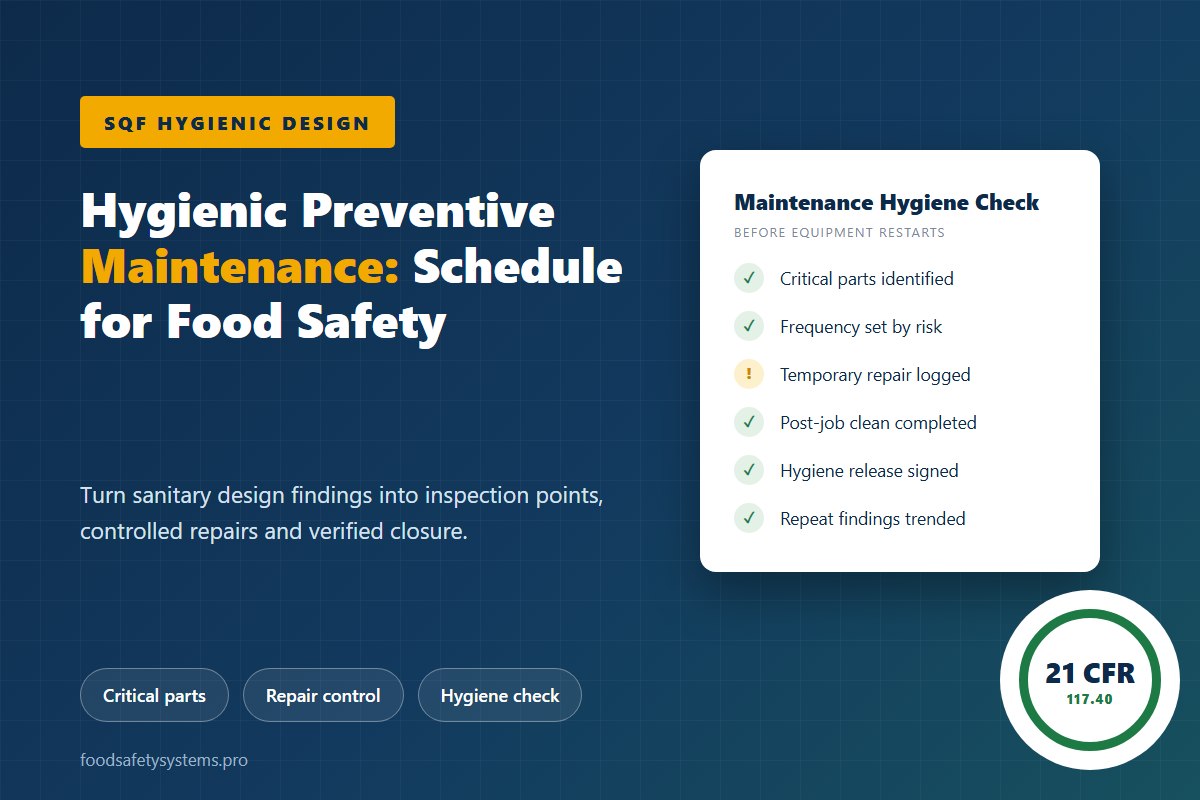
Hygienic preventive maintenance treats equipment care as a food safety control, not just an uptime task. Recurring equipment defects often return when maintenance schedules focus only on mechanical performance. As a result, worn seals, cracked guards and temporary repairs can sit in product zones for weeks. Sanitary design concerns therefore need inspection points and work priorities that reflect food safety exposure.
Quick answer: build hygienic preventive maintenance by classifying food safety-critical components, setting inspection frequencies from risk and history, controlling temporary repairs, adding a sanitation check after every maintenance job, and verifying documented closure of repeat findings. SQF certification and U.S. FDA current good manufacturing practice (cGMP) requirements are separate obligations, so review both where they apply.
Who this guidance is for
This article is written for SQF production managers, maintenance planners, sanitation leads and SQF practitioners. It is also useful for engineering teams that schedule work on food-contact equipment and for internal auditors who review repeat sanitation findings.
Why maintenance schedules miss sanitary design problems
Most maintenance systems are built around breakdowns, run hours and spare parts. Those triggers protect production capacity. However, they rarely ask whether a component can still be cleaned, inspected and kept free of residue.
Even a well-written food safety program is hard to apply when equipment has inaccessible surfaces, damaged seals, unsuitable materials or poorly controlled surroundings. A risk-based review considers the food, the process, product exposure, cleaning frequency and observed performance before deciding on corrective action.
The business impact also goes beyond the technical finding. Repeated re-cleaning, unclear corrective action closure, avoidable downtime and gaps in audit evidence all consume resources. Addressing root causes, in contrast, supports reliable operations and clearer accountability.
What good hygienic preventive maintenance looks like
A mature program links the maintenance schedule to the sanitation program and the food safety plan. In practice, this means a few specific habits:
- Food safety-critical components are identified. Gaskets, seals, scraper blades, belts, product-contact guides and bearings near exposed product are flagged in the asset register.
- Frequencies follow risk and history. Parts with frequent failures or high product exposure receive shorter inspection intervals.
- Temporary repairs are controlled. Tape, wire, cable ties and improvised shims are recorded, time-limited and replaced with permanent fixes.
- Every job ends with a hygiene release. Sanitation or quality staff confirm the area is clean, tools and parts are removed, and the equipment is fit for production.
- Repeat findings are trended. The same defect on the same asset triggers root cause analysis rather than another routine work order.
For context, U.S. FDA cGMP rules require equipment and utensils to be adequately cleanable and adequately maintained to protect against allergen cross-contact and contamination (21 CFR 117.40). Our SQF equipment hygiene article explains how equipment condition shows up during audits.
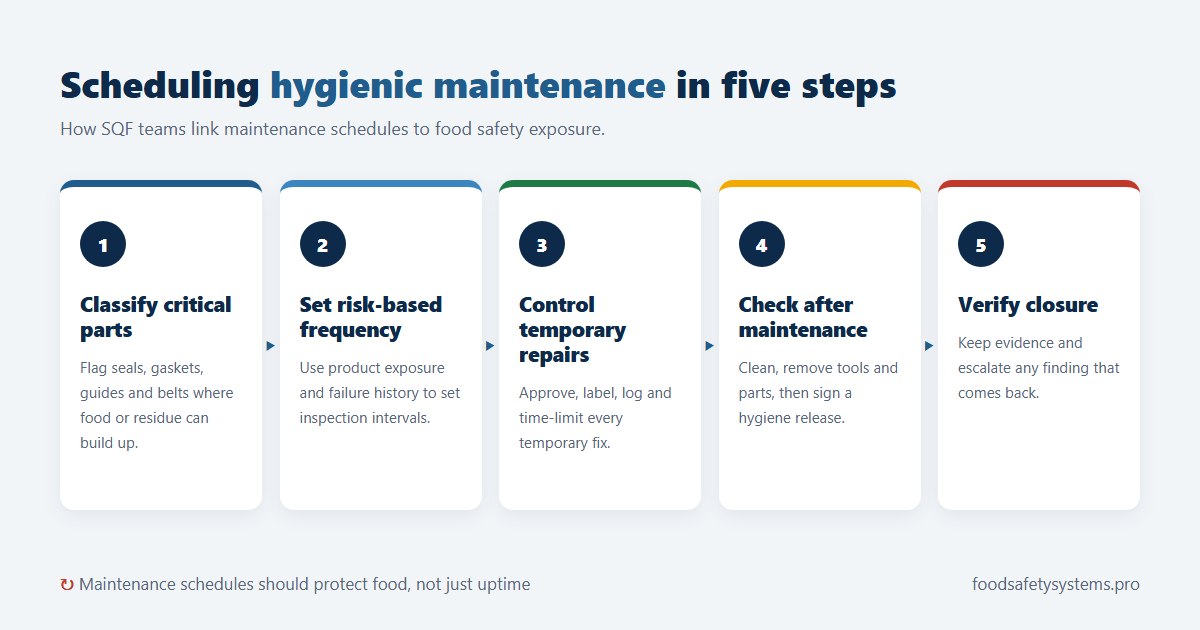
Five steps to schedule hygienic preventive maintenance
The following review steps turn sanitary design observations into a schedule that maintenance and food safety teams can both own.
1. Classify food safety-critical components
Walk each line with maintenance, sanitation and quality staff. Identify where food, residues, moisture or allergens could accumulate. Then record the component, its location, its product exposure and the hazard it could create.
2. Set inspection frequencies from risk and history
Assess severity and likelihood in the actual facility context. Review records of sanitation failures, equipment repairs and recurring observations. Next, assign each component an inspection interval, a responsible person and a clear acceptance criterion.
3. Control temporary repairs
Temporary fixes are sometimes unavoidable. Even so, they should be approved, labelled, logged with a removal date and checked during pre-operational inspection. An open temporary repair list is often the quickest way to see hidden hygiene risk.
4. Add post-maintenance sanitation checks
Work on or near product zones can leave lubricants, metal fragments, debris or fingerprints behind. For this reason, require a documented clean-up and a hygiene release before production restarts. Include tool and part counts where loose items could enter the product.
5. Verify closure of repeat findings
Check that the completed action actually removed the problem. Retain objective evidence, such as photos, swab or ATP results where used, and the signed release. When a finding returns, escalate it to corrective action rather than closing another work order.
Common problems we see
- Preventive maintenance tasks that list mechanical checks only, with no hygiene inspection points.
- Seal and gasket replacements based on failure instead of a planned interval.
- Temporary repairs that remain in place for months without review.
- Maintenance staff restarting equipment without a sanitation or quality release.
- Work orders closed without evidence that the root cause was addressed.
- No distinction between applicable requirements and voluntary technical guidance.
Records and evidence to keep
Auditors usually want to see that the schedule exists, that it is followed and that it works. Useful evidence includes:
- An asset register showing food safety-critical components and their inspection frequencies.
- Completed preventive maintenance work orders with hygiene checkpoints signed off.
- A temporary repair log with approval, removal dates and verification.
- Post-maintenance hygiene release records for work in or near product zones.
- Trend reports of repeat equipment and sanitation findings, linked to corrective actions.
- Calibration records for instruments that support food safety decisions.
Measuring devices deserve the same discipline. See our SQF calibration program guide for how to keep that evidence consistent.
Example scenario: a recurring gasket failure
In this illustrative example, a ready-meal plant records residue behind the door gasket of a mixer during three consecutive pre-operational inspections. Each time, the sanitation crew re-cleans and the line starts. However, nobody asks why the residue keeps returning.
During a hygienic preventive maintenance review, the team finds the gasket is replaced only when it tears. Its surface has hardened and cracked, so it now traps product. The team classifies the gasket as food safety-critical and sets a planned replacement interval. They also add a monthly visual check and require a hygiene release after each change.
Two months later, pre-operational records show no further residue at that point. The corrective action is closed with photos, work orders and inspection results as evidence.
Hygienic preventive maintenance checklist
- Identify food safety-critical components on every line.
- Confirm routine cleaning and inspection can reach the relevant surfaces.
- Evaluate layout, personnel movement, utilities and maintenance interfaces.
- Set inspection frequencies based on risk and failure history.
- Log, label and time-limit every temporary repair.
- Require a documented hygiene release after maintenance in product zones.
- Trend repeat findings and escalate them to corrective action.
- Separate applicable requirements from voluntary technical guidance.
Broader building and equipment upkeep is covered on our facility design, maintenance and pest control page.
Frequently asked questions
Is hygienic preventive maintenance different from normal preventive maintenance?
It uses the same planning tools. However, it adds food safety criteria: component cleanability, product exposure, temporary repair control and a hygiene release before restart.
Who should own the hygienic preventive maintenance schedule?
Maintenance usually owns the schedule. Even so, food safety, sanitation and operations should agree the critical components, frequencies and release criteria together.
When should we ask for outside support?
Consider outside help when the same condition returns despite prior corrective actions, when new equipment creates design uncertainty, or when evidence needs organizing before an audit.
How Consultare Inc. Group can help
Consultare Inc. Group can help SQF teams review maintenance program documentation, set up risk-based action registers and coordinate audit-readiness evidence. Exact deliverables depend on the approved scope. Facility management retains responsibility for approving and implementing changes, and we do not promise certification, regulatory approval or a particular audit outcome.
- SQF gap assessments and internal audits: maintenance and sanitation program review.
- Corrective action support: root cause analysis for repeat equipment findings.
- Audit readiness coaching: organize maintenance evidence before the audit.
- Compliance huddle training: short sessions on contamination prevention.
Need help managing your SQF responsibilities?
Discuss your products, documentation and compliance priorities with the Consultare team in a free consultation, or contact our team.
Start building your compliance system
Prefer to organize your compliance activities yourself? Create a free SystemsBuilder account to manage specifications, controlled documents, assigned actions and records in one structured workflow. Software supports record management; it does not by itself ensure compliance.
Technical sources: 21 CFR 117.40, 21 CFR 117.35 and SQFI. Independent educational content: Consultare Inc. Group is not affiliated with or endorsed by SQFI or FDA. This article is not legal advice, regulatory approval, certification or a guarantee of compliance; requirements depend on the facility, food, jurisdiction and applicable program, so confirm current requirements and obtain qualified technical review before implementation.