
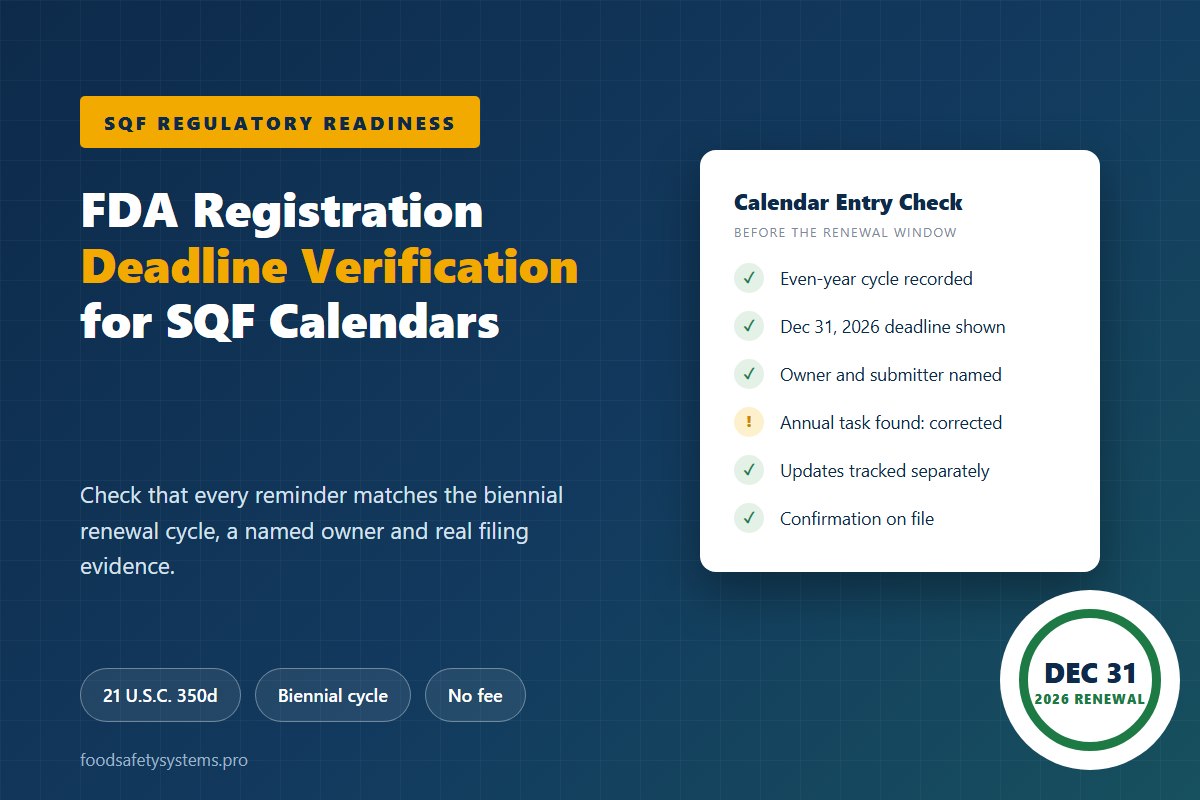
FDA registration deadline verification checks that the reminders in your SQF compliance calendar match the real regulatory due dates, owners and evidence. Compliance calendars reduce missed deadlines only when their entries are accurate and assigned to someone with the authority to act. A generic “annual renewal” task, for example, misstates the FDA biennial schedule and can send a team chasing the wrong date.
Quick answer: compare every FDA registration entry in the calendar with the statutory cycle. Covered food facilities renew between October 1 and December 31 of each even-numbered year, and the 2026 deadline is December 31. Then confirm that each entry has a named owner, an authorized submitter, an internal reminder date and a defined piece of filing evidence. Track registration updates as separate entries, because an update is not a renewal.
Who this guidance is for
This article is for SQF practitioners, compliance coordinators and quality managers who maintain a regulatory calendar for one or more sites. It is also useful for internal auditors who need to test whether that calendar actually works.
Why calendar entries need verification
A calendar is a control, and like any control it can be wrong. Entries are often copied from an older template, created by someone who has since left, or written as a recurring yearly task. As a result, the reminder may fire in the wrong year, point to the wrong facility or name an owner who cannot submit anything.
Verification closes that gap. Instead of asking “is there a reminder?”, the reviewer asks “is this reminder correct, and will it lead to a completed filing?” SQF management practices such as internal audits and management review can test that question. However, they do not replace the regulatory submission itself.
If you have not yet built the calendar, start with our guide to building an SQF regulatory calendar around FDA registration renewal. This article focuses on the next step: checking that the entries you already have are right.
The 2026 FDA registration requirement
Under section 415 of the Federal Food, Drug, and Cosmetic Act (21 U.S.C. 350d) and 21 CFR Part 1, Subpart H, food facilities required to register must renew between October 1 and December 31 of each even-numbered year. The 2026 deadline is December 31.
An earlier update does not replace the renewal. Updates to required registration information follow their own timing under 21 CFR 1.234, generally within 60 days of the change. FDA currently accepts a DUNS number as the Unique Facility Identifier and does not charge a renewal fee. Applicability and exemptions still require a facility-specific review.
How to run FDA registration deadline verification
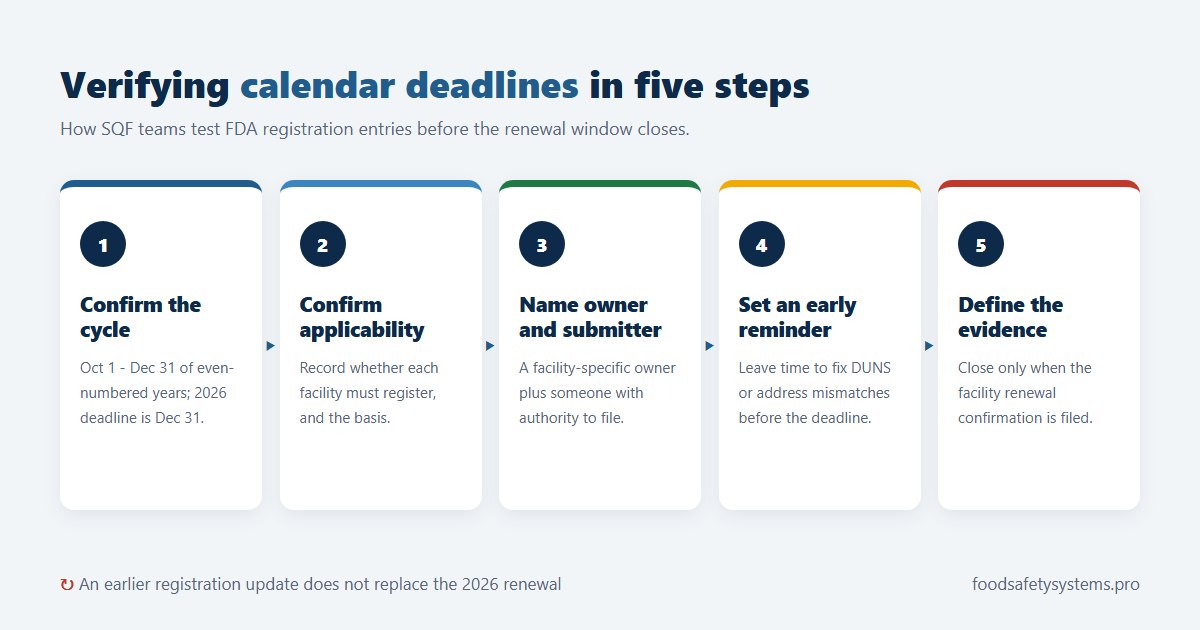
Work through the calendar one facility at a time. For each FDA registration entry, check the following points against an authoritative source rather than against the previous calendar.
1. Confirm the cycle and the date
The entry should reflect a biennial cycle tied to even-numbered years. It should show the statutory window and the December 31 deadline. If the entry repeats every year, or shows a date outside the window, correct it.
2. Confirm applicability
Next, record whether the facility is required to register and why. A site that is exempt, or whose status is uncertain, should carry a documented decision rather than a silent gap.
3. Confirm ownership and authority
Each entry needs a facility-specific owner. In addition, someone must hold the account access and authority to submit. Owners and submitters are often different people, so record both. Our article on assigning FDA renewal responsibilities explains how to divide those roles.
4. Set the internal reminder early enough
The internal reminder should fall well ahead of the legal deadline. That way, the team has time to fix data problems, such as a DUNS address that does not match the registration. Each facility should pick a lead time that suits its own approval process.
5. Define completion evidence
Finally, state what proves the task is done. Normally, that is the renewal confirmation for the specific facility, filed under document control. A verbal update or a ticked box is not enough.
Keep updates and renewals on separate lines
A frequent calendar error is merging two different obligations. A registration update is triggered by a change in required information, such as a new owner or contact. The biennial renewal, by contrast, follows the fixed even-year cycle.
When the two share a single entry, an update completed in spring may close the item. The renewal then has no reminder at all. Therefore, keep a recurring renewal entry and a separate, event-driven update entry linked to your change control process.
Records to keep
- A facility applicability register with the basis for each decision.
- The calendar entry, including owner, submitter, reminder date and deadline.
- The verification record showing who checked the entry, when and against which source.
- The renewal confirmation for each covered facility.
- Any correction made to the calendar, with the reason.
Common mistakes
- Scheduling FDA renewal as an annual task.
- Naming a department instead of a person as owner.
- Marking a task complete because a reminder was sent.
- Treating an SQF certificate or audit result as proof of FDA renewal.
- Letting a registration update close the renewal entry.
Example workflow
Consider a company with three SQF-certified sites. In early autumn, the compliance coordinator exports the calendar and reviews each FDA entry. She finds that one site’s reminder is set for every January, and another names a manager who has left. She corrects the cycle, assigns a new owner and authorized submitter, and logs both changes.
During the renewal window, each owner files the renewal and uploads the confirmation. The coordinator checks every confirmation before closing the entries. Finally, she reports the verified status at the next management review, with any open item and its due date clearly shown.
FDA registration deadline verification checklist
- Verify the statutory renewal date and the biennial cycle.
- Assign facility-specific owners and authorized submitters.
- Track interim updates separately from the biennial renewal.
- Confirm actual filing evidence before marking an entry complete.
- Review overdue or corrected entries through management review.
Frequently asked questions
How often should we verify calendar entries?
At a minimum, before each renewal window opens and whenever ownership or facility details change. Many teams also test a sample of entries during internal audits.
Does SQF certification confirm our FDA deadlines are correct?
No. SQF certification and FDA Food Facility Registration serve different purposes. SQF practices can help you verify ownership and completion, but the legal filing remains a separate obligation.
Can one calendar entry cover all our facilities?
It is safer to use one entry per covered facility. Each site has its own registration, owner and evidence, so a combined entry can hide a site that was missed.
How Consultare Inc. Group can help
Consultare Inc. Group provides food safety and regulatory compliance support tailored to the agreed engagement scope. We do not promise certification, regulatory approval or an audit outcome.
- FDA compliance integration: map regulatory deadlines into your SQF system.
- Internal audit support: test calendar entries against records.
- Document control: keep confirmations and calendar versions controlled.
- Post-certification compliance management: keep recurring obligations on track.
Need help managing your SQF responsibilities?
Discuss your products, documentation and compliance priorities with the Consultare team in a free consultation, or contact our team.
Start building your compliance system
Prefer to organize your compliance activities yourself? Create a free SystemsBuilder account to manage specifications, controlled documents, assigned actions and records in one structured workflow. Software supports record management; it does not by itself ensure compliance.
Regulatory references: FDA 2026 Biennial Renewal User Guide, FDA reminder on biennial renewal requirements, FDA Online Registration of Food Facilities, 21 U.S.C. 350d and 21 CFR Part 1, Subpart H. Independent educational content: Consultare Inc. Group is not affiliated with, endorsed by or authorized to act on behalf of the U.S. Food and Drug Administration (FDA) or the Safe Quality Food Institute (SQFI). This article is not legal advice or an official statement of FDA policy. Requirements may change, and applicability depends on each facility; verify current requirements with official FDA sources.