
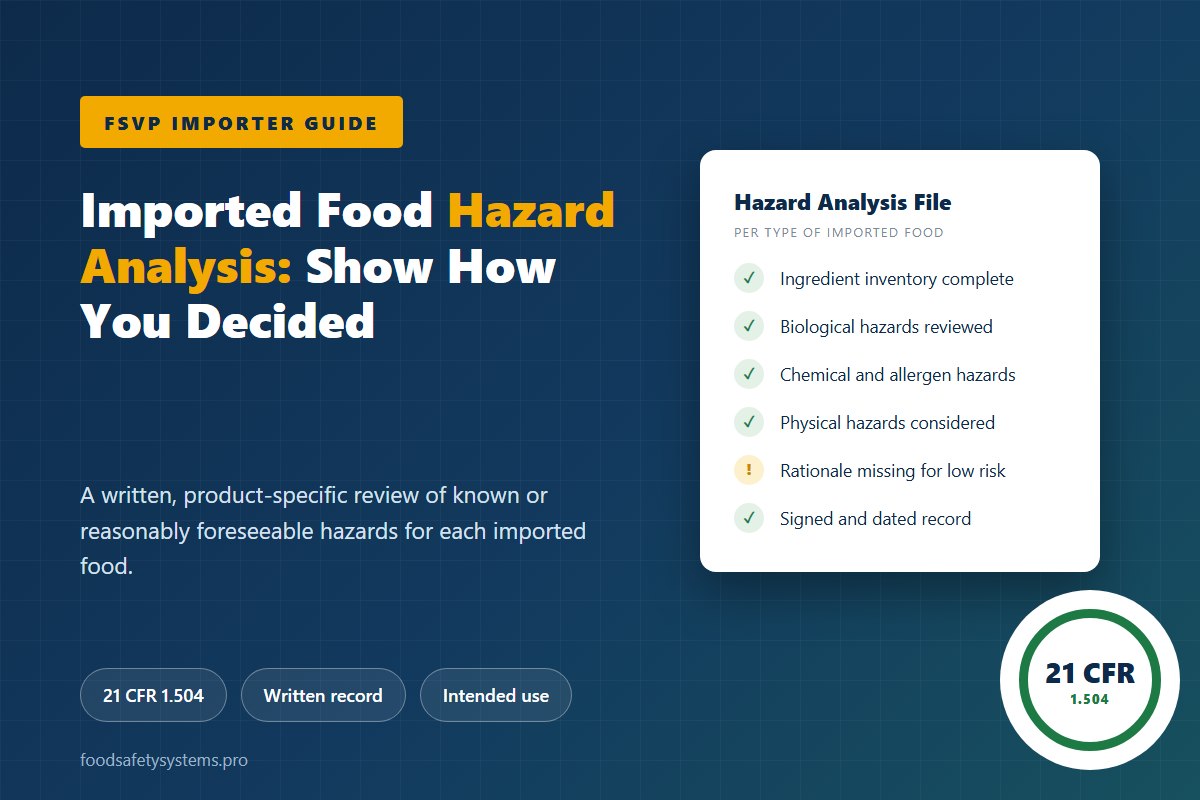
An imported food hazard analysis has to explain which hazards in a specific food need a control, and why. One finished product can contain dozens of ingredients, each with its own hazard profile. However, many food safety teams hold a finished-product specification with little visibility into raw-material hazards, allergen cross-contact, upstream processing or intended consumer use. A generic hazard list rarely closes that gap.
Quick answer: under the FDA Foreign Supplier Verification Program (FSVP) rule, 21 CFR 1.504 requires importers covered by the standard provisions to identify and evaluate known or reasonably foreseeable hazards for each type of food they import. The analysis must be written regardless of its outcome. It weighs the probability of each hazard in the absence of controls and the severity of illness or injury, and it then decides which hazards require a control.
What the FSVP hazard analysis must cover
The rule lists three hazard types. Biological hazards include parasites, environmental pathogens and other pathogens. Chemical hazards include radiological hazards, pesticide and drug residues, natural toxins, decomposition, unapproved food or color additives and food allergens. Physical hazards include stones, glass and metal fragments.
In addition, the analysis must consider hazards that occur naturally, are introduced unintentionally, or may be introduced intentionally for economic gain. The evaluation must also consider factors such as formulation, raw materials, processing and packing, transportation, storage, sanitation, and the intended or reasonably foreseeable use of the food.
The hazard analysis is the foundation, not the whole program. It feeds the supplier evaluation and verification steps that follow, but it does not satisfy every FSVP requirement on its own. Moreover, certain foods and importers are exempt or subject to modified requirements, so applicability should be confirmed first.
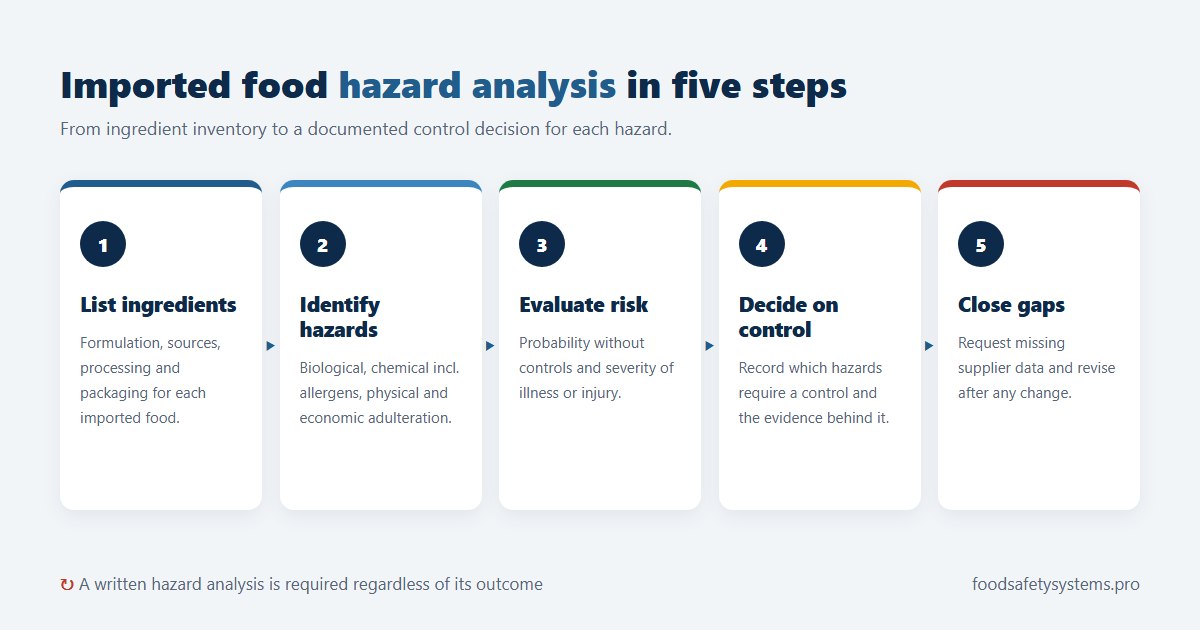
How to build an imported food hazard analysis step by step
Start with product-specific information rather than a generic template. A defensible assessment shows which hazards were considered and how each conclusion was reached.
- Build the product and ingredient inventory. List the formulation, ingredient sources, processing steps and packaging for each imported food.
- Identify reasonably foreseeable hazards. Examine how each ingredient and processing step could introduce or increase a hazard.
- Evaluate severity and probability without controls. Use experience, illness data, scientific reports and other relevant information.
- Decide whether each hazard requires a control. Record the decision, the rationale and the supporting evidence.
- Flag evidence gaps. Note missing supplier data or unanswered technical questions and assign follow-up.
What good evidence looks like
A reviewer should be able to trace every conclusion to a source. Useful evidence includes ingredient specifications, supplier process descriptions, published scientific information, recall and outbreak history for the food type, and testing data where available.
Consider intended use carefully. For example, a food that is normally cooked by the consumer may be evaluated differently from a ready-to-eat item. The hazard evaluation must also address environmental pathogens when a ready-to-eat food is exposed to the environment before packaging and receives no later treatment or other control that significantly minimizes the pathogen.
The rule also allows an importer to rely on a hazard analysis performed by another entity, including the foreign supplier, when a qualified individual conducted it. In that case, the importer must document its own review and assessment of that analysis, including evidence of the qualified individual. Simply filing the supplier’s document is not enough.
Common gaps in imported food hazard analysis files
- One generic hazard list is reused across very different products.
- Allergens and allergen cross-contact are missing or treated as a labeling issue only.
- Economically motivated adulteration is not considered for vulnerable ingredients.
- Conclusions state “low risk” without any reference or rationale.
- A supplier’s hazard analysis is on file, but there is no record of the importer’s review.
- The analysis has not been revisited after a formulation, supplier or process change.
Example scenario: a multi-ingredient snack bar
Illustrative example. An importer brings in a ready-to-eat snack bar containing roasted nuts, dried fruit, chocolate pieces and a grain binder. The original file lists “Salmonella, foreign material, allergens” with no further detail.
A product-specific review breaks the bar into its ingredients. Nuts and chocolate raise Salmonella and tree nut or milk allergen questions. Dried fruit may raise questions about mycotoxins or pesticide residues. The grain binder may raise questions about undeclared gluten. The team then records which hazards the foreign supplier controls, for example through roasting, and which depend on upstream ingredient suppliers. As a result, the later supplier evaluation has clear questions to answer.
How this connects to your SQF supplier program
FSVP is a U.S. importer obligation. SQF certification does not satisfy FSVP by itself. Still, an SQF site that imports raw materials can use the same hazard thinking in its approved supplier program and raw material controls. A supplier’s SQF or other GFSI certificate and audit report can be one input to the analysis. However, it does not replace a written, product-specific hazard analysis. Our guide to SQF supplier approval for imported ingredients explains the certification side, and mycotoxin hazard analysis and COA review shows ingredient-level hazard work in practice.
Records to keep
- The written imported food hazard analysis for each type of food, signed and dated.
- Supporting references and supplier information for each hazard decision.
- Your documented review of any hazard analysis prepared by another entity.
- Records of revisions after product, process or supplier changes.
FSVP records generally must be retained for at least 2 years, as described in 21 CFR 1.510.
Imported food hazard analysis checklist
- Confirm whether the food and importer fall under the standard FSVP provisions.
- Inventory ingredients, processing steps and intended use for each product.
- Consider biological, chemical (including radiological and allergens) and physical hazards.
- Include naturally occurring, unintentional and economically motivated hazards.
- Record severity, probability and the control decision for each hazard.
- Cite the evidence behind every conclusion and list open gaps.
- Review and document any hazard analysis supplied by another entity.
Frequently asked questions
Does an imported food hazard analysis have to be written if no hazards need a control?
Yes. Section 1.504 requires a written hazard analysis regardless of its outcome. If it concludes that no hazards require a control, the supplier evaluation and verification requirements in 1.505 and 1.506 generally do not apply, except for covered produce.
Can we use our foreign supplier’s hazard analysis?
Yes, if a qualified individual prepared it. You must document your review and assessment of it, including that a qualified individual conducted it.
Is an SQF certificate enough evidence for hazard analysis?
No. A certificate shows a site was audited against a scheme. It can inform your analysis, but it does not identify the hazards in your specific imported food.
How Consultare Inc. Group can help
Consultare Inc. Group supports product-specific hazard reviews, ingredient information review and hazard rationale documentation, tailored to the agreed engagement scope. Importers remain responsible for meeting their FSVP obligations.
- Supplier verification support: hazard-driven supplier evidence requests.
- Supplier specification verification: ingredient data for hazard decisions.
- Supplier regulatory compliance: align supplier files with FDA rules.
- SQF gap assessments: review raw material control records.
Importers that need dedicated FSVP program support can also visit our sister site, FSVP Services.
Need help managing your SQF responsibilities?
Discuss your products, documentation and compliance priorities with the Consultare team in a free consultation, or contact our team.
Start building your compliance system
Prefer to organize your compliance activities yourself? Create a free SystemsBuilder account to manage specifications, controlled documents, assigned actions and records in one structured workflow. Software supports record management; it does not by itself ensure compliance.
Technical sources: 21 CFR 1.504, 21 CFR 1.510 and FDA’s FSVP final rule page. Independent educational content, not legal advice, FDA approval or a compliance guarantee. Consultare Inc. Group is not affiliated with or endorsed by FDA or SQFI. FSVP obligations vary by food, importer and applicable exemptions or modified provisions; confirm current requirements and have specific conclusions reviewed by an appropriately qualified individual.