
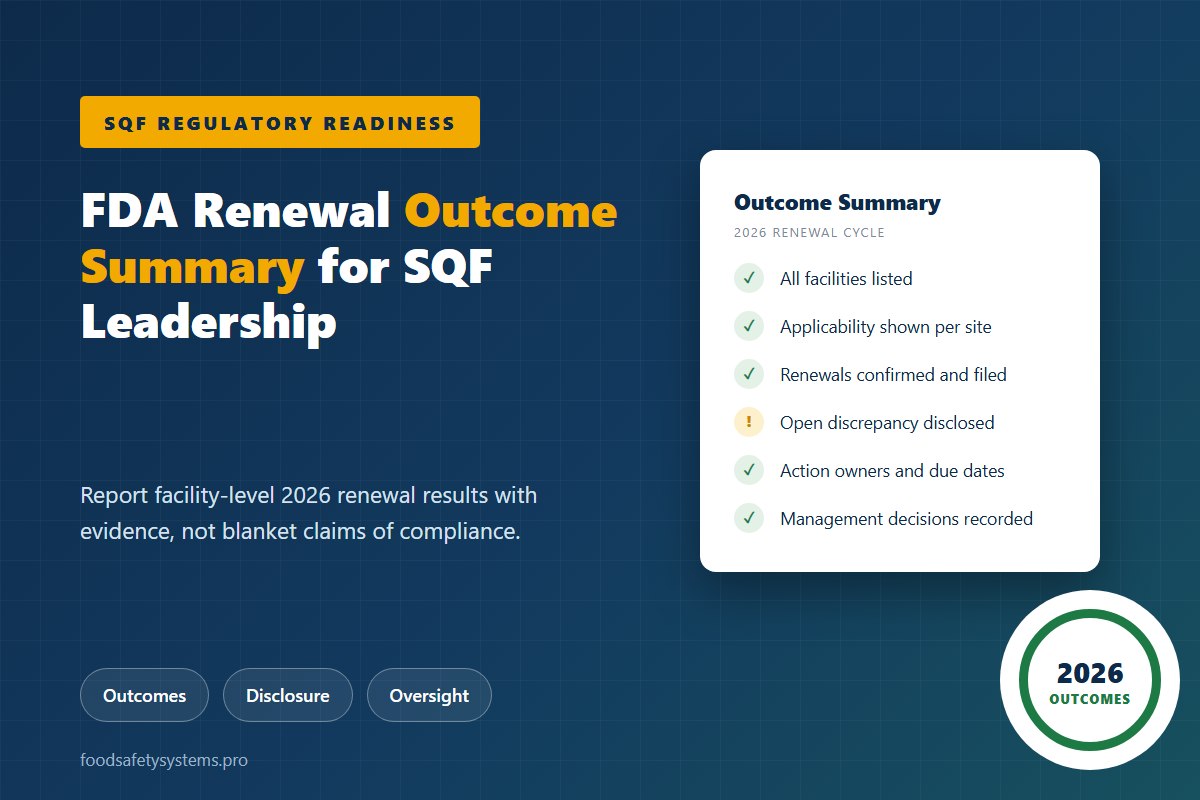
An FDA renewal outcome summary gives SQF leadership a concise, facility-level account of what happened in the 2026 registration renewal cycle, backed by evidence rather than assurances. SQF management can use it to confirm that applicable government registration deadlines were identified, assigned and reviewed. A good summary never simply states that “all facilities are compliant” without showing the basis for that statement.
Quick answer: list every covered site, its authorized submission owner and whether a 2026 renewal is confirmed. Then disclose any outstanding discrepancies and the corrective actions assigned to them. Keep SQF certification and FDA Food Facility Registration evidence separate, since one cannot substitute for the other. Record management’s review and decisions.
Who this guidance is for
This guide is for compliance leads, SQF practitioners and quality directors who report regulatory outcomes to senior management, owners or boards.
Why an outcome summary is different from status reporting
During the renewal window, teams report progress: what is pending, blocked or done. An outcome summary comes afterwards. It records the end result of the cycle and the decisions management made about it.
That difference matters. A progress report can tolerate “in progress”. An outcome summary should not. Each site needs a clear result supported by a record, or an open item with an owner. When the project formally ends, the summary also feeds your closeout file, as described in our guide to FDA renewal closeout in SQF systems.
2026 FDA registration renewal requirements
Under section 415 of the Federal Food, Drug, and Cosmetic Act (21 U.S.C. 350d) and 21 CFR Part 1, Subpart H, food facilities required to register must renew between October 1 and December 31 of each even-numbered year. The 2026 deadline is December 31.
An earlier update does not replace the required renewal. FDA currently accepts a DUNS number as the Unique Facility Identifier and does not charge a renewal fee. Registration is not FDA approval. Applicability and exemptions require facility-specific assessment.
What the FDA renewal outcome summary should include
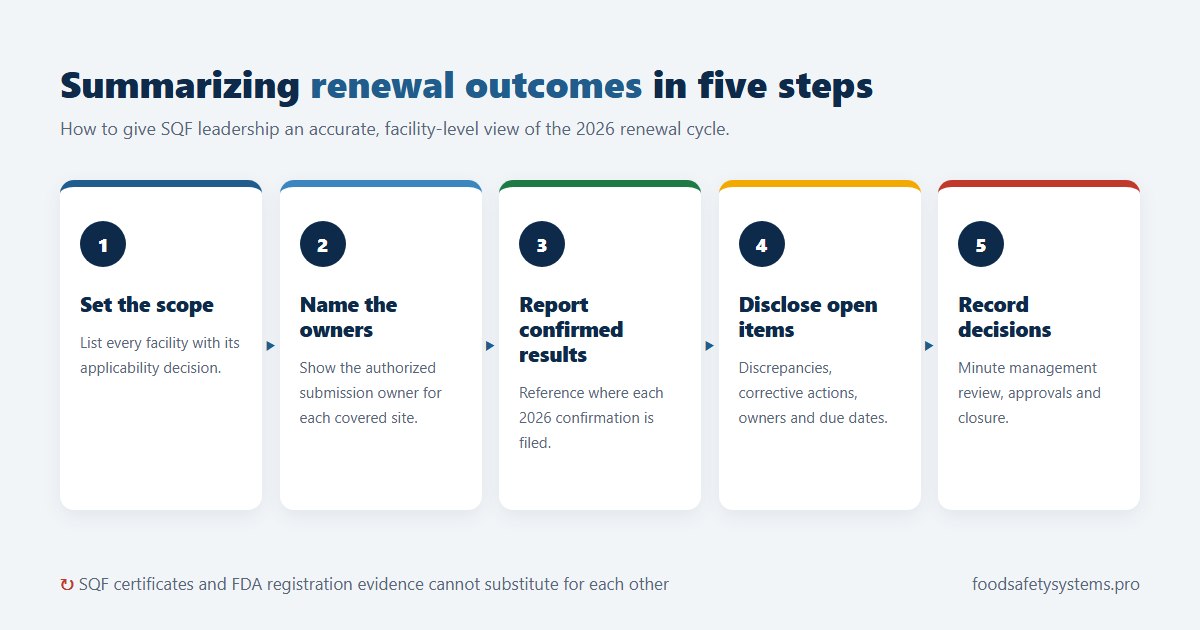
- Scope: all operating facilities, with the applicability decision for each.
- Owners: the authorized submission owner for every covered site.
- Outcomes: confirmed 2026 renewals, with a reference to where each confirmation is filed.
- Discrepancies: any outstanding data issue, such as a DUNS mismatch, and its status.
- Actions: open corrective actions, owners and due dates.
- Decisions: what management reviewed and what it approved or requested.
Keep the format short. A one-page table with a brief narrative usually works better than a long report. If your site already tracks food safety KPIs, the summary can sit alongside them as a regulatory indicator.
Keep SQF and FDA evidence separate
SQF certification and FDA Food Facility Registration serve different purposes. An SQF certificate shows the outcome of a certification audit against a voluntary standard. An FDA renewal confirmation, by contrast, shows that a legal filing was made for a specific facility.
Therefore, the summary should never cite one as evidence of the other. Present them in separate columns or sections. That way, leadership cannot read a strong audit result as proof of regulatory compliance.
Use the summary to improve the next cycle
An outcome summary is also a learning record. Alongside the results, note what slowed the cycle down. Typical examples include expired account access, unclear submitter authority, late DUNS corrections or a facility that joined the list late.
Each lesson should lead to a specific change, such as an earlier reminder, a backup submitter or a step in your acquisition checklist. Assign an owner to each change and review it before the next even-year renewal window opens. In this way, the FDA renewal outcome summary turns one cycle’s experience into a stronger process for the next.
Who does what
- Compliance lead: drafts the summary from verified records.
- Facility owners: confirm their site’s outcome and open items.
- SQF practitioner: checks that the summary matches the evidence on file.
- Senior management: reviews the summary, challenges gaps and records decisions.
Common mistakes
- Writing “all sites compliant” without listing the sites.
- Leaving out nonapplicable sites, which hides the applicability decision.
- Dropping open discrepancies to make the summary look clean.
- Citing the SQF certificate as regulatory evidence.
- Failing to record management’s review and decisions.
Example workflow
In early January, the compliance lead at a four-site manufacturer prepares the outcome summary. Three sites show confirmed 2026 renewals with filing references. The fourth renewed on time, but a DUNS address correction is still open with the facility’s office manager.
The summary lists all four sites, discloses the open correction and names its owner and due date. At the next management review, leadership accepts the result and asks for a lessons-learned note on account access, which slowed one submission. The minutes record both decisions, and the open item stays in the CAPA log until evidence closes it.
FDA renewal outcome summary checklist
- Confirm that all covered facilities are listed.
- Review the renewal confirmation for each facility.
- Disclose open actions and their owners.
- Document management review and closure.
Frequently asked questions
When should the outcome summary be prepared?
Shortly after the renewal window closes, once confirmations have been verified. Some organizations also present a draft just before December 31 to flag any remaining gaps.
Can we report full compliance if one discrepancy remains open?
It is more accurate to report the confirmed outcomes and disclose the open item, its owner and due date. A transparent summary is more useful to leadership than an overstated one.
Should nonapplicable facilities appear in the summary?
Yes. Listing them with the applicability decision shows that every site was considered, not forgotten.
How Consultare Inc. Group can help
Consultare Inc. Group supports food businesses with food safety, regulatory documentation and compliance coordination, tailored to the agreed engagement scope. We do not promise certification, regulatory approval or an audit outcome.
- Post-certification compliance management: management review and oversight support.
- Compliance dashboards: track facility-level status in one place.
- Internal audit support: verify the evidence behind the summary.
- Regulatory document control: keep confirmations and decisions controlled.
Need help managing your SQF responsibilities?
Discuss your products, documentation and compliance priorities with the Consultare team in a free consultation, or contact our team.
Start building your compliance system
Prefer to organize your compliance activities yourself? Create a free SystemsBuilder account to manage specifications, controlled documents, assigned actions and records in one structured workflow. Software supports record management; it does not by itself ensure compliance.
Regulatory references: FDA 2026 Biennial Renewal User Guide, FDA 2026 renewal reminder, FDA Online Food Facility Registration, 21 U.S.C. 350d and 21 CFR Part 1, Subpart H. Independent educational content: Consultare Inc. Group is not affiliated with, endorsed by or authorized to act on behalf of the U.S. Food and Drug Administration (FDA) or the Safe Quality Food Institute (SQFI). This article is not legal advice or an official statement of FDA policy. Requirements may change, and applicability depends on each facility; verify current requirements with official FDA sources.