
A foreign supplier risk evaluation connects what you know about a supplier with the risk posed by the actual food you import. A supplier may hold a certificate, but that document may not answer the questions an importer needs to resolve. Certificates and audit summaries give useful context. Still, they may not explain product-specific hazards, who controls them, sanitation practices or earlier safety events.
Quick answer: under 21 CFR 1.505, importers covered by the standard FSVP provisions evaluate the food’s hazard analysis, the entity that controls each hazard, and the foreign supplier’s performance. The evaluation must be documented, and it supports both supplier approval and the choice of verification activities.
What the rule asks you to consider
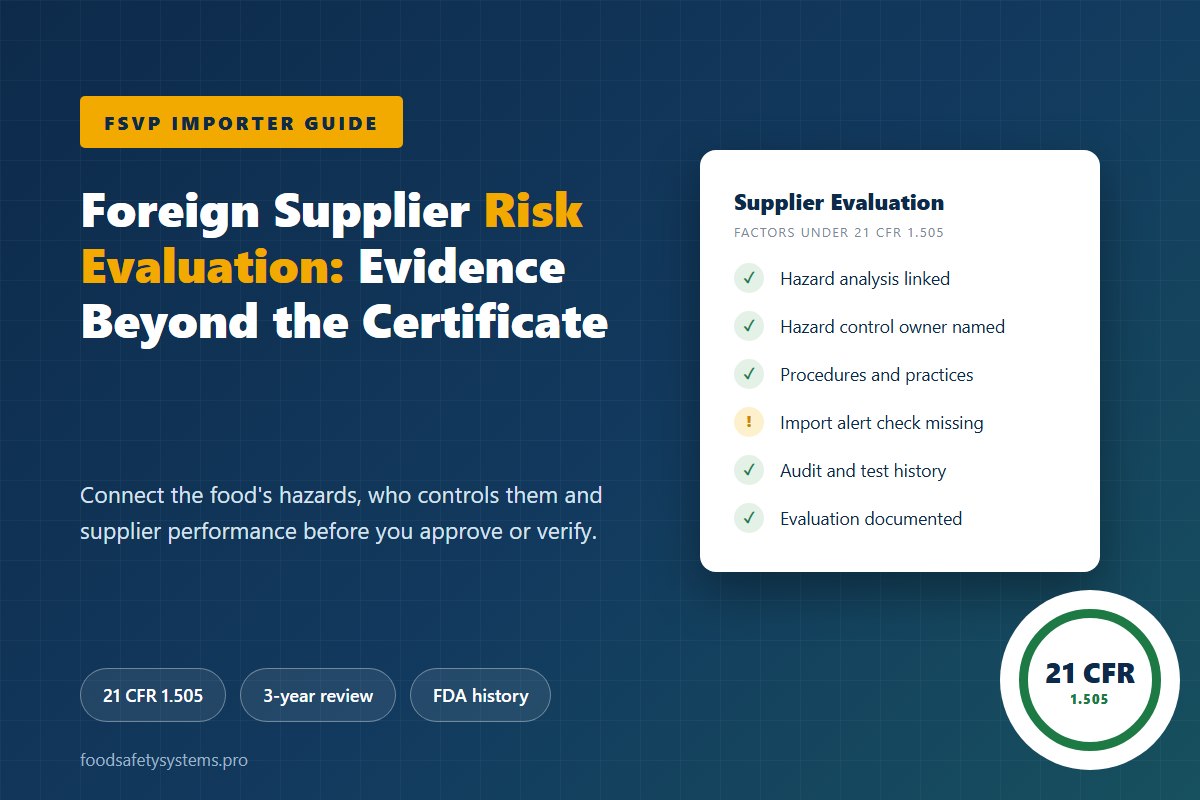
Section 1.505(a) sets out the factors. First, the hazard analysis of the food, including the nature of each hazard requiring a control. Second, the entity or entities that significantly minimize or prevent those hazards, or verify that they have been controlled. This may be the foreign supplier, its raw material supplier or another entity in the supply chain.
Third, foreign supplier performance. This covers the supplier’s food safety procedures, processes and practices. It also covers applicable FDA food safety regulations and the supplier’s compliance with them, including whether it is the subject of an FDA warning letter, import alert or other FDA compliance action related to food safety. Finally, it covers the supplier’s food safety history, such as testing results, audit results and responsiveness in correcting problems. Other factors, such as storage and transportation practices, may be added when appropriate.
How to run a foreign supplier risk evaluation
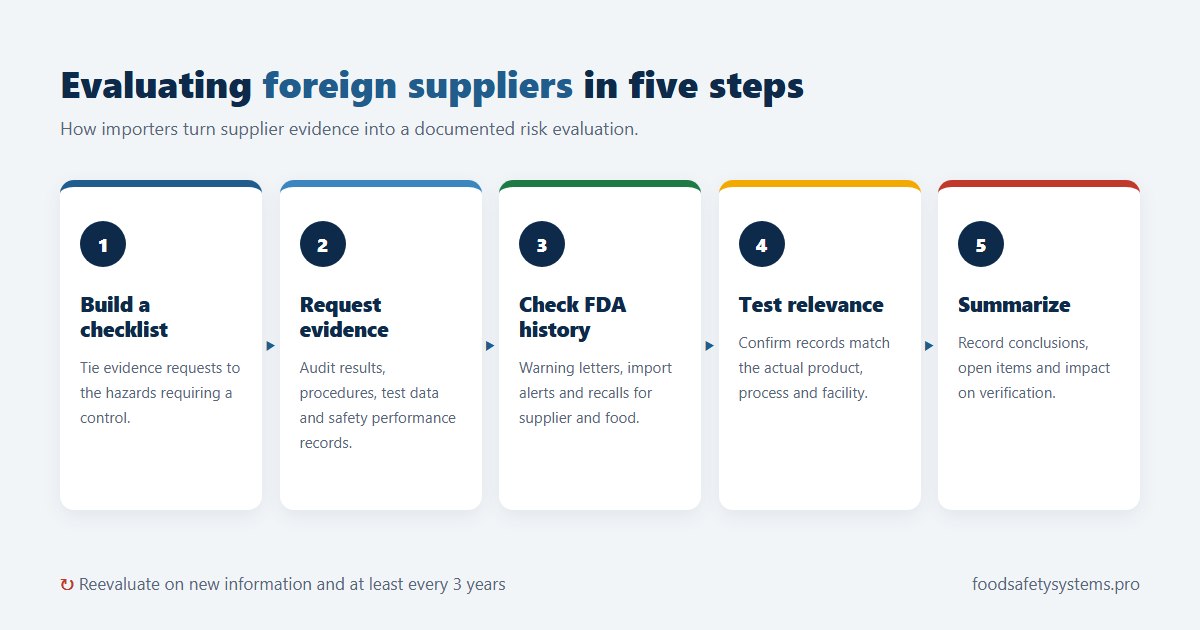
A supplier questionnaire is only a starting point. A defensible evaluation links objective evidence to the risks of the specific food and records the reasoning behind the decision.
- Create an evidence checklist tied to product risks. Start from the hazards requiring a control in your hazard analysis.
- Request the relevant evidence. Ask for audit results, procedures, testing data and food safety performance records.
- Check FDA compliance information. Search for warning letters, import alerts and recalls linked to the supplier and the food.
- Review findings for relevance, recency and gaps. Confirm that each record matches the actual product, process and facility.
- Summarize conclusions. State what the evidence shows, what remains unresolved, and how it shapes approval and verification.
What good evidence looks like
Strong evaluation files share a few traits. The evidence names the same facility and product that you import. It is recent enough to reflect current practices. In addition, it addresses the hazards that matter, rather than general good manufacturing practices only.
Overreliance on one document is the most common weakness. For example, a certificate may cover a different production line or omit the product entirely. When that happens, the gap between supplier claims and objective evidence stays hidden until a problem occurs.
Common gaps in supplier evaluation files
- Approval rests on a questionnaire with little supporting evidence.
- Audit, testing or regulatory history is missing or outdated.
- The file never identifies who controls each hazard.
- A new supplier, production site or product changed the risk picture without a new evaluation.
- The team cannot explain how supplier performance shaped approval or verification decisions.
Example scenario: a spice blend from a new origin
Illustrative example. An importer adds a second supplier for a chili spice blend. The new supplier sends a certificate and a completed questionnaire. A foreign supplier risk evaluation goes further. The hazard analysis flags Salmonella and possible economically motivated adulteration with unapproved colors. The team asks who controls each hazard, requests the full audit report and recent test results, and checks FDA import alert listings. The audit report shows that the steam treatment step was outside the audit scope. As a result, the team records that gap and plans additional verification before approval.
Keeping the evaluation current
The evaluation is not a one-time task. Under section 1.505(c), importers must promptly reevaluate the concerns when they become aware of new information about these factors. If no reevaluation has taken place within any 3-year period, one is required at the end of that period. Our article on FSVP supplier reevaluation covers triggers and records in more detail. Some imports qualify for exemptions or modified provisions, so confirm what applies to each food and importer.
Where SQF supplier controls fit
FSVP is a U.S. importer obligation, and SQF certification does not satisfy it by itself. However, an SQF site’s approved supplier program already collects much of the same evidence. A supplier’s SQF or other GFSI certificate and audit report can be one input to the evaluation, provided you check scope, date and findings. See our guide to SQF supplier approval for imported ingredients for the certification side.
Foreign supplier risk evaluation checklist
- Link the evaluation to the written hazard analysis for the food.
- Identify the entity that controls or verifies each hazard requiring a control.
- Review the supplier’s procedures, processes and practices.
- Check FDA compliance information, including warning letters and import alerts.
- Review testing results, audit results and responsiveness to problems.
- Document the evaluation, conclusions and open items.
- Set reevaluation triggers and track the 3-year period.
Frequently asked questions
Can we rely on someone else’s evaluation of a foreign supplier?
Section 1.505(d) allows an importer to review and assess an evaluation performed by an entity other than the foreign supplier, using a qualified individual. You must document that review, including that a qualified individual conducted the evaluation.
Is a GFSI certificate enough for a foreign supplier risk evaluation?
Usually not on its own. It is useful evidence, but the rule asks you to consider the food’s hazards, who controls them, and the supplier’s compliance and safety history.
How often must the evaluation be repeated?
Promptly when new information about the factors emerges, and at least at the end of any 3-year period without a reevaluation.
How Consultare Inc. Group can help
Consultare Inc. Group provides structured reviews of foreign supplier evidence, risk-based gap assessments and evaluation summaries, tailored to the agreed engagement scope. The importer remains responsible for its FSVP decisions.
- Supplier verification support: organized evidence and follow-up.
- Approved supplier program: risk-based supplier criteria.
- Supplier regulatory compliance: FDA compliance history checks.
- COA and certification verification: confirm certificate scope and dates.
For dedicated importer program support, see our sister site FSVP Services.
Need help managing your SQF responsibilities?
Discuss your products, documentation and compliance priorities with the Consultare team in a free consultation, or contact our team.
Start building your compliance system
Prefer to organize your compliance activities yourself? Create a free SystemsBuilder account to manage specifications, controlled documents, assigned actions and records in one structured workflow. Software supports record management; it does not by itself ensure compliance.
Technical sources: 21 CFR 1.505, 21 CFR 1.506 and FDA’s FSVP final rule page. Independent educational content, not legal advice, FDA approval or a compliance guarantee. Consultare Inc. Group is not affiliated with or endorsed by FDA or SQFI. FSVP obligations vary by food, importer and applicable exemptions or modified provisions; confirm current requirements and have specific conclusions reviewed by an appropriately qualified individual.