
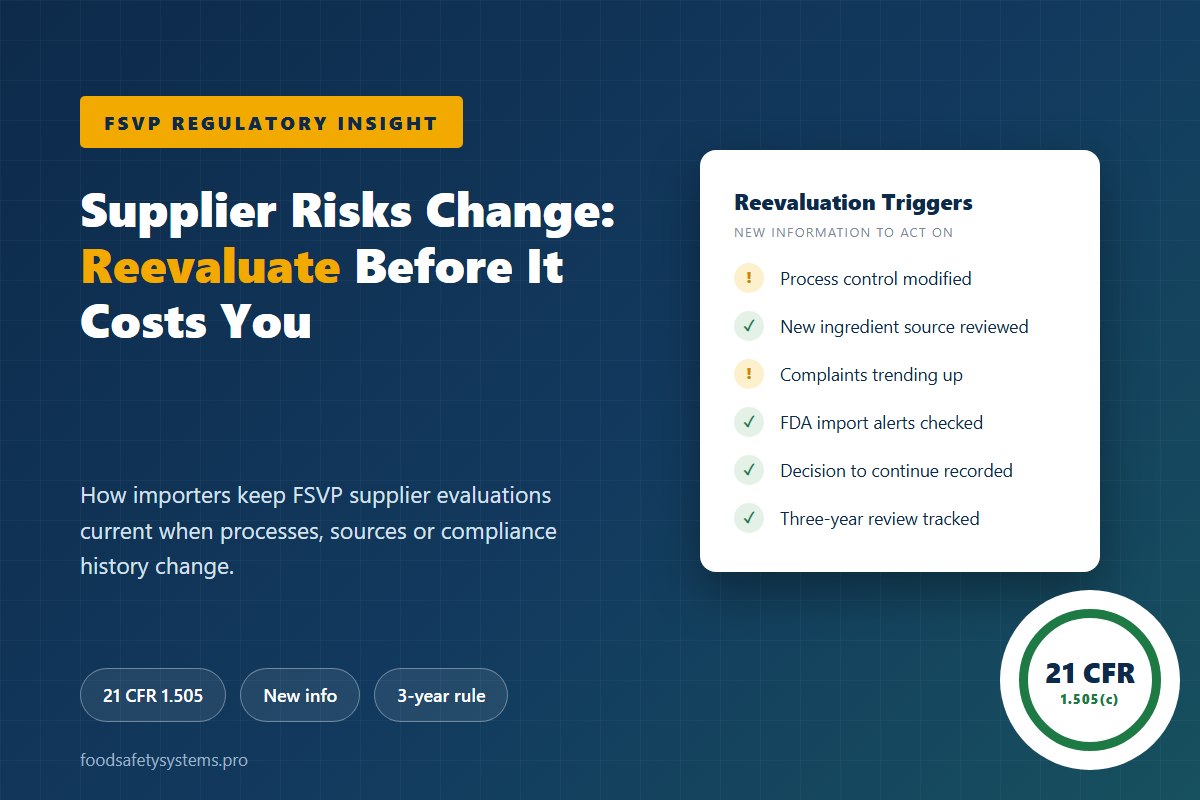
FSVP supplier reevaluation matters because a supplier’s process can change while your documented risk assessment stays the same. A changed heat treatment, a new ingredient source or a different allergen handling practice can alter the hazards and weaken existing controls. If your evaluation does not reflect those changes, your approval and verification decisions may rest on outdated information.
Quick answer: under 21 CFR 1.505(c), an importer must promptly reevaluate the concerns about a food and foreign supplier when it becomes aware of new information, and document the reevaluation. If concerns have changed, it must decide, and document, whether to keep importing and whether verification activities need to change. If no reevaluation has happened within any three-year period, one must be done then. This is not a mandatory annual audit.
Who this guidance is for
U.S. food importers, supplier quality managers and food safety teams, including SQF certified sites that buy imported ingredients and manage an approved supplier list.
What the FSVP rule asks you to reevaluate
A reevaluation revisits the same factors used in the original evaluation. These include the hazard analysis and the nature of the hazard requiring a control, and the entity that controls it. They also cover the supplier’s food safety procedures and practices, its compliance with applicable FDA food safety regulations, and its food safety history.
The compliance factor explicitly includes whether the supplier is the subject of an FDA warning letter, import alert or other FDA compliance action related to food safety. Food safety history includes available test results, audit results and how responsive the supplier has been in correcting problems. Other factors, such as storage and transportation practices, may also apply. Our article on foreign supplier risk evaluation covers the initial evaluation in depth.
Triggers that call for prompt reevaluation
The word “promptly” means you should not wait for the three-year point. Teams that track trends are better placed to spot when a prior conclusion needs technical review. Common triggers include:
- The supplier modifies process controls, equipment or a critical treatment step.
- A new raw material source or sub-supplier is introduced.
- Customer or consumer complaints related to food safety increase.
- Hazard information changes, such as new scientific reports or outbreak data.
- Supplier testing trends deteriorate or audit findings worsen.
- FDA issues a warning letter, import alert or other compliance action involving the supplier.
Practical steps for an FSVP supplier reevaluation
A productive reevaluation starts with meaningful evidence and stays traceable to the food and the concerns that matter for safety.
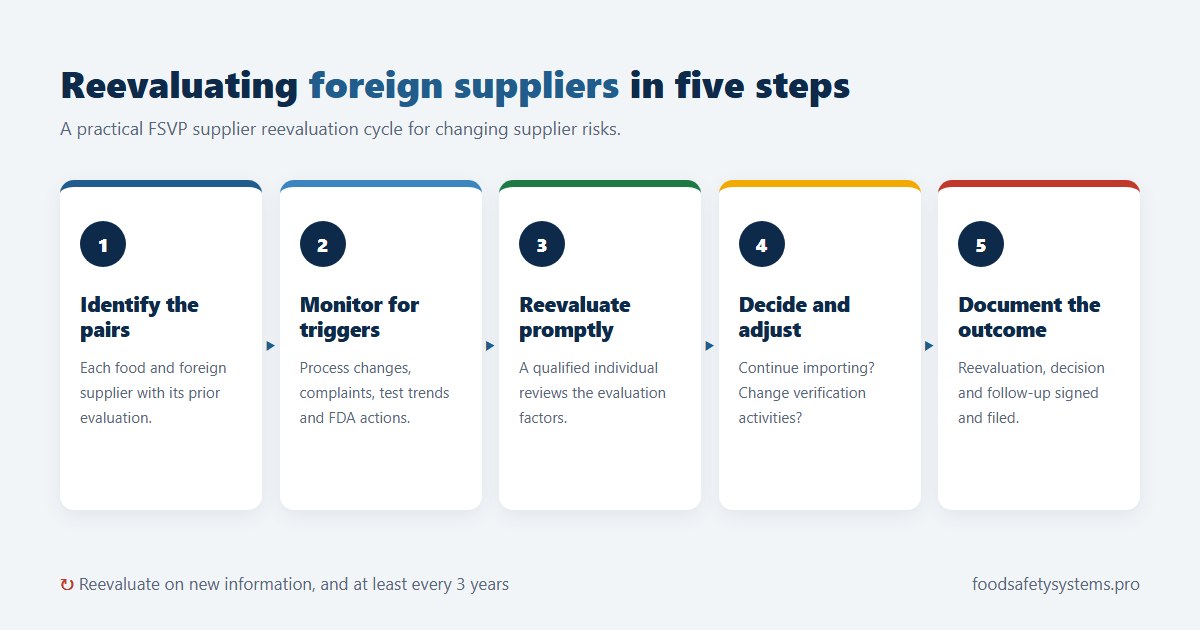
- Identify: confirm the supplier-food relationships and retrieve the prior evaluation, hazard information and approval decision.
- Monitor: gather new compliance actions, process or site changes, audit findings, complaints and other relevant evidence.
- Reevaluate: have a qualified individual assess the concerns and document whether the new information changes risk or verification decisions.
- Document: retain the reevaluation, conclusions, follow-up assignments and any resulting approval or verification changes.
Where another entity, using a qualified individual, has already reevaluated the supplier, the importer may review and assess that work instead. In that case, document your review and that a qualified individual performed it.
Common gaps in reevaluation files
- The evaluation date is years old and nothing shows it was revisited.
- New information was received but no one recorded a decision.
- Verification activities were not reconsidered after a process change.
- Annual customer reviews or certification cycles are treated as the FSVP reevaluation without checking the required factors.
- Follow-up actions were assigned but never closed.
Example scenario: a supplier changes its pasteurizer
Consider a hypothetical importer of a refrigerated fruit puree. The supplier informs the importer that it has replaced its pasteurization unit and changed the hold time. The original evaluation, written two years earlier, relied on validation data for the old unit.
The importer’s qualified individual treats the notice as new information. She requests the validation data for the new unit and the first months of temperature records. She also checks FDA import alert and warning letter listings for the supplier. Based on the evidence, she documents that the hazard is still controlled, but adds a temporary increase in record reviews until performance is confirmed. The reevaluation, decision and follow-up are signed, dated and filed.
Records to keep
- The prior evaluation and the new information that triggered reevaluation.
- The reevaluation itself, including the factors considered.
- The decision on whether to continue importing from the supplier.
- Any changes to supplier verification activities and their rationale.
- Follow-up actions, owners and closure evidence.
Under 21 CFR 1.510, records of evaluations and determinations must be kept for at least two years after their use is discontinued, for example after a reevaluation replaces them. Our SQF supplier approval for imported ingredients guide shows how to keep this history in the supplier file.
Linking reevaluation to your SQF approved supplier program
SQF sites typically review supplier performance through their approved supplier program and raw material monitoring. That data, such as complaints, receiving rejections and COA trends, is valuable input for an FSVP reevaluation. However, FSVP is a U.S. importer obligation, and SQF certification does not satisfy FSVP by itself.
A supplier’s renewed SQF or other GFSI certificate can be one input to the reevaluation. It does not replace a documented look at the specific factors the FSVP rule names. Keep mandatory FDA requirements distinct from voluntary customer reviews, certification cycles and internal best-practice frequencies.
FSVP supplier reevaluation checklist
- Every food and foreign supplier pair has a dated evaluation on file.
- A trigger register captures changes, complaints, test trends and FDA actions.
- New information is reviewed promptly by a qualified individual.
- The decision to continue importing is documented after each reevaluation.
- Verification activities are reconsidered when concerns change.
- Any pair not reevaluated within three years is flagged and reviewed.
Frequently asked questions
Does FSVP require an annual supplier reevaluation?
No. The standard rule requires prompt reevaluation when you become aware of new information, and a reevaluation at the end of any three-year period without one. Some foods and importers follow modified requirements.
What counts as new information?
Anything relevant to the evaluation factors, such as process changes, test or audit results, complaints, supplier responsiveness, or FDA compliance actions like warning letters and import alerts.
Can we rely on someone else’s reevaluation?
Yes, if another entity used a qualified individual to perform it. You must review and assess that reevaluation and document your review, including that a qualified individual conducted it.
How Consultare Inc. Group can help
Consultare Inc. Group supports evidence-based reevaluations, trigger registers and documented follow-up. The FSVP importer remains accountable for program decisions, records and corrective actions.
- Supplier verification support: reevaluation matrices and current-versus-prior evidence comparisons.
- Approved supplier program: connect SQF supplier monitoring to FSVP decisions.
- Supplier regulatory compliance: compliance history and FDA action checks.
- Validation and verification of control measures: review changed process controls.
For importer-focused FSVP program support, see our sister site FSVP Services.
Need help managing your SQF responsibilities?
Discuss your products, documentation and compliance priorities with the Consultare team in a free consultation, or contact our team.
Start building your compliance system
Prefer to organize your compliance activities yourself? Create a free SystemsBuilder account to manage specifications, controlled documents, assigned actions and records in one structured workflow. Software supports record management; it does not by itself ensure compliance.
Technical sources: 21 CFR Part 1, Subpart L (especially §§ 1.503, 1.505(c)-(d), 1.506 and 1.510) and FDA’s FSVP key requirements. Independent educational content: Consultare Inc. Group is not affiliated with or endorsed by FDA or SQFI. This article is not legal advice, FDA endorsement, supplier approval or a guarantee of compliance. FSVP obligations vary by food, importer, supplier and any applicable exemption or modified requirement, and conclusions should be reviewed by a qualified individual.