

An FSVP records review only works when the supplier records you read are tied to the hazards in the food you actually import. Specifications, food safety plans, validation studies and monitoring summaries can look convincing on their own. However, a large stack of files is not the same as evidence that a hazard is controlled. What matters is reviewing the right records, in context, and documenting a clear conclusion.
Quick answer: under the FDA Foreign Supplier Verification Program (FSVP) rule, reviewing a foreign supplier’s relevant food safety records is one of the recognized verification activities in 21 CFR 1.506. It is not automatically enough for every food. When you use it, a qualified individual must perform the review, and you must document the review dates, the general nature of the records, the conclusions and any corrective actions taken for significant deficiencies.
Who this guidance is for
U.S. food importers, supplier quality teams and food safety managers, including SQF certified sites that import ingredients or finished foods and want their supplier files to stand up to an FDA FSVP inspection.
How an FSVP records review fits the verification process
The FSVP rule lists four types of supplier verification activity: onsite audits, sampling and testing, review of the supplier’s relevant food safety records, and other appropriate activities. Before importing a food, the importer must determine and document which activities are needed, and how often, based on its evaluation of the food and the foreign supplier.
A records review can be used alone or alongside other activities. That choice depends on the risk-based determination, not on convenience. For certain serious hazards controlled by the supplier, the rule expects an initial and at least annual onsite audit unless the importer makes an adequate written determination that other activities are appropriate. Our article on selecting FSVP verification activities by food risk explains that decision in more detail.
Some importers and foods are subject to modified requirements or exemptions. For example, a receiving facility that complies with the relevant parts of 21 CFR Part 117, such as a risk-based supply-chain program, is deemed to comply with most of the FSVP subpart. Confirm which situation applies before building your review process.
Start with hazards, not a certificate list
A useful review begins with the hazard analysis and the documented verification determination. Only then should you decide which records to request. A universal list of certificates rarely matches what a specific food needs.
First, confirm the imported food, the foreign supplier and the manufacturing facility. Next, identify the hazards requiring a control, such as a pathogen, an undeclared allergen or a chemical contaminant. Then trace each hazard to the supplier control and to the records that show how that control is implemented and monitored.
What good supplier record evidence looks like
Strong evidence is current, product-specific, understandable and relevant to the activity you selected. In practice, ask four questions of each record set:
- Is it the right product and site? Records should name the food and the facility you buy from, not a sister plant or product family.
- Is it current? Monitoring and verification records should cover the period you are relying on.
- Does it show the control working? Look for monitoring results, deviations and corrective actions, not only a written procedure.
- Can your reviewer read it? A qualified individual must be able to read and understand the language of the records reviewed.
Depending on the food, relevant records may include process-control evidence such as cook or pasteurization logs, allergen changeover and cleaning verification, sanitation records, environmental monitoring summaries, applicable test results, audit findings and corrective action documentation.
Common gaps in imported food record reviews
Several weaknesses appear again and again. They usually come from collecting documents without linking them to a hazard.
- Complex ingredient blends where no one has mapped which supplier controls which hazard.
- Allergen changeover evidence that is unclear or missing for shared lines.
- Supplier food safety plans that are high level and never show monitoring data.
- Monitoring and corrective action records that do not match the controls the supplier claims.
- A review file with no date, no named reviewer and no written conclusion.
Practical steps for a defensible FSVP records review
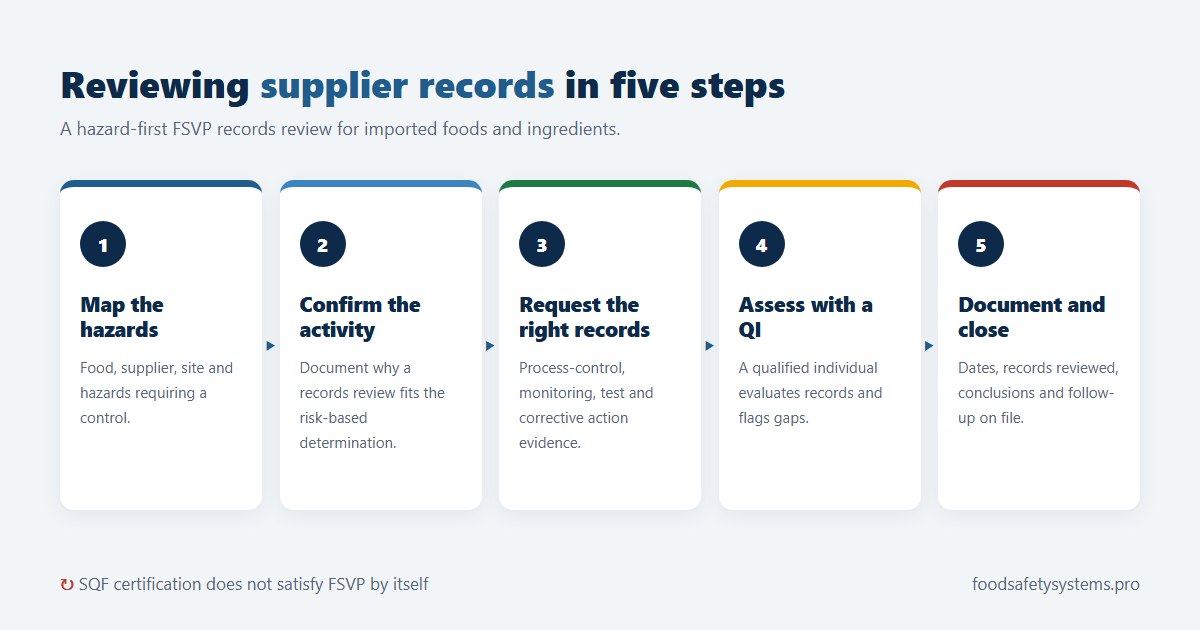
Use a simple four-step cycle and tailor the requests to the food, the supplier and the evidence the chosen activity needs.
- Define: map the food, supplier, hazards, control responsibilities and the selected verification activity.
- Collect: request the relevant records, such as process-control evidence, audit findings, applicable test results and corrective action records.
- Assess: have a qualified individual evaluate the records, explain the conclusions and flag material gaps or inconsistencies.
- Close: document follow-up, obtain more information when needed, and keep the required FSVP records retrievable.
Remember that the importer must promptly review and assess the results of verification activities. If the results do not give adequate assurance that the hazards are significantly minimized or prevented, the importer must take appropriate corrective action under 21 CFR 1.508.
Example scenario: a spice blend supplier
Consider a hypothetical importer that brings in a seasoning blend for a ready-to-eat snack line. The hazard analysis identifies Salmonella and an undeclared allergen as hazards requiring a control at the supplier. The supplier sends a food safety plan, a certificate and a sanitation procedure.
The qualified individual notices that the plan describes a steam treatment but no treatment logs were provided. In addition, the allergen procedure covers a different line. As a result, the reviewer records the gap, requests six months of treatment records and line-specific changeover verification, and holds the conclusion until the evidence arrives. The file then shows the dates, the records reviewed, the conclusion and the follow-up, which is exactly what the rule asks for.
Records to keep
- The date or dates of each record review.
- The general nature of the records reviewed.
- The conclusions of the review.
- Any corrective actions taken in response to significant deficiencies.
- Documentation that a qualified individual conducted the review.
Under 21 CFR 1.510, FSVP records must be legible, available promptly to FDA on request, and generally retained for at least two years. Records kept offsite must be retrievable within 24 hours. Our record retention requirements page covers how to organize retention in an SQF document system.
How FSVP records relate to your SQF supplier approval program
An SQF site’s approved supplier program and raw material controls already collect much of this evidence. That overlap is useful, but it is not automatic compliance. FSVP is a U.S. importer obligation, and SQF certification does not satisfy FSVP by itself.
A supplier’s SQF or other GFSI certificate and audit report can be one input to your supplier evaluation. Even so, you still need to show how the records relate to the specific hazards in the food you import. Our guide to SQF supplier approval for imported ingredients shows how to keep both systems aligned. Distinguish legally required FSVP records from supplementary best-practice documents and customer requests.
FSVP records review checklist
- Hazards requiring a control are identified for each imported food and supplier.
- The verification determination explains why a records review is appropriate.
- Requested records are product-specific, site-specific and current.
- A qualified individual who can read the records performs the review.
- Conclusions, gaps and corrective actions are written down and dated.
- Records are retrievable within the timeframes the FSVP rule requires.
Frequently asked questions
Is a supplier records review always enough for FSVP?
No. It is one of several verification activities. Whether it is appropriate alone or with others depends on the hazard, the supplier’s performance and your documented determination. Serious hazards controlled by the supplier generally call for onsite audits unless you justify an alternative in writing.
Can the foreign supplier review its own records for us?
No. The FSVP rule does not allow the importer to rely on the foreign supplier or its employees to perform verification activities, except for sampling and testing. You can rely on another qualified entity, but you must review and assess its results.
Do records have to be in English?
The reviewer must be able to read and understand the records. Upon FDA request, the importer must provide an English translation of non-English records within a reasonable time.
How Consultare Inc. Group can help
Consultare Inc. Group helps importers compare supplier records against identified hazards, identify unsupported conclusions and organize evidence requests. The importer keeps its regulatory responsibilities and final supplier decisions.
- Supplier verification support: hazard-to-record mapping and findings registers.
- Approved supplier program: align SQF supplier files with FSVP evidence.
- Supplier specification verification: check specifications against actual controls.
- Supplier regulatory compliance: separate legal requirements from customer requests.
For importer-focused FSVP program support, see our sister site FSVP Services.
Need help managing your SQF responsibilities?
Discuss your products, documentation and compliance priorities with the Consultare team in a free consultation, or contact our team.
Start building your compliance system
Prefer to organize your compliance activities yourself? Create a free SystemsBuilder account to manage specifications, controlled documents, assigned actions and records in one structured workflow. Software supports record management; it does not by itself ensure compliance.
Technical sources: 21 CFR Part 1, Subpart L (especially §§ 1.503, 1.505, 1.506 and 1.510) and FDA’s FSVP key requirements. Independent educational content: Consultare Inc. Group is not affiliated with or endorsed by FDA or SQFI. This article is not legal advice, FDA approval or a guarantee of compliance. FSVP obligations vary by food, importer, supplier and any applicable exemption or modified requirement, and conclusions should be reviewed by a qualified individual.