
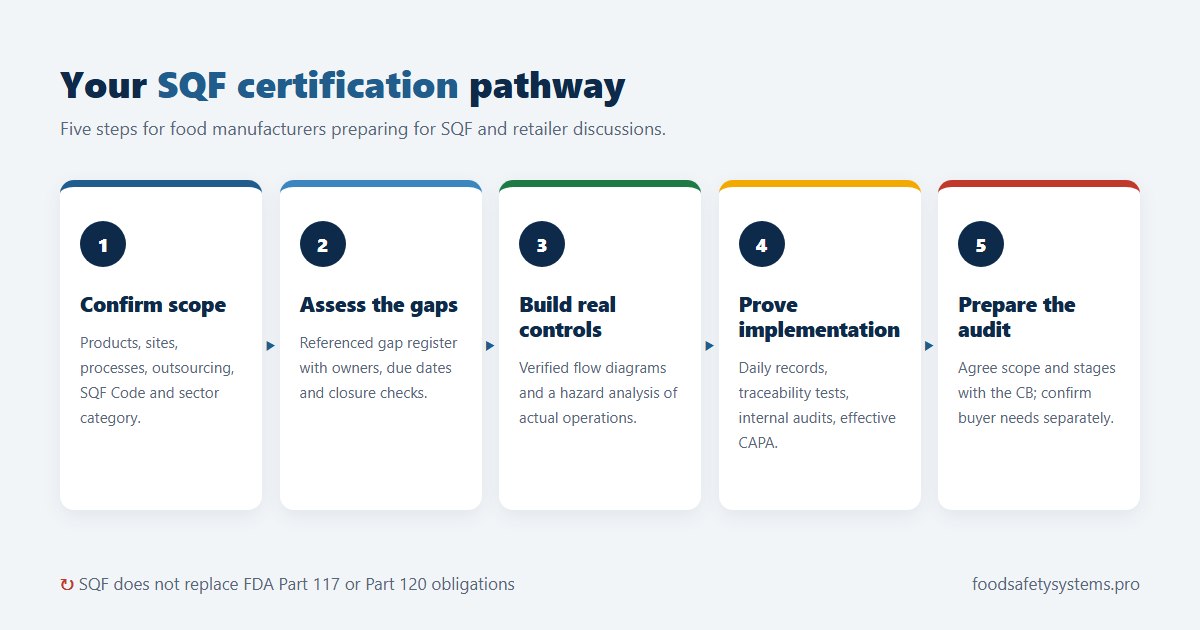
This SQF food safety certification guide sets out five practical steps for food manufacturers who want to supply Costco: confirm scope, assess gaps, build real process controls, prove implementation with records and prepare for the audit. A product concept is not enough. Buyers need a reliable operation that produces safe, consistent products and meets the commercial and technical expectations they communicate. SQF certification can provide a structured, independently audited framework when the selected Code and scope fit the facility.
Quick answer: Costco’s public vendor information does not establish SQF certification as a universal requirement for every food supplier. Confirm category-specific certification and audit expectations with the appropriate Costco contact first. Then work through the five steps below, keeping SQF requirements, FDA obligations and buyer requests on separate tracks.
Who this guidance is for
Food and beverage manufacturers planning a first SQF certification, quality managers building an implementation plan and teams preparing for retailer supplier discussions.
Step 1: Confirm the product, site and certification scope
List the products proposed for retail, the manufacturing and storage sites involved, the processes at each site and any outsourced activities. Next, identify the applicable SQF Code and food sector category using current SQF Code requirements and certification body guidance.
Check that the proposed scope covers the actual activities and products. A certificate for a different site, process or product category may not demonstrate the capability the buyer wants to evaluate. Our article on SQF certification for food manufacturers explains why scope fit matters so much.
Step 2: Complete a gap assessment against the applicable SQF Code
Review every area the selected Code applies to your operation. Typical areas include management responsibility, food safety culture, document control, hazard analysis and prerequisite programs. They also include supplier approval, allergen management, sanitation, pest prevention, maintenance, calibration, product identification, traceability and corrective action.
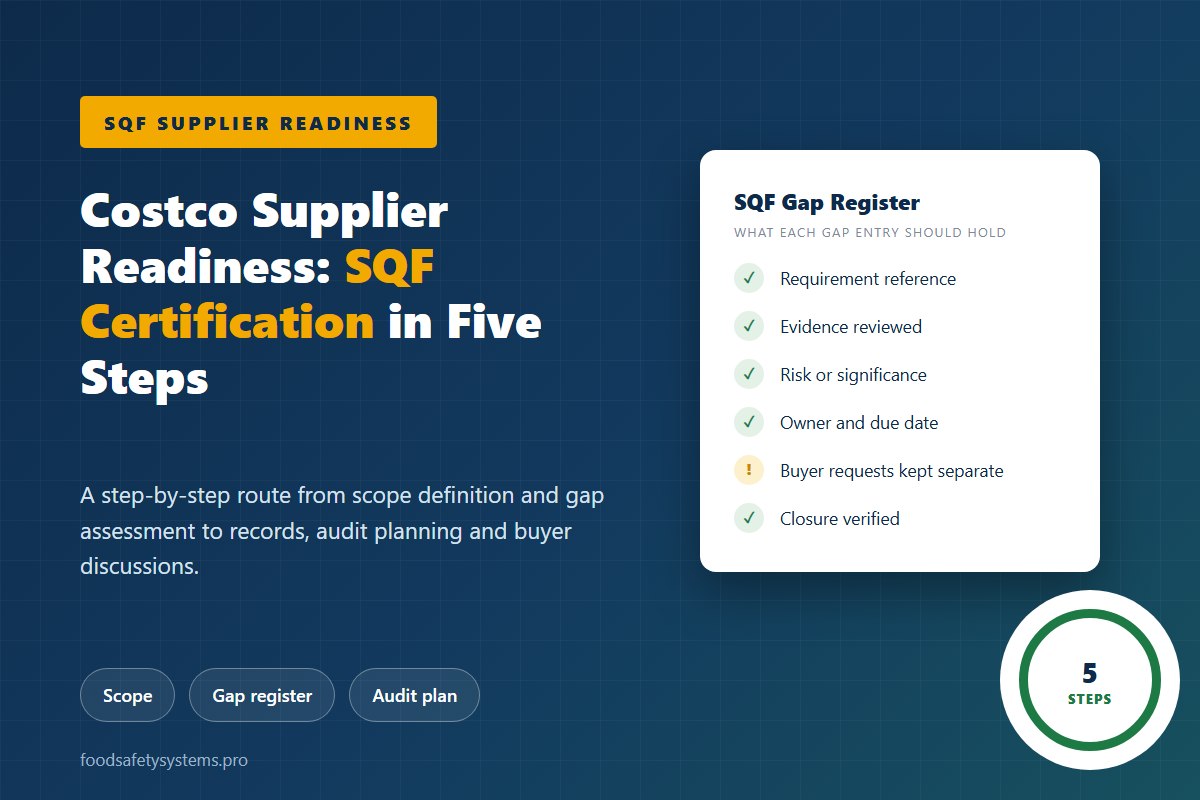
Record each gap with its requirement reference, the evidence reviewed, its risk or significance, an owner, a due date and closure verification. In addition, separate mandatory Code requirements from optional enhancements and buyer-specific requests.
Step 3: Build controls around the real production process
Verify process flow diagrams on site. Make sure the hazard analysis reflects actual ingredients, equipment, processing steps, packaging, storage and distribution. For juice and beverage operations, assess blending, holding, treatment, filling, packaging integrity and post-process contamination risks. Supplier controls deserve particular care; see our approved supplier program page.
SQF implementation does not replace applicable FDA or USDA requirements. For example, covered juice processing may be subject to FDA Juice HACCP under 21 CFR Part 120. Meanwhile, other covered human food operations may be subject to preventive controls under 21 CFR Part 117.
Step 4: Verify that records demonstrate implementation
Prepare records showing that procedures are used in daily operations. Examples include receiving inspections, supplier approvals, sanitation monitoring and allergen changeover checks. They also include process monitoring, environmental or product testing where appropriate, traceability exercises, nonconformance investigations and corrective action effectiveness reviews.
Then use your internal audit program and management review to find recurring issues. Confirm that corrective actions are completed and effective.
Step 5: Prepare for certification and retailer discussions
Coordinate certification readiness with an independent certification body. Confirm audit scope, audit stages, the applicable edition, site readiness and how nonconformities will be addressed. Certification decisions are made by the certification body, not by the consultant or the retailer. With Edition 10 audits approaching, our SQF Edition 10 audit preparation plan covers the timing questions to ask.
Separately, ask the relevant Costco buyer or division contact which certification schemes, audit reports, documents and product requirements apply to your category. SQF certification supports readiness, but it does not guarantee Costco approval or a purchasing agreement.
SQF food safety certification guide checklist
- Confirm product category, facility, processes and proposed SQF scope.
- Use current SQFI Code and certification body requirements for the gap assessment.
- Close documented gaps with evidence and effectiveness checks.
- Verify that the hazard analysis and prerequisite programs reflect actual operations.
- Complete traceability and recall exercises and internal audits.
- Confirm Costco buyer-specific requirements separately.
Frequently asked questions
Where should a first-time SQF project start?
With scope. Define the products, sites, processes and outsourced activities, then select the SQF Code and food sector category before running a gap assessment.
Who decides whether a site is SQF certified?
The independent certification body. Consultants can help prepare the system, and retailers set their own supplier requirements, but neither issues the certificate.
Should buyer requests go into the SQF gap register?
Track them, but label them separately. Keeping Code requirements, regulatory obligations and buyer-specific requests apart avoids confusion during the audit.
How Consultare Inc. Group can help
Consultare Inc. Group supports SQF gap assessments, food safety system development, prerequisite programs, documentation, internal audit preparation, corrective action planning and certification readiness. Independent certification bodies retain responsibility for certification audits and decisions.
- SQF gap assessments and internal audits: a referenced, owner-assigned gap register.
- SQF document control services: procedures and records that match practice.
- FDA compliance integration: align SQF with Part 117 or Part 120.
- SQF audit readiness coaching: prepare your team for the certification audit.
Need help managing your SQF responsibilities?
Discuss your products, documentation and compliance priorities with the Consultare team in a free consultation, or contact our team.
Start building your compliance system
Prefer to organize your compliance activities yourself? Create a free SystemsBuilder account to manage specifications, controlled documents, assigned actions and records in one structured workflow. Software supports record management; it does not by itself ensure compliance.
Sources: SQFI, Costco Vendor Inquiries, FDA Preventive Controls for Human Food and FDA Juice HACCP guidance. Independent educational content: Consultare Inc. Group is not affiliated with or endorsed by Costco Wholesale, SQFI or FDA. Costco-specific supplier requirements must be confirmed directly with the relevant Costco contact. This article does not constitute regulatory approval, certification or legal advice; applicability must be assessed for each product, facility and operation.