
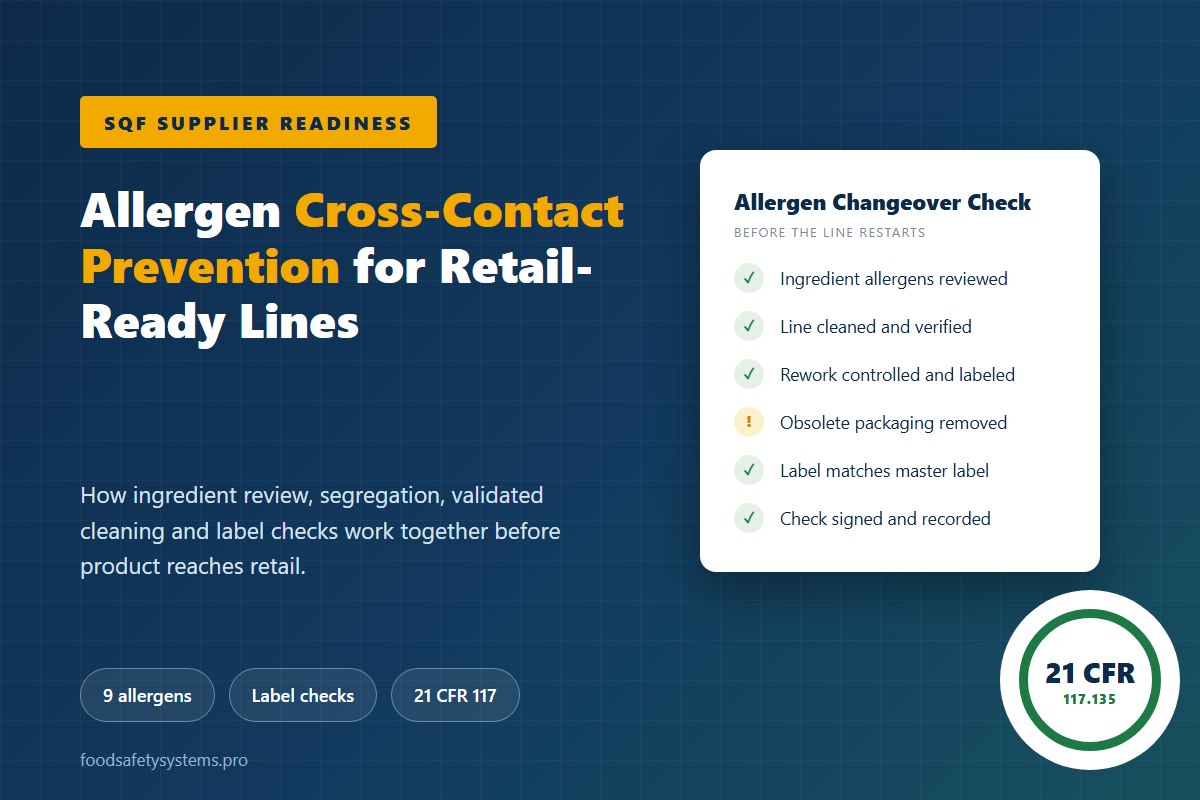
Allergen cross-contact prevention is a core part of manufacturing safe, accurately labeled packaged foods. A formulation error, a weak changeover or the wrong packaging can put allergic consumers at serious risk. It can also lead to a product withdrawal or recall. For that reason, retail-ready manufacturers need controls that cover ingredients, production lines, packaging and label approval together.
Quick answer: build allergen controls around your actual ingredients, suppliers, lines and labels. For facilities subject to FDA preventive controls, food allergen controls under 21 CFR 117.135 must address cross-contact and finished-food labeling. Customers such as Costco may add their own specifications, which must be confirmed with the buyer.
Who this guidance is for
Food manufacturers preparing for Costco or other retail opportunities, SQF practitioners, QA managers, production supervisors and label approval teams.
Identify all relevant allergens in ingredients and processing aids
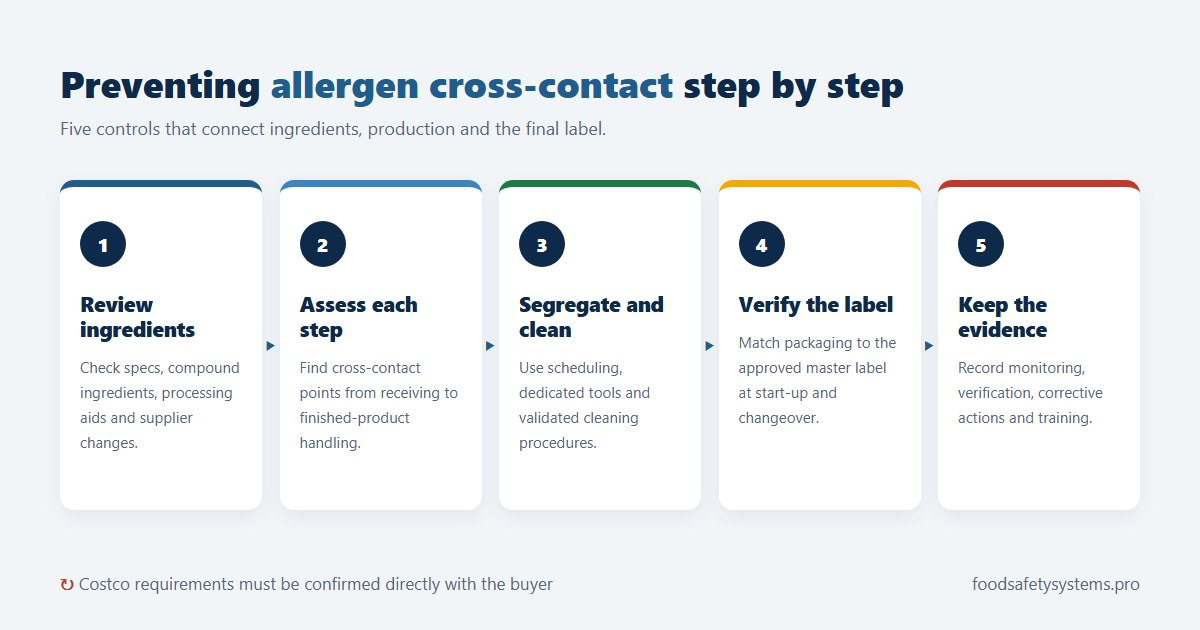
Start with a full review of ingredient specifications, compound ingredients, processing aids, rework and supplier change notifications. Determine whether any component contains or is derived from a major food allergen. Then confirm that the ingredient declaration and allergen statement are accurate.
U.S. law recognizes nine major food allergens: milk, eggs, fish, crustacean shellfish, tree nuts, peanuts, wheat, soybeans and sesame. For ingredient-specific questions, such as tree nut identification or highly refined oils, consult the FDA food allergies page and its current labeling guidance. Our allergen identification and documentation page explains how to record this review.
Allergen cross-contact prevention during handling and production
Next, evaluate every step where cross-contact could occur. That includes receiving, storage, weighing, staging, scheduling, utensils, equipment, rework, employee practices and finished-product handling.
Typical controls include segregation, clear identification, dedicated equipment where appropriate, validated cleaning procedures and controlled rework. However, select controls based on the facility’s own products and process. A written procedure should state responsibilities, sequence, acceptance criteria and what happens when a control fails. Our allergen control measures guide covers these options in more detail.
Control label and packaging accuracy
Use an approved master label for each product and SKU. Verify that the label matches the current formulation, ingredient suppliers, allergen profile, net contents and other applicable declarations.
At line start-up and changeover, confirm the correct packaging is present. Remove obsolete or incorrect materials from the line. In addition, use independent checks or other risk-appropriate verification to reduce the chance of applying the wrong label.
Connect allergen controls to the food safety plan
For facilities subject to FDA preventive controls requirements, food allergen controls may be preventive controls. This applies when they are identified as necessary to significantly minimize or prevent a hazard. The written procedures should then address cross-contact prevention and finished-food labeling as applicable.
Keep evidence of monitoring, verification, corrective actions, training and record review. Do not assume that a general sanitation procedure alone controls every allergen hazard. Our allergen control verification page shows how to prove controls work.
Prepare for retailer and customer review
Maintain current formulations, ingredient specifications, allergen assessments, approved labels and change-control records. Also keep cleaning verification evidence and employee training records. Above all, make sure every document matches the actual manufacturing site and product.
Ask the relevant Costco contact for product-category-specific technical requirements. A general allergen program is not proof of Costco approval, and SQF certification does not guarantee acceptance by any retailer.
Supplier readiness checklist
- Maintain current ingredient and supplier allergen information.
- Assess allergen cross-contact at each relevant production step.
- Establish segregation, scheduling, cleaning and rework controls.
- Verify approved labels at line start-up and changeover.
- Document monitoring, verification, corrective actions and training.
- Confirm retailer-specific product and label requirements in writing.
Frequently asked questions
Is a sanitation procedure enough for allergen cross-contact prevention?
Not always. General sanitation may not address every allergen hazard. Cleaning methods for allergen changeovers should be validated and verified, and they work alongside segregation, scheduling and rework controls.
What should a label check at changeover confirm?
That the packaging on the line matches the approved master label for the product being run, and that obsolete or incorrect materials have been removed. Record who did the check and when.
Does an allergen program guarantee Costco approval?
No. Costco supplier and product requirements must be confirmed directly with the relevant Costco contact. A documented allergen program supports readiness but is not an approval.
How Consultare Inc. Group can help
Consultare Inc. Group supports allergen risk assessments, ingredient and label reviews, preventive control documentation, changeover procedure review, training coordination and internal audit preparation. Recommendations are tailored to the product, process and applicable requirements.
- SQF gap assessments and internal audits: allergen control and label review.
- FDA compliance integration: align allergen controls with 21 CFR Part 117.
- SQF retail and wholesale solutions: prepare documentation for retail buyers.
- Food safety training: allergen awareness and changeover training.
Need help managing your SQF responsibilities?
Discuss your products, documentation and compliance priorities with the Consultare team in a free consultation, or contact our team.
Start building your compliance system
Prefer to organize your compliance activities yourself? Create a free SystemsBuilder account to manage specifications, controlled documents, assigned actions and records in one structured workflow. Software supports record management; it does not by itself ensure compliance.
Technical sources: FDA Food Allergies, FDA Food Allergen Labeling Guidance, Edition 5, 21 CFR 117.135 and Costco Vendor Inquiries. Independent educational content: Consultare Inc. Group is not affiliated with or endorsed by Costco Wholesale, SQFI or FDA. Costco-specific supplier requirements must be confirmed directly with the relevant Costco contact. Regulatory applicability depends on the specific product, facility, activity and current law.