
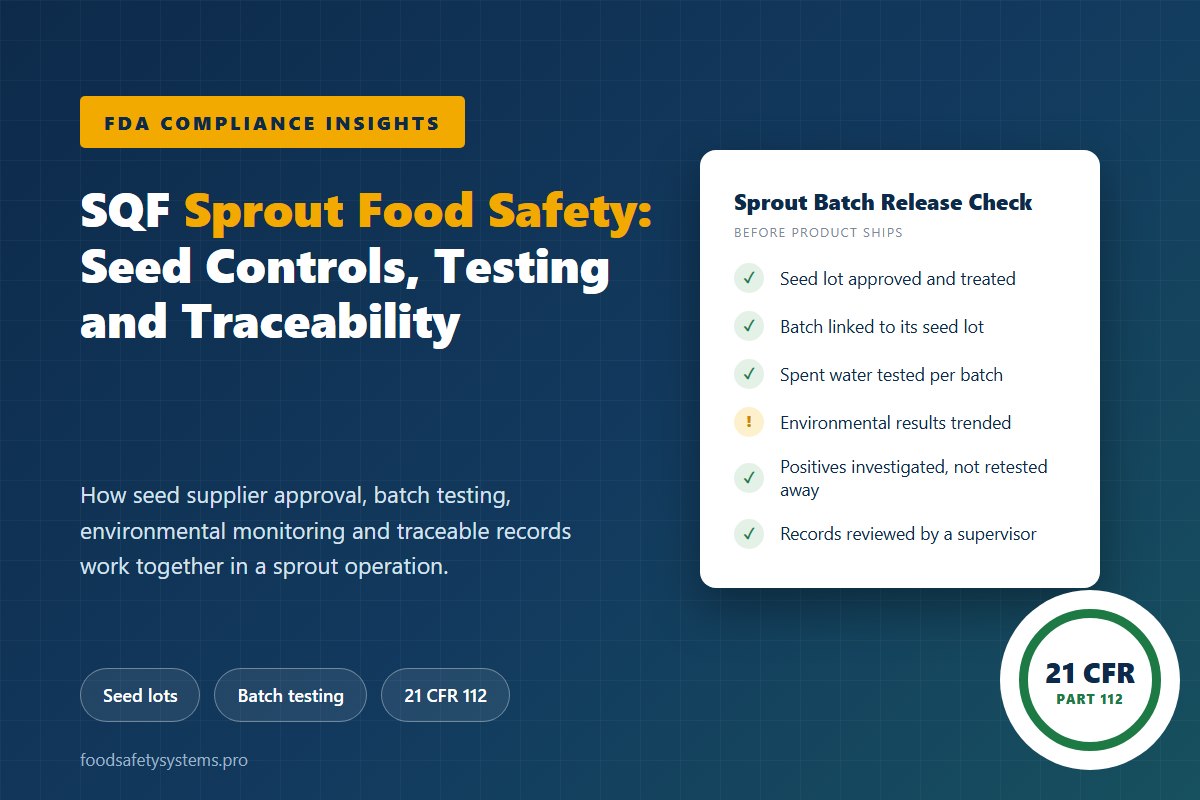
Sprout food safety depends on controls that start long before harvest: the warm, moist conditions that make seeds germinate can also let pathogens from contaminated seed or the growing environment multiply quickly. A credible program connects seed sourcing, seed treatment, growing conditions, batch testing, environmental monitoring, equipment hygiene, traceability and a documented response to adverse results. An SQF food safety system can organize that evidence, but SQF certification does not replace the sprout requirements in Subpart M of the FDA Produce Safety Rule, 21 CFR Part 112.
Quick answer: an SQF-aligned sprout program links seed supplier approval, environmental monitoring, batch test records and hygienic equipment to documented corrective actions. Which FDA sprout provisions apply must be assessed separately for each operation.
Who should review these sprout food safety controls?
Sprout growers, food safety managers, quality assurance leaders, seed procurement teams and businesses that manage supplier or import documentation for sprouts. Specific duties depend on the operation, the product and the rule that applies to it.
Control the incoming seed supply
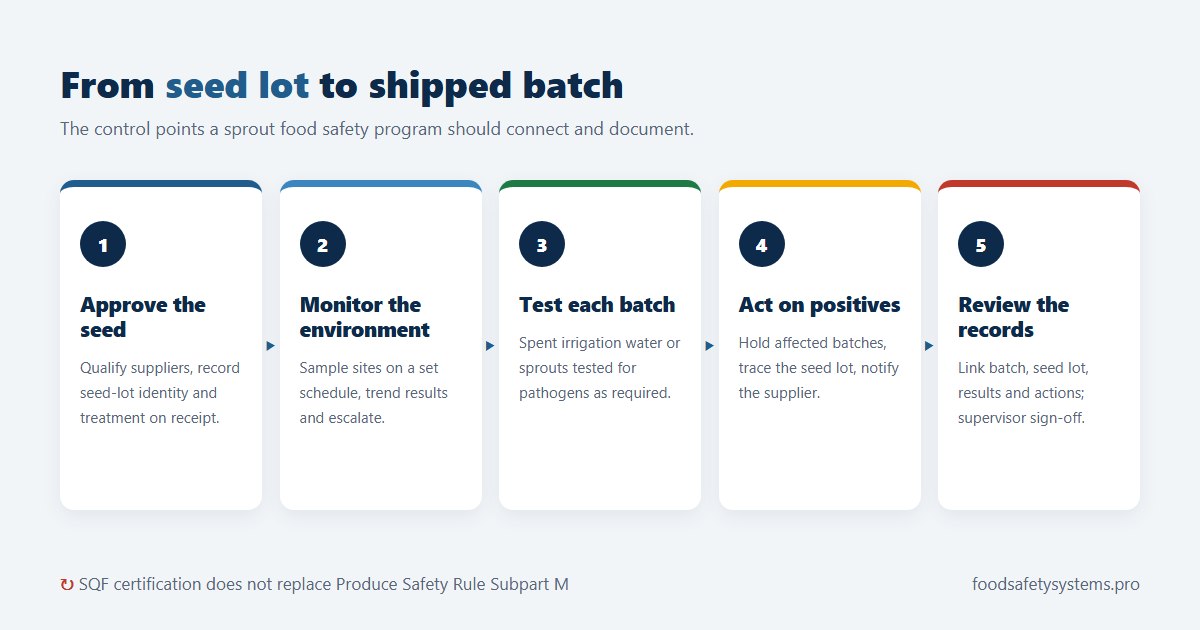
Seed is the most common source of sprout contamination, so supplier control comes first. Document supplier qualification, seed-lot identity and the receiving process, and record how each lot is treated to reduce microorganisms before sprouting (or the evidence that it was treated before you received it), as 21 CFR 112.142 describes. Set escalation and supplier communication procedures for any finding that may implicate a seed lot. Our approved supplier program guide covers the documentation side.
Design effective environmental monitoring for sprouts
Define environmental sampling sites, frequencies, methods, trending and escalation. Covered sprout operations must also meet the specific environmental monitoring requirements for Listeria species or Listeria monocytogenes in the growing, harvesting, packing and holding environment (21 CFR 112.144 and 112.145), including what to do after a positive result (112.147). For broader program design, see our guide to Listeria environmental monitoring and sanitation.
Verify every applicable sprout production batch
Check whether spent sprout irrigation water, or in-process sprouts where spent water cannot be used, is tested for E. coli O157:H7 and Salmonella for each production batch as the applicable Produce Safety Rule provisions require. Occasional sampling is not the same as batch coverage, and a testing plan that skips batches leaves product unverified.
Address positive microbial findings
Document lot identification, affected batches, seed-lot decisions, supplier notification, product disposition and effectiveness checks. Do not assume that a later negative sample cancels a prior positive: the original result stands and must be acted on under the applicable requirements (21 CFR 112.146 for spent water and sprout test results).
Keep sprout equipment cleanable and sanitary
Inspect conveyor seams, welds, belts and other food-contact surfaces for damage or residue build-up, and verify cleaning and sanitation before use. Equipment that cannot be cleaned properly becomes a harborage point that environmental monitoring will eventually find. Our SQF hygiene and sanitation programs page explains the evidence auditors expect.
Close the record-review loop
Tie each production batch to its seed lot, sampling records, test results, any affected-product disposition, supplier notifications and corrective actions, and have a supervisor review the records promptly. Seed-lot traceability is what lets you find every other batch potentially linked to a contaminated lot; test it with mock recalls.
Sprout food safety checklist
- Have you confirmed which FDA rules and SQF certification requirements actually apply to your operation?
- Is each production batch identified and linked to its seed lot and supplier?
- Are required microbial tests and environmental monitoring performed on schedule?
- Are equipment and food-contact areas inspectable, cleanable and maintained?
- Are test results, deviations, corrective actions and authorized record reviews kept?
Frequently asked questions
Why are sprouts a high-attention food safety category?
The conditions that support sprout germination can also support growth of pathogens associated with contaminated seed or the production environment, and sprouts are often eaten raw.
Does a negative retest erase an earlier positive result?
No. A later sample does not automatically invalidate a positive finding. The original result and the required regulatory response must be evaluated.
What is the value of seed-lot traceability?
It identifies other production batches potentially linked to a contaminated seed lot and supports supplier communication, containment and follow-up.
How Consultare Inc. Group can help
Consultare Inc. Group provides professional food safety and regulatory compliance support for sprout operations, tailored to the agreed scope of work.
- SQF gap assessments and internal audits: find seed-lot, testing and monitoring gaps before your auditor does.
- Supplier verification support: seed supplier approval and seed-lot traceability review.
- FDA compliance integration: align your SQF system with Produce Safety Rule requirements.
- Corrective action support: CAPA planning and effectiveness checks after positive results.
Need help managing your SQF responsibilities?
Discuss your products, documentation and compliance priorities with the Consultare team in a free consultation, or contact our team.
Start building your compliance system
Prefer to organize your compliance activities yourself? Create a free SystemsBuilder account to manage specifications, controlled documents, assigned actions and records in one structured workflow. Software supports record management; it does not by itself ensure compliance.
Technical sources: 21 CFR Part 112, Subpart M and SQFI. Independent educational content: Consultare Inc. Group is not affiliated with or endorsed by FDA. This article does not constitute regulatory approval, certification or legal advice; applicability must be assessed for each product, facility and operation.