
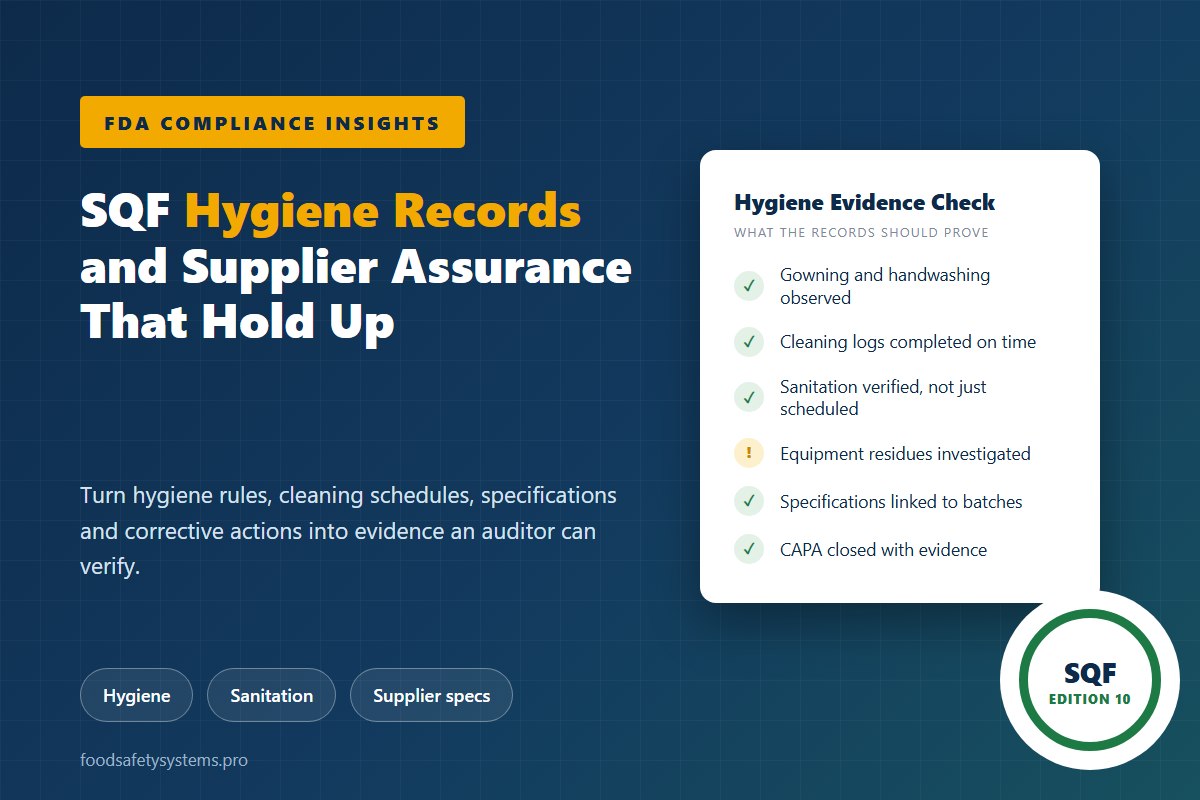
SQF hygiene records are the bridge between what your procedures say and what actually happens on the floor. Manufacturers and importers need a reliable way to connect written compliance procedures to everyday operating evidence, because gaps in personnel hygiene, facility conditions, manufacturing records, product specifications or complaint review undermine confidence in the whole quality program. The right controls depend on the product category, facility activities and the regulatory or certification requirements that apply.
Quick answer: SQF programs are strongest when there is evidence that hygiene rules, cleaning schedules, equipment checks, product specifications and corrective actions are actually implemented. The applicable SQF Code and certification scope set the detailed requirements.
Who this guidance is for
SQF practitioners, food safety managers, facility operators and manufacturers, including dietary supplement and ingredient makers, who are reviewing supplier, hygiene or sanitation documentation.
Connect hygienic practices to controlled procedures
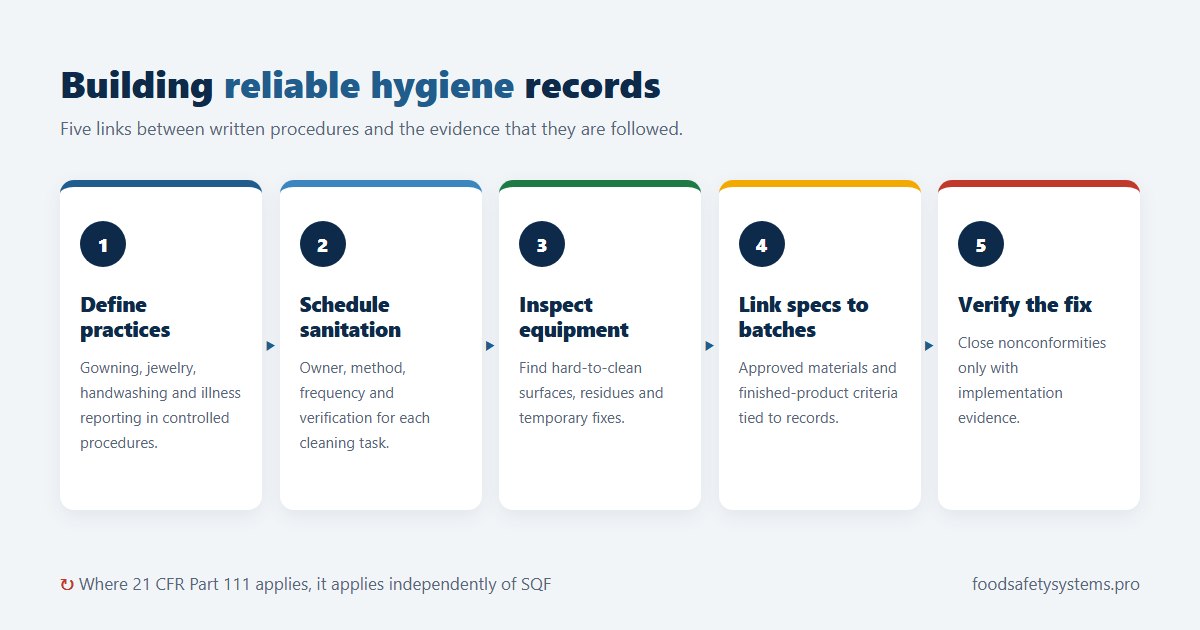
Document gowning, jewelry restrictions, handwashing access, illness reporting and employee practices wherever products or ingredients are exposed. Then check whether observed behavior matches training and the written procedure. Hygiene records that only show training attendance do not prove the practice is followed.
Make sanitation evidence demonstrable
Use approved sanitation schedules that name the responsible person, cleaning method, frequency, completion record and verification. A written schedule alone does not show the work was done. See our SQF sanitation requirements guide for what auditors look for.
Assess hygienic equipment design
Inspect mixers, scoops, fillers, flanges, bins and other product-contact equipment for hard-to-clean surfaces, residue build-up, temporary materials such as tape or cable ties, and preventable contamination. Our article on SQF equipment hygiene covers shared-line equipment in more detail.
Verify supplier and product specifications
Connect material approval, ingredient identity, finished-product requirements and acceptance criteria to an appropriate verification process, and align those controls with your actual products and certification scope. Supplier assurance only works when the specification you verify against is current and approved; see supplier specification verification.
Control batch and production records
Use traceable production records that reference equipment, cleaning, monitoring, yields and any deviations, and check that personnel complete them at the time the work is done rather than afterwards.
Confirm corrective action effectiveness
Close nonconformities only with implementation evidence: records, observation, inspections, trend data and management review where warranted. A CAPA process that verifies effectiveness stops the same hygiene finding from returning at the next audit.
SQF hygiene records checklist
- Confirm the regulatory and program scope for each product and facility.
- Assign accountable owners and current approvals for each written procedure.
- Verify hygienic practices, equipment condition and cleaning implementation by observation.
- Link product specifications and manufacturing records to traceable batches.
- Document complaints, deviations, product impact and corrective action evidence.
- Review recurring findings and verify that improvements remain effective.
Frequently asked questions
Does SQF certification replace dietary supplement CGMP requirements?
No. Where FDA dietary supplement CGMP applies, 21 CFR Part 111 applies independently of a voluntary SQF certification.
What is the most useful sanitation evidence?
Completed cleaning logs, verification records, investigation of missed tasks and documented follow-up give the strongest demonstration of implementation.
How should repeated equipment residues be handled?
Evaluate the product impact, remove the immediate condition, identify the cause, improve the cleaning method or equipment design, and verify that the fix works.
How Consultare Inc. Group can help
Consultare Inc. Group supports organizations that want coordinated, practical food safety and regulatory compliance assistance. Recommendations and deliverables depend on the agreed engagement scope.
- SQF readiness assessments and internal audits: test hygiene and sanitation records against floor practice.
- Supplier verification support: supplier and product documentation reviews.
- Document control services: controlled procedures, approvals and record templates.
- Corrective action support: CAPA planning and implementation verification.
For dedicated dietary supplement CGMP support, see our sister site DietarySupplements.pro.
Need help managing your SQF responsibilities?
Discuss your products, documentation and compliance priorities with the Consultare team in a free consultation, or contact our team.
Start building your compliance system
Prefer to organize your compliance activities yourself? Create a free SystemsBuilder account to manage specifications, controlled documents, assigned actions and records in one structured workflow. Software supports record management; it does not by itself ensure compliance.
Technical sources: SQFI and 21 CFR Part 111. Independent educational content: Consultare Inc. Group is not affiliated with or endorsed by FDA. This article does not constitute regulatory approval, certification or legal advice; applicability must be assessed for each product, facility and operation.