
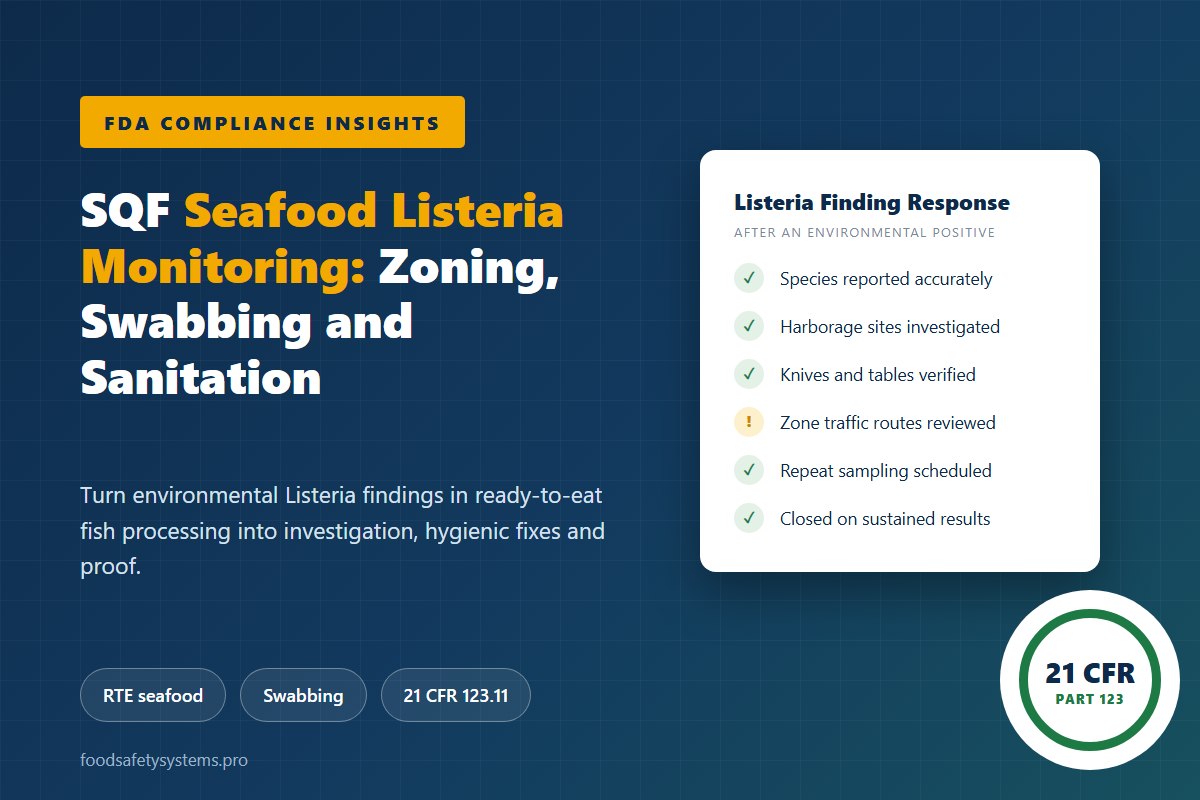
Seafood Listeria monitoring matters most where ready-to-eat fish intended for raw consumption meets the processing environment, because contamination from surfaces and tools cannot be cooked out later. Environmental Listeria findings can signal sanitation weaknesses even when the isolated species is non-pathogenic. A strong SQF system turns those signals into documented investigation, hygienic design improvements and preventive action.
Quick answer: an SQF seafood facility can strengthen environmental Listeria control by combining risk-based swabbing, hygienic equipment and personnel practices, sanitation verification, traceable investigations and effectiveness checks. SQF certification does not replace applicable FDA seafood HACCP requirements under 21 CFR Part 123.
Who this guidance is for
Seafood processors that use SQF as their food safety certification framework, especially those handling ready-to-eat products such as salmon for raw consumption.
Design a risk-based seafood Listeria monitoring program
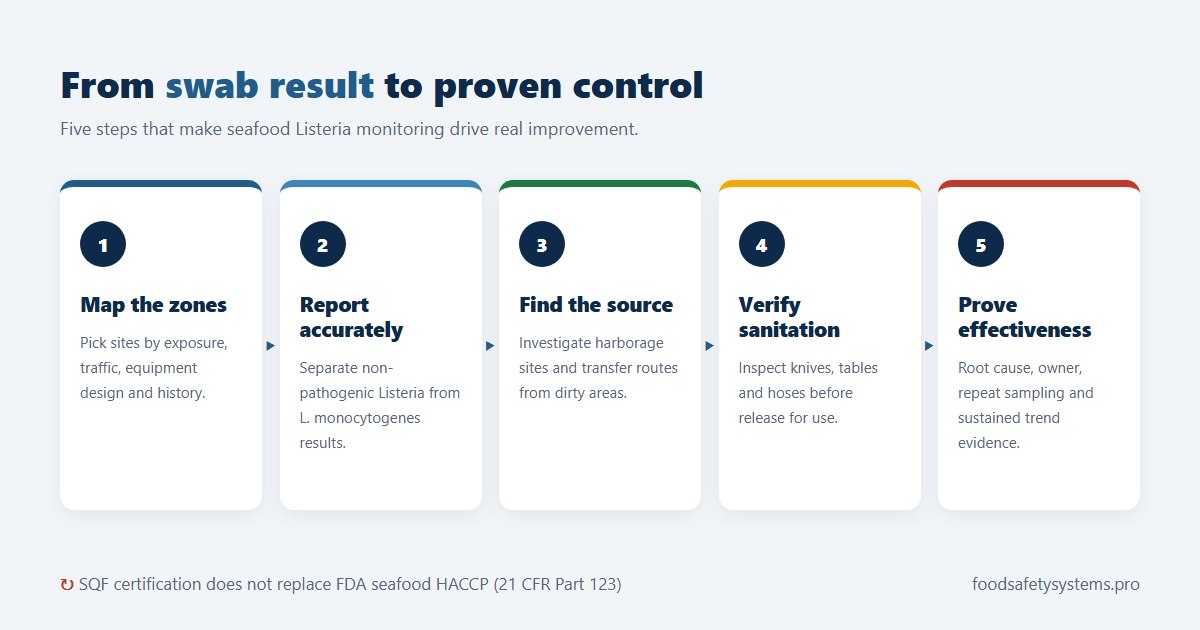
Choose sampling sites deliberately. Select food-contact and non-food-contact locations based on product exposure, traffic, equipment design, historical findings and hygienic zones. Then define the organisms tested, sampling methods, frequency, triggers for extra sampling and how often results are trended. Our broader guide to environmental monitoring program design explains zoning and trending in more detail.
Investigate Listeria species findings accurately
Report exactly what the laboratory found. Differentiate non-pathogenic Listeria species from Listeria monocytogenes, and never mislabel either result. Even so, a non-pathogenic finding still shows that conditions allow Listeria to survive. Assess what it means for environmental control, and investigate potential harborage sites and transfer routes.
Verify cleaning of tools and work surfaces
Knives, sharpening equipment, cutting tables and hoses are touched constantly. Therefore, inspect these high-contact items before they are released for use. Document cleaning verification, and escalate repeated residues or deteriorating surfaces that could become harborage points.
Prevent movement from dirty to clean areas
Listeria often travels on hands, gloves and equipment. To limit that movement, control:
- Gloves, hands and door handles between zones.
- Waste handling and the routes waste containers take.
- Hoses, pallets and packaging containers that cross zone boundaries.
- Handwashing and glove changes after contact with potentially contaminated objects.
Align SQF procedures with seafood HACCP
Coordinate sanitation programs and environmental verification with the site’s Part 123 obligations. For instance, seafood HACCP processors must monitor and record key sanitation conditions under 21 CFR 123.11, including food-contact surface condition and prevention of cross-contamination. In addition, review whether product-specific hazard analyses and HACCP plans address the relevant hazards.
Close findings based on demonstrated effectiveness
A recurring positive is not resolved because one follow-up swab was negative. Use root-cause investigations, responsible owners, due dates, repeat environmental sampling and sustained evidence before closing the issue. Our CAPA process guide explains how to prove a fix holds. For ready-to-eat plants more broadly, see Listeria environmental monitoring and sanitation.
Seafood Listeria control checklist
- Confirm which regulations and standards apply to the actual products and operations.
- Document product- and process-specific hazards and supplier responsibilities.
- Review sanitation, personnel hygiene, equipment and contact surfaces.
- Verify that written monitoring procedures match records and observed practices.
- Track deviations, root causes, corrective actions and effectiveness evidence.
Storage conditions after processing also matter, so see our sibling guide on seafood cold storage controls.
Frequently asked questions
Does a non-pathogenic Listeria finding mean Listeria monocytogenes was detected?
No. A finding of Listeria welshimeri, for example, is not a positive result for Listeria monocytogenes. However, it can indicate environmental conditions that justify additional sanitation investigation.
Can SQF certification replace a seafood HACCP plan?
No. Where 21 CFR Part 123 applies, a processor must separately meet the applicable federal seafood HACCP requirements.
What should an SQF team retain after an environmental positive?
Results, sample locations, affected-product assessments where warranted, investigations, corrections, corrective actions, verification evidence and trend reviews.
How Consultare Inc. Group can help
Consultare Inc. Group provides professional food safety and regulatory compliance support for seafood processors. Services and deliverables depend on the applicable requirements and the agreed engagement scope.
- SQF gap assessments and internal audits: hygienic zoning and monitoring review.
- Hygiene and sanitation programs: sanitation verification for tools and surfaces.
- HACCP implementation support: align monitoring and sanitation with Part 123.
- Corrective action support: root cause and effectiveness checks after positives.
Need help managing your SQF responsibilities?
Discuss your products, documentation and compliance priorities with the Consultare team in a free consultation, or contact our team.
Start building your compliance system
Prefer to organize your compliance activities yourself? Create a free SystemsBuilder account to manage specifications, controlled documents, assigned actions and records in one structured workflow. Software supports record management; it does not by itself ensure compliance.
Technical sources: 21 CFR Part 123, 21 CFR 123.11 and SQFI. Independent educational content: Consultare Inc. Group is not affiliated with or endorsed by FDA, SQFI or any companies referenced in the underlying regulatory materials. This article does not constitute regulatory approval, certification or legal advice; applicability must be assessed for each product, facility and operation.