
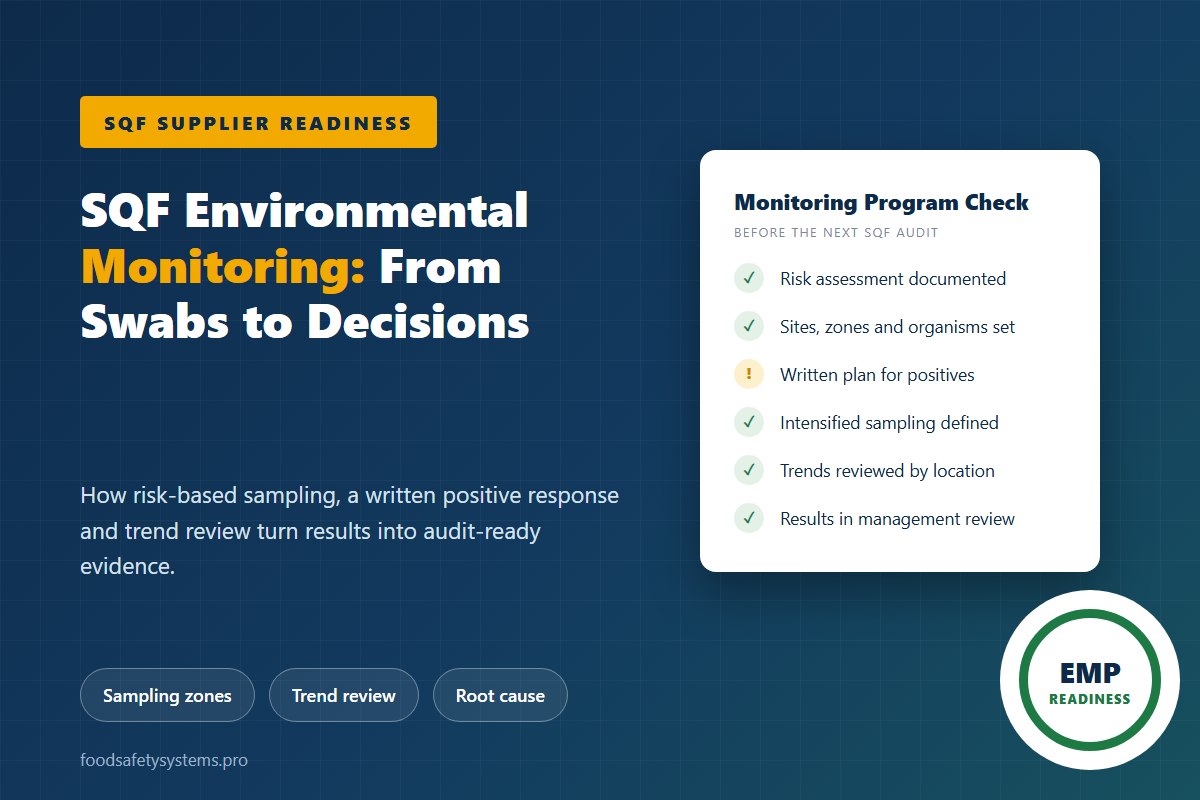
SQF environmental monitoring for Walmart food suppliers only adds value when results drive timely decisions: a program that collects swabs but never acts on trends may miss persistent contamination risks. Strong programs connect environmental results to documented investigation, correction and improvement. For manufacturers considering Walmart supply relationships, that evidence matters as much as the sampling plan itself.
Quick answer: base the program on a documented risk assessment, define sampling sites, zones, organisms and response thresholds, write a response plan for positive findings and trend results into internal audits and management review. Walmart supplier requirements vary by product, facility and commercial relationship, so confirm current Walmart policies with your Walmart contact before treating any recommended practice as a mandatory Walmart rule.
Who this guidance is for
SQF practitioners, sanitation leads and quality managers at food manufacturers, especially sites with exposed ready-to-eat product, who are preparing for retail supplier review.
Decide what the program must address
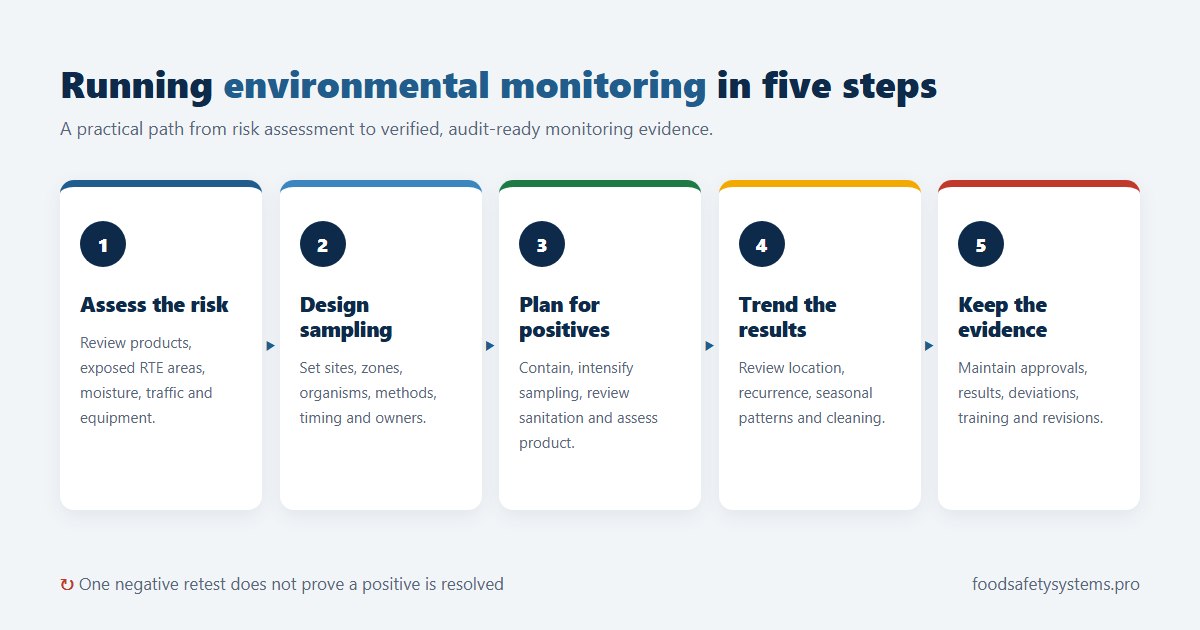
Assess your products, exposed ready-to-eat areas, moisture, traffic patterns, equipment and environmental pathogen risk. The scope and sampling methods should reflect the site and the applicable SQF Code. In other words, do not adopt a sampling template without examining whether it fits your operation. Our guide to SQF hygienic zoning for ready-to-eat foods explains how zoning shapes the risk picture.
Design sampling zones and responsibilities
Define sampling sites, zone classifications where used, target organisms, methods, timing, responsible personnel and response thresholds. Then sample consistently enough to support meaningful trending. At the same time, allow targeted investigation when conditions change, for example after construction or an equipment repair.
Prepare for positive findings
Create a written plan for containment, intensified sampling, sanitation review, root cause investigation and assessment of potentially affected product. A positive result calls for a risk-based response. However, a single negative follow-up sample does not prove that the original problem is resolved. See our Listeria environmental monitoring article for investigation steps after a positive.
Trend SQF environmental monitoring for Walmart food suppliers
Review results by location, recurrence and seasonal pattern. Also compare them with cleaning performance and corrective action effectiveness. Bring the findings into internal audits and management review; our guide to SQF internal audits for Walmart food suppliers explains what auditors should sample, and restrict access where sensitive data require confidentiality.
Coordinate certification evidence
Maintain program approval, results, deviations, training and revision history in line with the applicable certification scope. Environmental monitoring obligations vary by product and facility. Therefore, verify current Walmart requirements separately rather than assuming SQF certification covers them. For the broader design principles, read our environmental monitoring program guide.
Supplier readiness checklist
- Decide what the program must address.
- Design sampling zones and responsibilities.
- Prepare for positive findings.
- Trend results and verify effectiveness.
- Coordinate certification evidence.
- Verify the applicable Walmart supplier program and all relevant product and facility requirements.
- Assign owners for documentation, follow-up actions and periodic review.
Frequently asked questions
Is one negative retest enough after a positive swab?
Usually not. A positive result calls for a risk-based response, including containment, intensified sampling, sanitation review and root cause investigation. One negative follow-up sample does not demonstrate that the original problem is resolved.
Can we use a standard sampling template?
A template can be a starting point. However, the scope, sites and frequencies should reflect your products, exposed areas, moisture and traffic patterns, as well as the applicable SQF Code.
Does SQF certification cover Walmart’s environmental monitoring expectations?
Not necessarily. Obligations vary by product and facility, and SQF certification does not guarantee supplier acceptance. Confirm Walmart-specific expectations directly with the relevant Walmart contact.
How Consultare Inc. Group can help
Consultare Inc. Group can help evaluate sampling coverage, written responses to positive results, training needs and the evidence required to support an effective SQF audit.
- SQF gap assessments and internal audits: test sampling coverage and records.
- Food safety system development: build the written monitoring program.
- Corrective action support: root cause and follow-up after positives.
- Retail and wholesale solutions: prepare for retail customer review.
Need help managing your SQF responsibilities?
Discuss your products, documentation and compliance priorities with the Consultare team in a free consultation, or contact our team.
Start building your compliance system
Prefer to organize your compliance activities yourself? Create a free SystemsBuilder account to manage specifications, controlled documents, assigned actions and records in one structured workflow. Software supports record management; it does not by itself ensure compliance.
Technical sources: SQFI: SQF Code and guidance documents, FDA: Preventive Controls for Human Food and Walmart: Audits, Certifications and Testing. Independent educational content: Consultare Inc. Group is not affiliated with or endorsed by Walmart Inc., SQFI or FDA. Walmart-specific supplier requirements must be confirmed directly with Walmart. SQF certification does not guarantee supplier acceptance. Regulatory applicability depends on the product, facility, activity and current law; this article is not legal advice.