
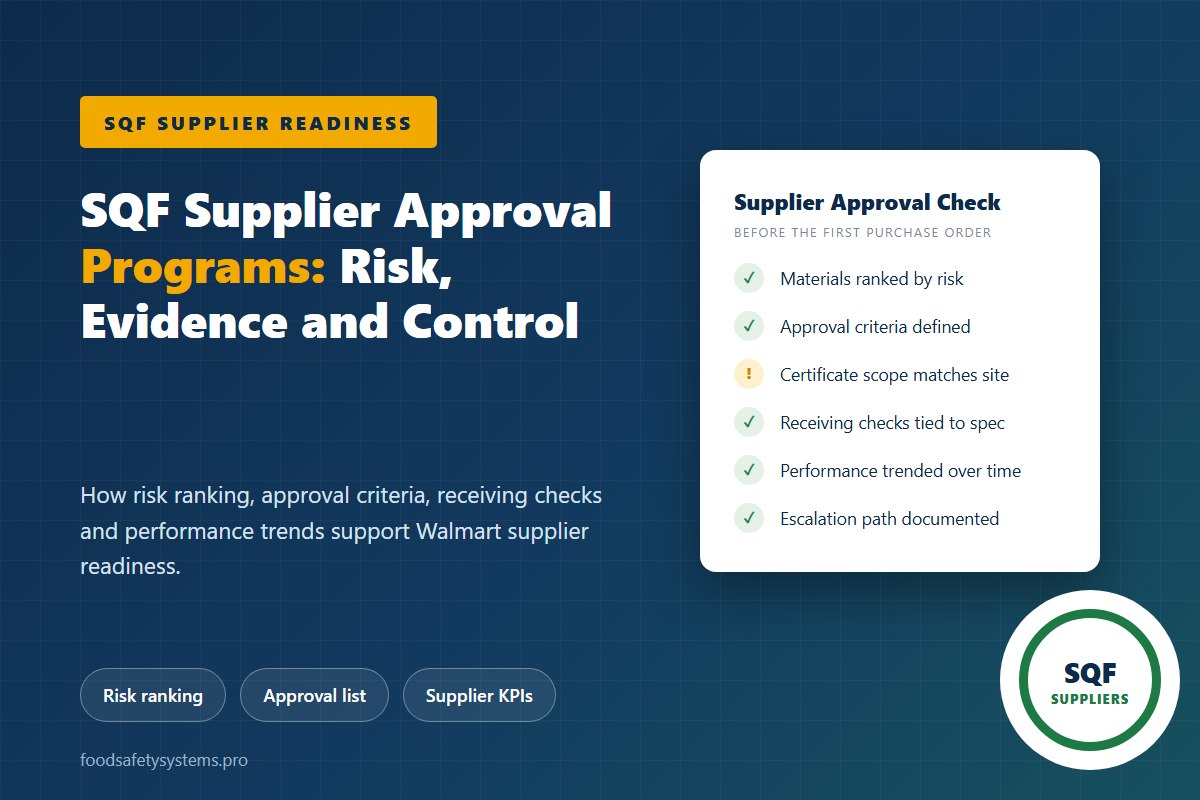
SQF supplier approval programs for Walmart supply relationships work best when they rank materials by risk, set approval criteria before purchasing, verify incoming lots and monitor supplier performance over time. For manufacturers and importers considering Walmart as a customer, the priority is to show that safety and quality controls work in practice. Current, accurate records must also support that claim. For the wider certification picture, see our guide to SQF certification for Walmart food suppliers.
Quick answer: build a documented, risk-based approval method, confirm that every certificate matches the right legal entity, facility and material, and link receiving checks to the approved specification. Walmart supplier requirements vary by product, facility and commercial relationship, so check Walmart’s current supplier policies with your Walmart contact before treating any recommended practice as a mandatory Walmart rule.
Who this guidance is for
SQF practitioners, purchasing teams and quality managers at food manufacturers and importers who approve ingredient, packaging and service suppliers.
Classify materials and suppliers by risk
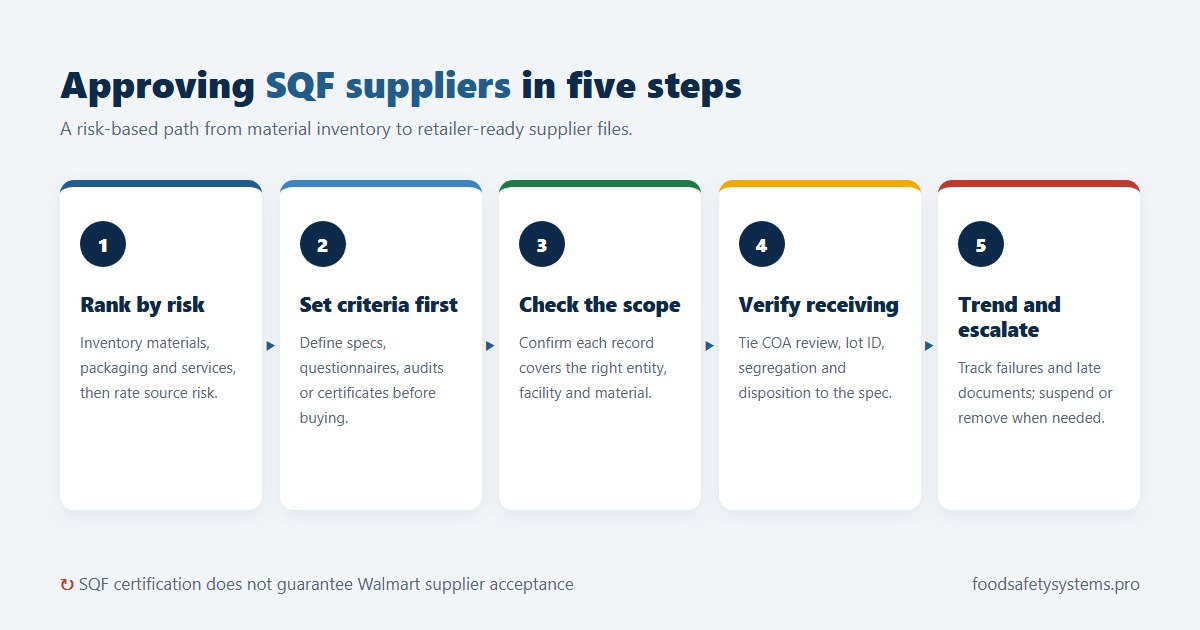
Start with an inventory of raw materials, ingredients, packaging and outsourced services. Then evaluate the food safety significance of each item and the risks linked to its source. Use a documented method to evaluate both products and manufacturing sites. In short, do not treat every supplier or material as if it carried identical risk.
Set SQF supplier approval criteria before purchasing
Define the evidence that supports approval before the first order is placed. Typical evidence includes specifications, questionnaires, audit results, testing and recognized certifications where relevant. Next, confirm that each record covers the correct legal entity, facility and supplied material. A certificate for a sister plant or an unrelated product line does not support approval. Our approved supplier program page explains how to structure the approved supplier list.
Verify incoming material controls
Align receiving checks with the approved specification. These checks may include certificate of analysis review where appropriate, lot identification, segregation and disposition decisions. When a delivery deviates, investigate the cause and decide whether the supplier needs additional verification. See our guide to COA verification for practical review steps.
Monitor supplier performance
Trend complaints, shipment issues, test failures, late documents and corrective action responses over time. In addition, define a documented escalation process for conditional approval, suspension or removal from the approved supplier list. As a result, decisions stay consistent and traceable when a supplier’s performance slips.
How SQF supplier approval programs for Walmart connect to retailer readiness
Connect supplier files with your hazard analysis, traceability records, allergen program and current SQF Code requirements. The supplier approval program supports the wider food safety system; it does not replace it. For imported materials, our article on SQF supplier approval for imported ingredients covers the documentation in more depth. Separate Walmart certification or category-specific expectations must still be verified directly.
Supplier readiness checklist
- Classify materials and suppliers by risk.
- Set approval criteria before purchasing.
- Verify incoming material controls.
- Monitor supplier performance.
- Integrate supplier approval with retailer readiness.
- Verify the applicable Walmart supplier program and all relevant product and facility requirements.
- Assign owners for documentation, follow-up actions and periodic review.
Frequently asked questions
Does an approved supplier list satisfy Walmart’s requirements?
Not on its own. A sound supplier approval program supports your SQF food safety system, but Walmart-specific supplier requirements must be confirmed directly with the relevant Walmart contact. SQF certification does not guarantee supplier acceptance.
Can we accept a supplier’s certificate without further checks?
Only after you confirm that it covers the correct legal entity, facility and supplied material, and that it is current. Then combine it with specifications, receiving checks and performance monitoring based on risk.
When should a supplier be suspended?
Follow your documented escalation process. Repeated test failures, unresolved corrective actions or missing documents can justify conditional approval, suspension or removal from the approved supplier list.
How Consultare Inc. Group can help
Consultare Inc. Group supports food businesses with compliance gap assessments, program development, documentation control, audit preparation and corrective action coordination. Services are adapted to the specific product, site and customer program.
- Supplier verification support: risk ranking and approval evidence review.
- SQF gap assessments and internal audits: test supplier files before the audit.
- Retail and wholesale solutions: prepare for retail customer review.
- Corrective action support: close supplier nonconformities with evidence.
Need help managing your SQF responsibilities?
Discuss your products, documentation and compliance priorities with the Consultare team in a free consultation, or contact our team.
Start building your compliance system
Prefer to organize your compliance activities yourself? Create a free SystemsBuilder account to manage specifications, controlled documents, assigned actions and records in one structured workflow. Software supports record management; it does not by itself ensure compliance.
Technical sources: SQFI: SQF Code and guidance documents, Walmart: Audits, Certifications and Testing and 21 CFR Part 117. Independent educational content: Consultare Inc. Group is not affiliated with or endorsed by Walmart Inc., SQFI or FDA. Walmart-specific supplier requirements must be confirmed directly with Walmart. SQF certification does not guarantee supplier acceptance. Regulatory applicability depends on the product, facility, activity and current law; this article is not legal advice.