
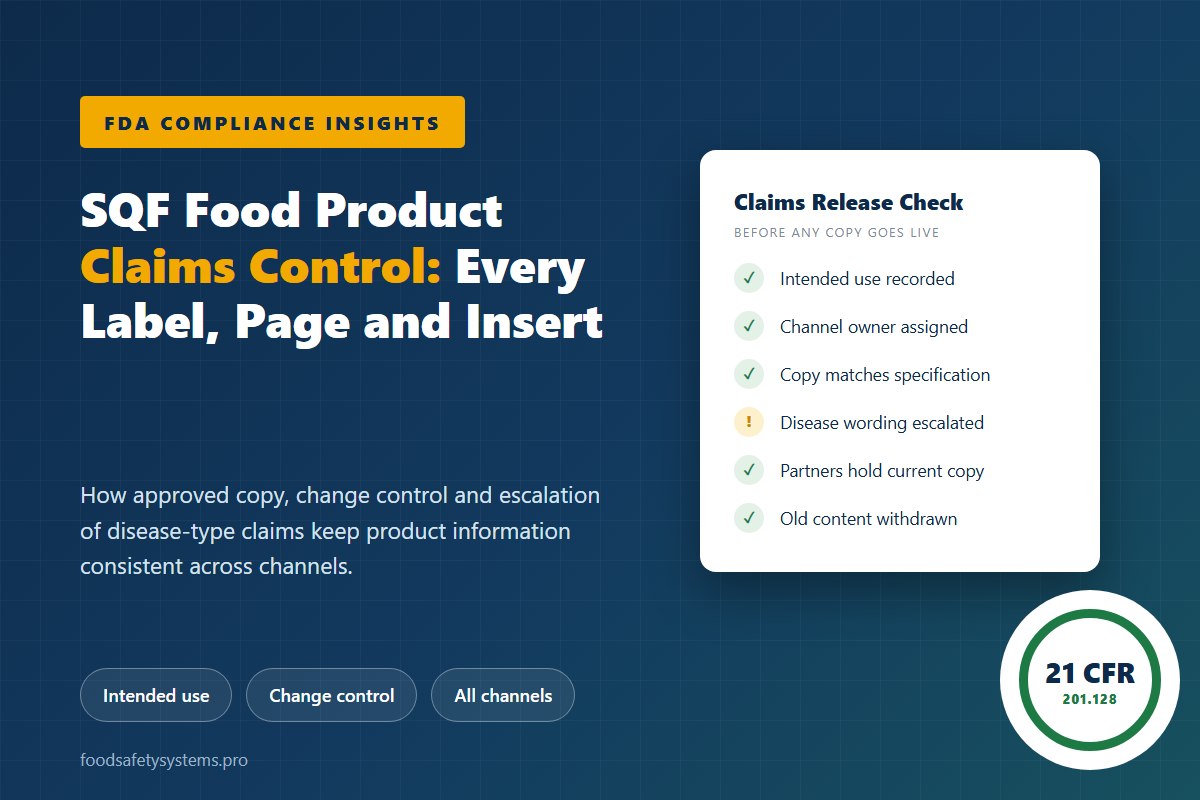
SQF food product claims control starts with one question: what does each label, webpage and leaflet say your product does? When a product is promoted to treat, prevent, mitigate or cure disease, that language can change how FDA classifies it. Such statements can appear on packaging, ecommerce pages, blogs, promotional leaflets and inserts shipped with orders. Therefore, review the product’s intended use and supporting documentation before any therapeutic wording reaches the U.S. market.
Quick answer: an SQF food safety system can support controlled product specifications, approved labels, change management and traceable records. However, SQF certification does not authorize claims to treat or prevent disease. FDA drug classification must be reviewed separately.
Who this guidance is for
SQF-certified and SQF-aspiring food manufacturers that control labels, claims and external product information. It applies to any product line, not only dietary supplements.
Why disease-type claims are a classification issue
Under the Federal Food, Drug, and Cosmetic Act, 21 U.S.C. 321(g)(1) defines a drug to include articles intended for use in the diagnosis, cure, mitigation, treatment or prevention of disease. FDA’s rule on the meaning of intended uses, 21 CFR 201.128, explains that intended use can be shown by labeling claims, advertising and other statements. In other words, the words you publish help define the product. Food safety certification and import paperwork do not settle this question.
Map every claims channel
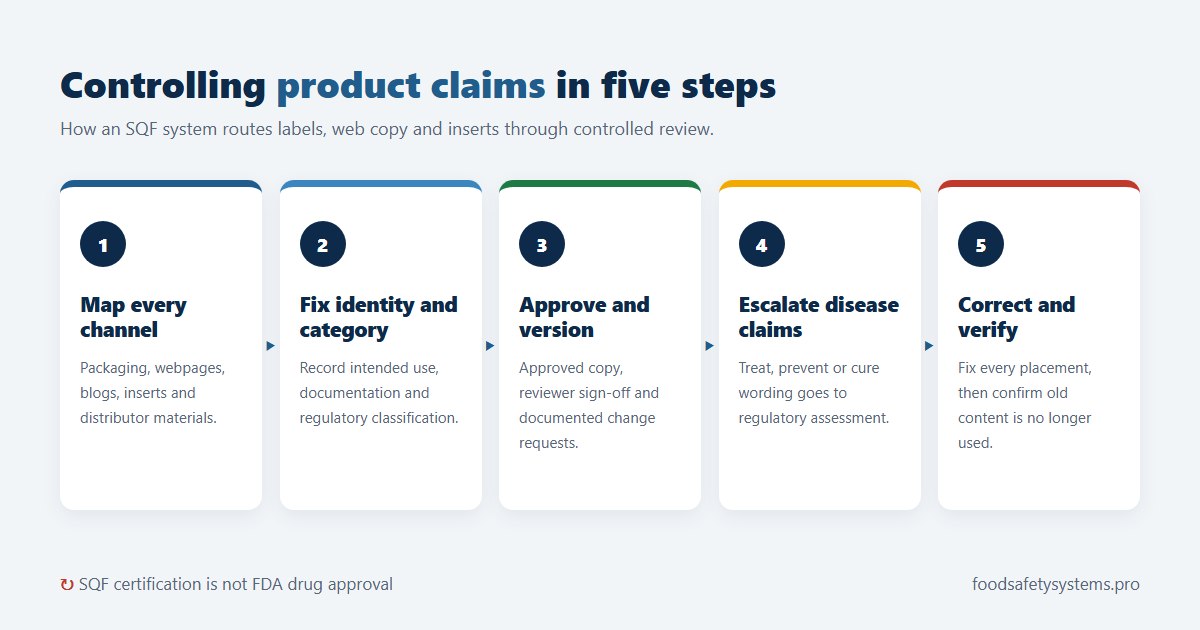
First, build an inventory of product packaging, product webpages, category headings, blogs, inserts shipped with orders and distributor-supplied materials. Next, name the person responsible for approving each channel. A claim that is controlled on the label but uncontrolled on a category page is still a published claim.
Verify product identity and legal category
Keep product identity, intended use, supporting documentation and regulatory classification consistent across records. Remember that a food safety certificate does not determine whether disease-related claims make a product a drug. For supplement lines, our guide to dietary supplement disease claims screening covers that category in detail.
Apply SQF food product claims control to every content change
Use approved copy, version control, reviewer sign-off and documented change requests before launching or changing marketing assets. Treat claims text like any other controlled document: one current version, a named approver and a dated history. Our document control procedure page explains how to structure that workflow.
Connect specifications and labeling
Check that product names, ingredient information, product descriptions and labels match approved product specifications and the intended market. When they drift apart, a claim can outlive the formulation it described. See how SQF product specifications and label review keep these records aligned.
Manage outsourced content
Agencies, online sellers and distribution partners often publish your product information. Send them the current approved claims, and set up a way to withdraw superseded copy. Then confirm that partners actually removed it.
Verify corrections and keep them in place
When an unsupported disease claim is found, assess every placement, not just the one reported. Document the correction and its cause. Finally, confirm that the old content is no longer in use, and recheck it later. Our claims review guide shows how this works for supplement marketing.
Practical compliance checklist
- Confirm the product category, intended use and responsible reviewer.
- Inventory packaging, website content, blogs, product inserts and relevant third-party listings.
- Flag disease-treatment and disease-prevention statements for regulatory assessment.
- Keep current approved wording, reviewer decisions and change history.
- Document corrective actions and verify that affected materials were updated.
Frequently asked questions
Does SQF certification permit disease-treatment claims?
No. SQF certification addresses an applicable food safety system. FDA intended-use and drug rules are separate and must be assessed on their own.
Should website copy be part of document control?
Yes, where the business uses claims and product information in marketing. Controlling versions, approval and withdrawal keeps every channel consistent.
What is the first practical step?
Create a complete inventory of labels, site pages, blog content, inserts and partner-facing promotional claims.
How Consultare Inc. Group can help
Consultare Inc. Group provides structured, practical compliance support. Deliverables and regulatory applicability depend on the agreed engagement scope.
- SQF gap assessments and internal audits: review how labels and claims are controlled today.
- SQF document control services: controlled procedures and product information workflows.
- FDA compliance integration: align your SQF system with FDA intended-use rules.
- Corrective action support: correction records and verification that old claims are gone.
Need help managing your SQF responsibilities?
Discuss your products, documentation and compliance priorities with the Consultare team in a free consultation, or contact our team.
Start building your compliance system
Prefer to organize your compliance activities yourself? Create a free SystemsBuilder account to manage specifications, controlled documents, assigned actions and records in one structured workflow. Software supports record management; it does not by itself ensure compliance.
Technical sources: 21 U.S.C. 321(g)(1), 21 CFR 201.128 and SQFI. Independent educational content: Consultare Inc. Group is not affiliated with or endorsed by FDA, SQFI or any company referenced in the underlying regulatory materials. This article does not constitute regulatory approval, certification or legal advice; applicability must be assessed for each product, facility and operation.