
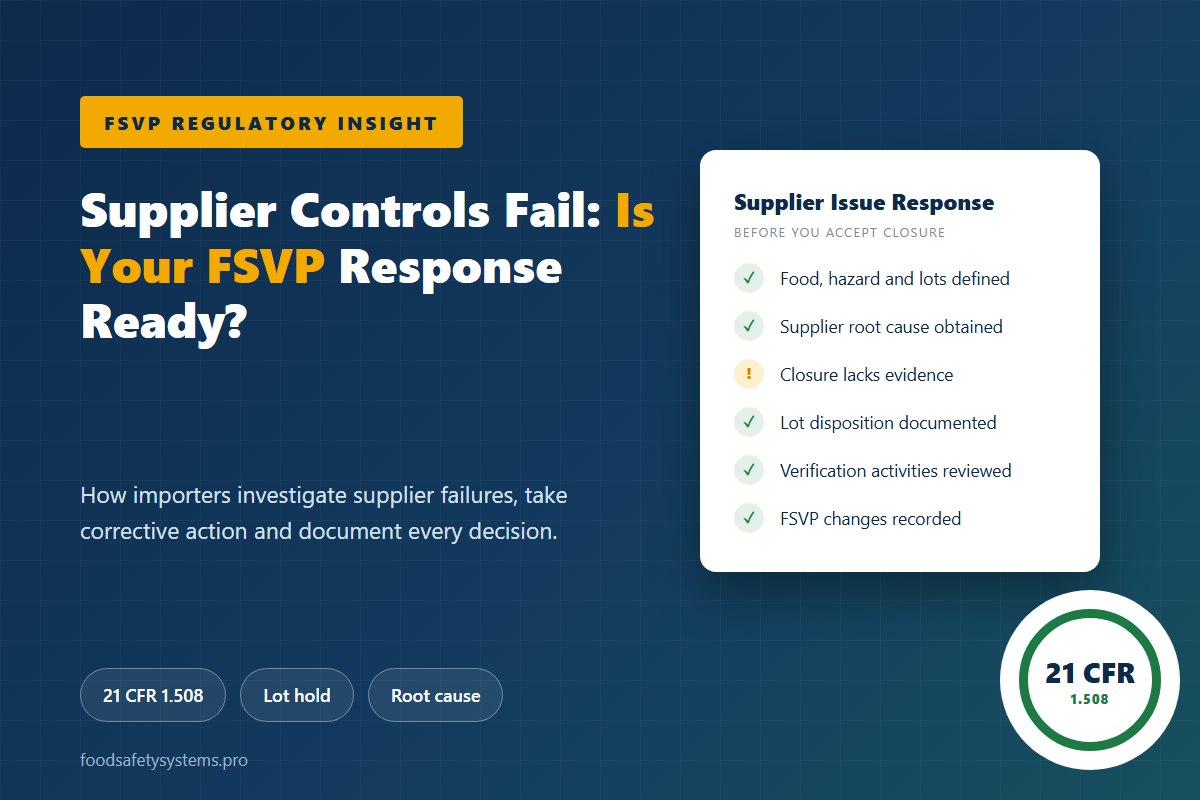
FSVP corrective actions are tested the moment a supplier’s food safety controls fail: do your records show what happened next? A repeated sanitation failure or a concerning laboratory result raises a serious question for any importer. A supplier’s promise to improve is not the same as understanding the food safety impact and deciding on a suitable response.
Quick answer: under 21 CFR 1.508, an importer must promptly take appropriate corrective actions when it determines that a foreign supplier is not producing food in line with the required level of public health protection, or is producing adulterated or allergen-misbranded food. Actions depend on the circumstances and may include discontinuing use of the supplier until the cause is addressed. All corrective actions must be documented.
Who this guidance is for
U.S. food importers, supplier quality teams and food safety decision makers, including SQF certified sites that import ingredients and manage supplier nonconformities.
When FSVP corrective actions are required
The trigger is a determination that the foreign supplier does not produce the food under processes and procedures giving at least the same level of public health protection as the applicable preventive controls or produce safety requirements. It also applies when the supplier produces food that is adulterated, or misbranded for major food allergen labeling.
That determination can come from many sources. The rule names consumer, customer or other food safety complaints, supplier verification results, a reevaluation of the food and supplier, or any other relevant information. Our article on FSVP supplier reevaluation explains how new information should feed that process.
The rule also covers problems found outside your own verification. If you learn of a supplier failure by other means, you must promptly investigate whether your FSVP is adequate and modify it when appropriate. Investigations, corrective actions and program changes must all be documented. Furthermore, these duties do not limit other FDA obligations, such as those relating to recalls.
What a sound response looks like
A sound response connects the specific food, hazard, supplier, affected lots and the actual evidence. It should be driven by the documented facts rather than a generic checklist. In practice, the review should cover:
- The hazard analysis and the hazard requiring a control that is affected.
- Testing trends and any out-of-specification results.
- Affected products, lots and time periods.
- The control deviation and the supplier’s investigation of its cause.
- Disposition decisions for affected product already received.
- Follow-up verification that the fix is working.
Seek objective evidence before accepting closure. A checklist, an email assurance or a certificate alone does not decide compliance.
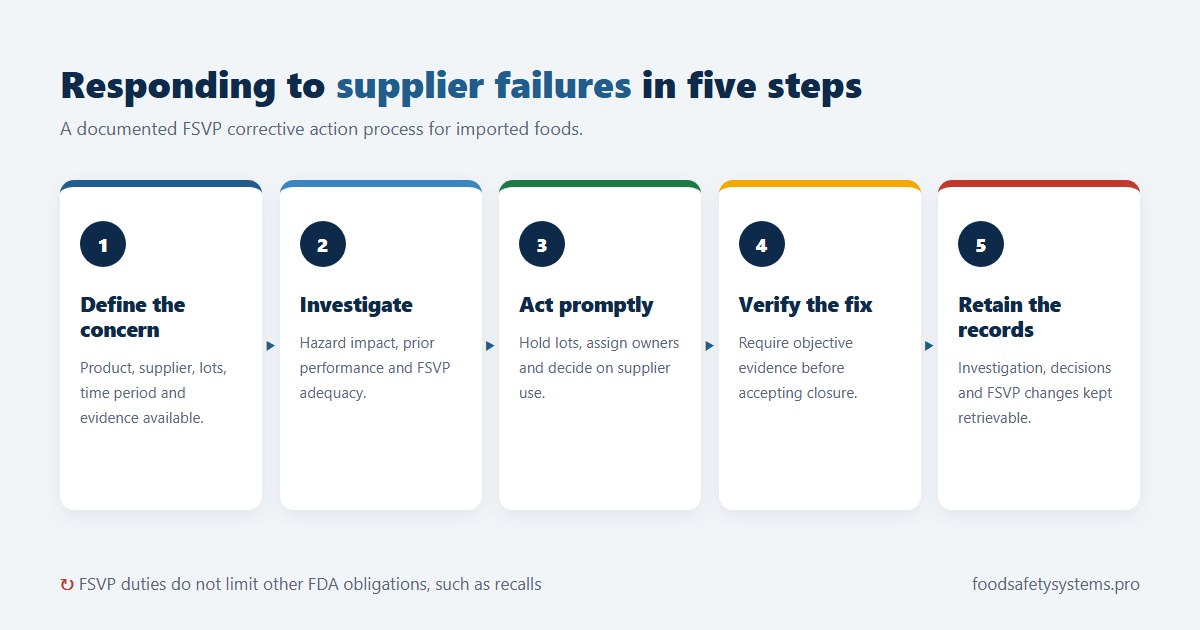
Practical steps for importers
- Define: capture the product, supplier, lot or time period, available evidence and the specific concern.
- Investigate: obtain supplier information and consider the hazard, the food safety implications, prior performance and whether your FSVP remains adequate.
- Act: when required, promptly take corrective action, assign responsible people and decide whether supplier use or verification activities should change.
- Retain: keep the investigation, decisions, supplier communications and corrective action records readily retrievable.
Common gaps in corrective action files
- Repeat deviations occur, but each one is closed as a separate event.
- The supplier closes an issue without evidence that the cause was fixed.
- Emerging data change the risk, yet verification activities stay the same.
- Responsibility for the importer’s review is unclear.
- No record shows who decided to keep, hold or reject affected lots.
Example scenario: repeated Listeria findings at a supplier
Imagine a hypothetical importer of ready-to-eat smoked fish. During a record review, the qualified individual sees three positive Listeria environmental results on food-contact surfaces over two months. The supplier’s response to each one says only “area recleaned.”
The importer places received lots from the affected period on hold and asks for product test results and a root cause investigation. Meanwhile, it pauses new orders. The supplier finds a damaged slicer that could not be cleaned properly, replaces it and shows eight weeks of negative results. The importer documents the evaluation, the lot disposition and the decision to resume, and adds an onsite audit before the next order cycle. For background on monitoring programs, see our Listeria environmental monitoring guide.
Records to keep
- The information that triggered the determination and the date it was received.
- The investigation, including evidence considered and qualified personnel involved.
- Corrective actions taken, owners and completion dates.
- Decisions on supplier use, lot disposition and changes to verification activities.
- Any changes made to the FSVP itself.
Keep these records under the FSVP recordkeeping rules in 21 CFR 1.510, which require prompt availability to FDA and generally at least two years’ retention.
How FSVP corrective actions relate to SQF systems
SQF sites already run corrective action and supplier nonconformity processes. Those tools can host FSVP corrective actions, provided the records contain what the FSVP rule needs. Our article on SQF audit corrective action management shows how to verify effectiveness.
Even so, FSVP is a U.S. importer obligation, and SQF certification does not satisfy it by itself. A supplier’s SQF or other GFSI certificate can be one input to supplier evaluation, but it does not close an FSVP corrective action. Differentiate binding FSVP requirements from optional QMS tools, customer expectations and voluntary certifications.
FSVP corrective actions checklist
- Each supplier concern is linked to a food, hazard, supplier and lot range.
- Complaints, verification results and reevaluations all feed the same process.
- Decisions on affected product and supplier use are documented and dated.
- Supplier closure requires objective evidence of an effective fix.
- Verification activities are reviewed after every significant failure.
- Investigations and FSVP changes are retained and retrievable.
Frequently asked questions
Do we have to stop using a supplier after a failure?
Not always. The appropriate corrective action depends on the circumstances. The rule gives discontinuing use of the supplier until the cause is addressed as one possible action, not the only one.
What if we learn of a problem from the news or another customer?
You must promptly investigate whether your FSVP is adequate and, when appropriate, modify it. Document the investigation, any corrective actions and any program changes.
Does an FSVP corrective action replace a recall decision?
No. The FSVP corrective action section does not limit other obligations under laws FDA enforces, such as those relating to product recalls.
How Consultare Inc. Group can help
Consultare Inc. Group supports risk-based issue triage, corrective action record review and structured follow-up planning. The FSVP importer remains accountable for its decisions, and any need for added verification, recall activity or supplier suspension depends on the actual facts.
- Corrective action support: issue registers, root cause review and effectiveness checks.
- Supplier verification support: supplier evidence requests and follow-up verification.
- Approved supplier program: align supplier status with corrective action outcomes.
- CAPA process: build a corrective and preventive action workflow.
For importer-focused FSVP program support, see our sister site FSVP Services.
Need help managing your SQF responsibilities?
Discuss your products, documentation and compliance priorities with the Consultare team in a free consultation, or contact our team.
Start building your compliance system
Prefer to organize your compliance activities yourself? Create a free SystemsBuilder account to manage specifications, controlled documents, assigned actions and records in one structured workflow. Software supports record management; it does not by itself ensure compliance.
Technical sources: 21 CFR Part 1, Subpart L (especially §§ 1.503, 1.506, 1.508 and 1.510) and FDA’s FSVP key requirements. Independent educational content: Consultare Inc. Group is not affiliated with or endorsed by FDA or SQFI. This article is not legal advice, FDA endorsement, supplier approval or a guarantee of compliance. FSVP obligations vary by product, importer and any applicable exemption, and conclusions should be reviewed by a qualified individual.