
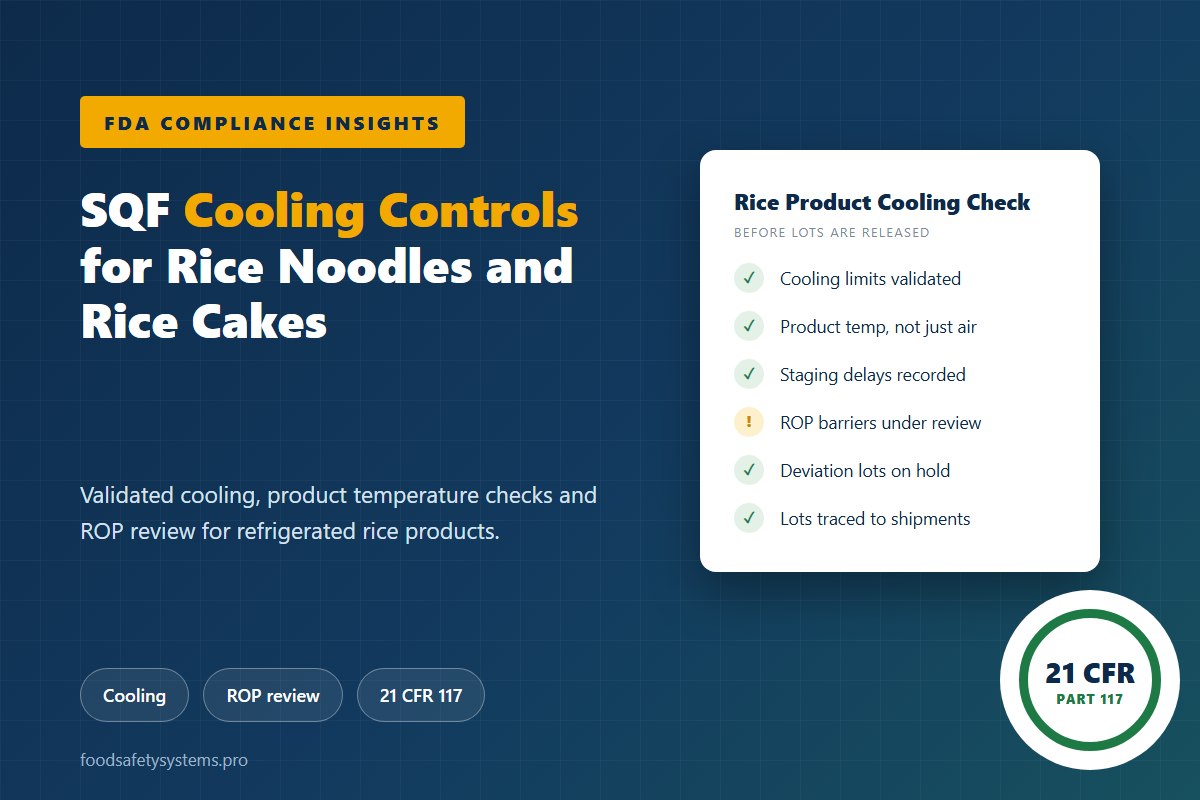
SQF cooling controls for refrigerated rice noodles and rice cakes must reflect the real product and process, because these foods can face significant time-temperature hazards during preparation, cooling, staging, packaging and storage. Generic refrigeration assumptions are not enough. An SQF program should translate each hazard into an operational control with evidence behind it.
Quick answer: SQF sites should assess cumulative time-temperature exposure, set scientifically supported cooling and refrigerated storage criteria, evaluate reduced-oxygen packaging (ROP) risks, and keep monitoring and corrective-action evidence appropriate to their food safety plans.
Who this guidance is for
SQF-certified and certification-seeking rice-product manufacturers, QA managers and production teams.
Map the full rice-product process
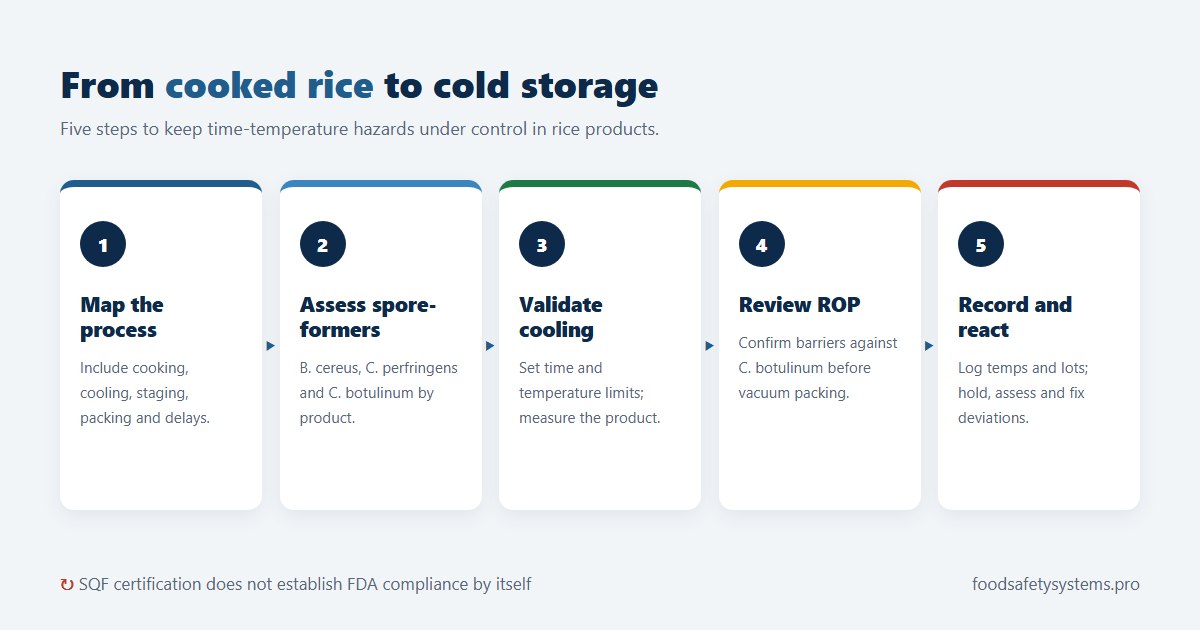
Document preparation, cooking, cooling, ambient staging, packaging, warehousing and distribution, including delays between steps. Account for both ready-to-eat and not-ready-to-eat products. Short waits add up, so the map should show cumulative exposure rather than each step in isolation.
Evaluate pathogen growth and toxin formation
Assess the relevant spore-forming microorganisms, including Bacillus cereus, Clostridium perfringens and Clostridium botulinum. Base the assessment on product characteristics, processing and packaging. For FDA-registered facilities, this work also feeds the hazard analysis required under 21 CFR 117.130, where that rule applies.
Validate SQF cooling controls and storage criteria
Set defensible temperature and duration criteria. Measure actual product temperature, not only cooler air temperature. In addition, verify that packaging and loading practices do not slow cooling; tightly stacked cases can hold heat far longer than expected. Our page on validation and verification of control measures explains the evidence auditors look for.
Review reduced-oxygen packaging
Before relying on vacuum or other reduced-oxygen packaging, evaluate whether product-specific barriers adequately address C. botulinum hazards. Refrigeration alone may not be a sufficient barrier, so document the reasoning and the supporting data.
Strengthen monitoring and traceability
Record the time, product temperature, location, lot, monitoring operator and disposition of any deviation. Then connect raw materials through finished-product and shipment records, so affected lots can be found quickly. Our time-temperature control for ready-to-eat foods guide covers monitoring design.
Verify corrective action and food safety plan updates
Hold and assess potentially affected product, and investigate root causes. Next, verify effectiveness through follow-up monitoring, internal audit and management review. Update the food safety plan whenever the process or packaging changes.
Practical compliance checklist
- Confirm the products, intended use, regulatory scope and current process flow.
- Review the hazard analysis against actual time-temperature exposure and packaging.
- Verify scientifically justified process criteria, monitoring methods and records.
- Identify and assess deviations, affected lots and any required corrective action.
- Confirm management oversight, ongoing verification and record availability.
Frequently asked questions
Does refrigeration alone make reduced-oxygen-packaged rice noodles safe?
No. Safety depends on product formulation, validated process and storage controls, packaging conditions and other barriers appropriate to the identified hazards.
Should a site monitor product temperature or refrigerator temperature?
Both can be relevant. Product-specific validation should determine which measurements reliably demonstrate control through cooling and storage.
Does SQF certification replace FDA requirements?
No. SQF certification is distinct from applicable legal requirements and does not itself establish FDA compliance.
How Consultare Inc. Group can help
Consultare Inc. Group supports rice-product manufacturers with practical food safety work, scoped to the applicable product, facility and agreed service engagement.
- SQF gap assessments and internal audits: cooling-process and record review.
- HACCP implementation support: hazard analysis and validation planning.
- FDA compliance integration: packaging hazard assessment against Part 117.
- Corrective action support: traceability and deviation follow-up.
Need help managing your SQF responsibilities?
Discuss your products, documentation and compliance priorities with the Consultare team in a free consultation, or contact our team.
Start building your compliance system
Prefer to organize your compliance activities yourself? Create a free SystemsBuilder account to manage specifications, controlled documents, assigned actions and records in one structured workflow. Software supports record management; it does not by itself ensure compliance.
Technical sources: 21 CFR Part 117, 21 CFR 117.130 and SQFI. Independent educational content: Consultare Inc. Group is not affiliated with or endorsed by FDA, SQFI or any companies referenced in the underlying regulatory materials. This article does not constitute regulatory approval, certification or legal advice; applicability must be assessed for each product, facility and operation.